Situation Summary
Uruguay remains a relatively stable country (global threat rank #160), but experiences acute spikes in lethal street violence concentrated in Montevideo and neighboring departments. August 2026 has seen a marked surge in homicides—at least 12 documented fatalities in the past five days—alongside a sustained DDoS campaign against government infrastructure, indicating both criminal-violence escalation and cyber-targeting of state systems. The geographic and temporal clustering of these incidents suggests potential territorial disputes or gang activity rather than random crime, and the cyber campaign indicates coordinated activism or state-adjacent operations targeting state institutions.
Key Developments
- Montevideo, Villa García – 16 August, ~20:20 local time: Two men (aged 18 and 21) fatally shot at Dionisio Fernández and Camino Mangangá; attackers fled on motorcycles after multiple-round volley. Victims transported to Policlínica de Malinas; deaths confirmed from abdominal gunshot wounds.
- Government cyber infrastructure – 13 August, ongoing: Distributed Denial-of-Service campaign (#OpUruguay) targeting Unified Portal of Uruguayan State, Parliament, Judicial Branch, Court of Accounts, Administrative Disputes Court, and Social Security Bank; technical hardening and DDoS mitigation measures now recommended across state agencies.
- Montevideo, Marconi – 14 August, reported/updated 16 August: Man in wheelchair fatally shot with approximately 30 rounds near Pasaje Cibeles; scene indicates sustained, high-lethality attack pattern consistent with targeted execution rather than robbery.
- Montevideo, Tres Cruces – 13 August, coverage updated 16 August: Male victim stabbed in back, robbed of backpack, and died from injuries near intersection of Duvimioso Terra and Pagola; CCTV review underway for assailant identification.
- Montevideo, Piedras Blancas – 12 August, continuing mid-August coverage: 24-year-old woman fatally shot during nighttime attack; separate incident same area involved 25-year-old woman and 57-year-old stepfather shot near Camino Teniente Galeano, victim attributed attack to ex-partner.
Highest-Risk Areas
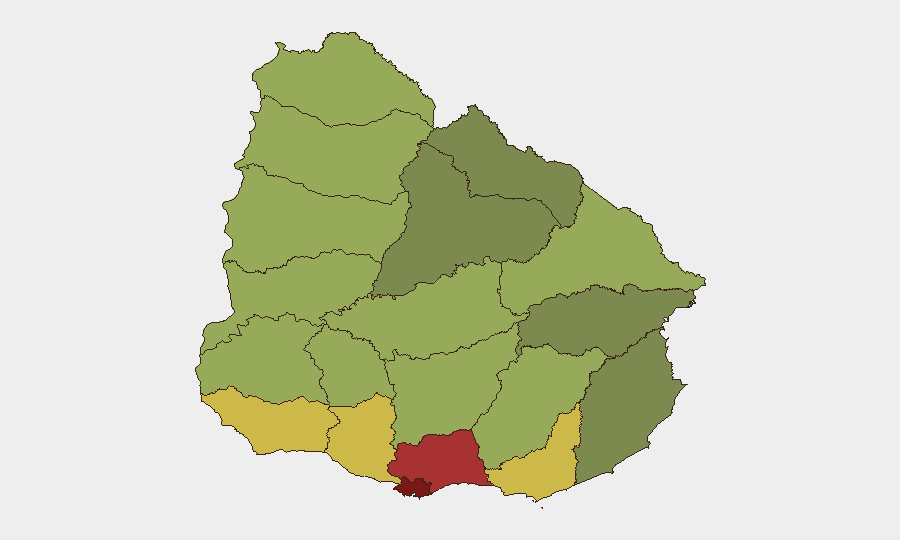
Montevideo (risk 92) remains the primary locus of lethal violence, accounting for the majority of recent homicides and street shootings. Neighboring Canelones (risk 78) and Maldonado (risk 68) show elevated secondary risk, though the homicide cluster on 12 August extended to Colonia (risk 62, one documented fatal shooting in Carmelo) and even Rivera near the Brazilian border. The concentration of firearm lethality in specific neighborhoods—Marconi, Villa García, Peñarol, Flor de Maroñas, Piedras Blancas—suggests localized gang or territorial conflict rather than generalized urban crime, making micro-neighborhood assessment critical for duty-of-care planning.
How GeoBit Would Assist
Security teams operating in Uruguay should deploy AOI Monitoring & Early Warning on high-risk Montevideo neighborhoods to trigger alerts on homicide clustering and timing patterns; Network & Actor Analysis to map shooter/gang affiliations across recent incidents; and OSINT Sweep (X/Twitter, Telegram, local news) to track ongoing cyber and physical-violence campaigns in near-real time. GIS & Spatial Analysis would enable routing optimization to avoid micro-hotspots, while Early Warning & Prediction models can flag temporal spikes (such as the 12 August cluster) before they spread to secondary departments.
7-Day Outlook
Lethal street violence is likely to remain elevated through late August absent rapid police intervention or territorial resolution; the 12–16 August homicide concentration suggests either escalating gang conflict or organized retaliation cycles. Cyber pressure on government portals may persist as long as #OpUruguay claims remain active, though state hardening responses should mitigate operational disruption. Corporate assets and personnel in Montevideo's higher-risk neighborhoods (Marconi, Peñarol, Flor de Maroñas) should maintain heightened situational awareness and restrict non-essential movement during late evening/early morning hours.
Highest-Risk Areas — Ranked
| # | State / Region | Risk |
|---|---|---|
| 1 | Montevideo | 92 |
| 2 | Canelones | 78 |
| 3 | Maldonado | 68 |
| 4 | San José | 64 |
| 5 | Colonia | 62 |
| 6 | Soriano | 58 |
| 7 | Río Negro | 56 |
| 8 | Salto | 54 |
| 9 | Artigas | 52 |
| 10 | Paysandú | 50 |
| 11 | Florida | 48 |
| 12 | Flores | 46 |
Sources
Previous Daily Briefs
A new Uruguay brief is written every day — each with its own risk map and downloadable CSV. Here's the last week; use the calendar to go further back.
- August 16, 2026
- August 15, 2026
- August 14, 2026
- August 13, 2026
- August 12, 2026
- August 11, 2026
- August 10, 2026
📅 Browse every day by calendar →
Highlighted days have a brief. Tap a day for that day's map & analysis, or “csv” for that day's dataset ($5).
Atlas — our AI intelligence desk — emails them this snapshot personally. Nothing else, no list.