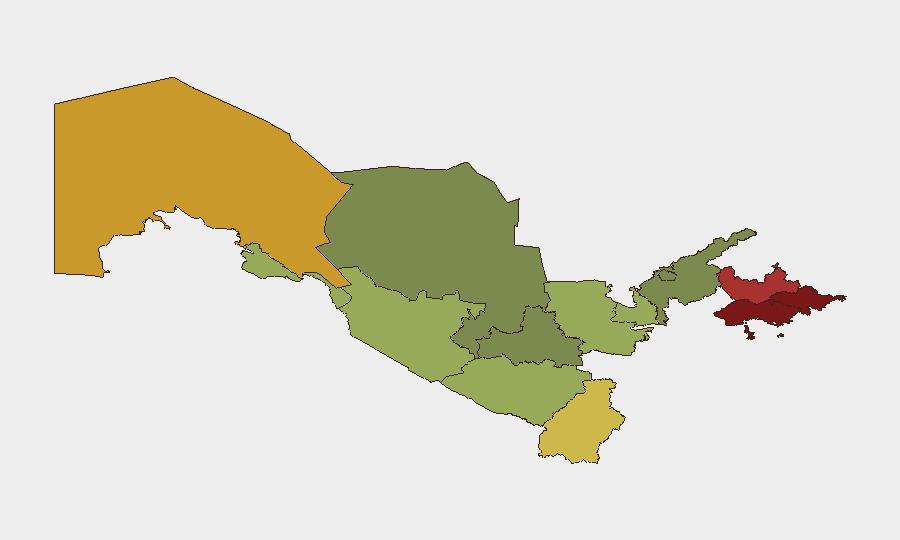
Situation Summary
Uzbekistan remains a low-threat environment globally (composite score 3, rank #189), with no material security incidents recorded in the past 24–48 hours. Bilateral diplomatic friction with Kazakhstan was signaled on 2026-07-11 (reduction in relations), though no operational impact on internal Uzbek security has been reported. Sub-national threat concentrations persist in the Fergana Valley (Andijan, Fergana, Namangan regions) and western territories, reflecting historical patterns of transnational crime, irregular migration, and border-region instability rather than acute escalation.
Key Developments
- Tashkent (Yashnabad & Yakkasaray districts) – cybercrime dismantling. Uzbekistan's Ministry of Internal Affairs reported the dismantling of two illegal call-center operations targeting European and North American victims with cryptocurrency and high-yield investment fraud schemes; 131 suspects detained, including foreign nationals. (Publication date unconfirmed within last 24–48h; included as highest-confidence incident in available reporting window.)
- Uzbekistan–Kazakhstan diplomatic signal (2026-07-11). Both nations signaled a reduction in bilateral relations; no military mobilization or border incident has been confirmed, and cross-border commerce and regional stability remain intact. Drivers and trajectory require monitoring.
- No verified civil unrest, armed-group activity, or critical infrastructure disruption reported in the last 24–48 hours across any region.
Highest-Risk Areas
The Fergana Valley—comprising Andijan (risk 88), Fergana (risk 82), and Namangan (risk 78)—remains the principal sub-national risk corridor, driven by transnational smuggling networks, irregular migration flows, border permeability, and historical militant recruitment pathways. Karakalpakstan (risk 72) and Surxondaryo (risk 65) present secondary regional concerns tied to water-scarcity pressure, socioeconomic fragility, and weak state capacity in remote areas. Southern and eastern regions (Qashqadaryo, Sirdaryo) carry moderate persistent risk from organized crime and informal cross-border activity. The capital and northern manufacturing zones (Tashkent, Bukhara, Samarqand) remain lower-risk urban centers, though cybercrime and financial-fraud networks operate there with transnational reach, as the recent call-center dismantling illustrates.
How GeoBit Would Assist
Security and risk teams operating in or supporting assets in Uzbekistan would benefit from AOI Monitoring & Early Warning (persistent watch on Fergana Valley, Karakalpakstan, and border regions with automated alerts for activity changes); Network & Actor Analysis (mapping of transnational crime and smuggling nodes, particularly in the south and east); and Intel Sweep & OSINT fusion (multi-language monitoring of local security agency reporting, Telegram channels, and regional news to detect emerging threats faster than public disclosure). For duty-of-care teams managing staff travel, Routing & Network Analysis provides alternative journey planning around higher-risk regions and real-time corridor assessment.
7-Day Outlook
No escalation of the Uzbekistan–Kazakhstan diplomatic friction to operational security impact is expected in the near term, though bilateral border monitoring should continue. Persistent transnational organized-crime activity (smuggling, fraud, irregular migration) will likely sustain baseline risk in Fergana Valley and western regions; disruption of individual crime networks (as seen with the call centers) will not materially alter the underlying risk profile. Travel and asset security in Tashkent, Bukhara, and major urban centers remains routine-risk dependent.
Highest-Risk Areas — Ranked
| # | State / Region | Risk |
|---|---|---|
| 1 | Andijan Region | 88 |
| 2 | Fergana Region | 82 |
| 3 | Namangan Region | 78 |
| 4 | Republic of Karakalpakstan | 72 |
| 5 | Surxondaryo Region | 65 |
| 6 | Qashqadaryo Region | 58 |
| 7 | Sirdaryo Region | 55 |
| 8 | Jizzakh Region | 48 |
| 9 | Xorazm Region | 45 |
| 10 | Bukhara Region | 42 |
| 11 | Navoiy Region | 38 |
| 12 | Samarqand Region | 35 |
Sources
Previous Daily Briefs
A new Uzbekistan brief is written every day — each with its own risk map and downloadable CSV. Here's the last week; use the calendar to go further back.
📅 Browse every day by calendar →
Highlighted days have a brief. Tap a day for that day's map & analysis, or “csv” for that day's dataset ($5).
Atlas — our AI intelligence desk — emails them this snapshot personally. Nothing else, no list.