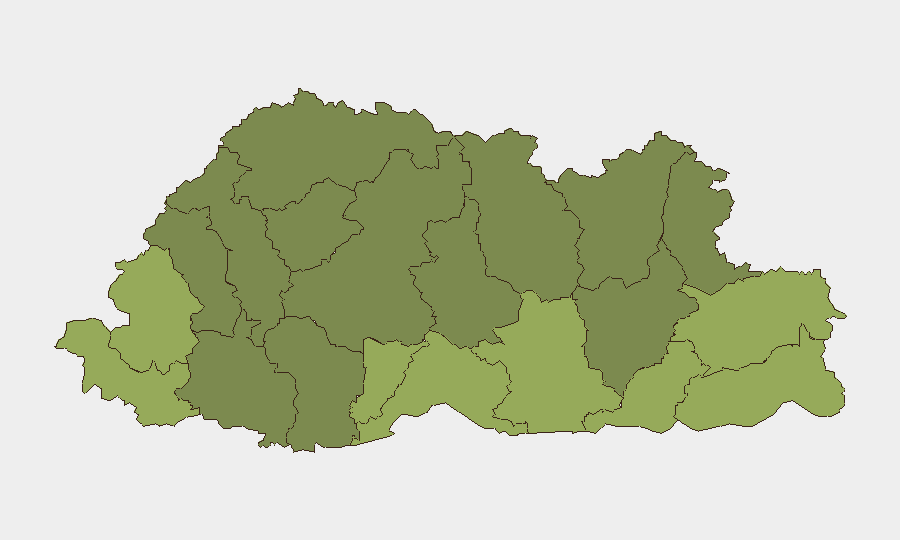
Situation Summary
Bhutan remains one of the world's lowest-threat environments, with a composite threat score of 2 and no tracked security events in the current monitoring window. No credible, independently verified reports of civil unrest, organized crime incidents, infrastructure disruptions, or political instability have emerged in the past 24–48 hours. The national security posture is assessed as stable with no indicators of imminent escalation.
Key Developments
- Countrywide – no new incidents (24–48h): Official government and Ministry of Health channels show routine operations only; no emergency notices or incident advisories posted in the monitoring window.
- Border districts (Samtse, Sarpang, Haa) – no discrete incidents reported (24–48h): Chronic cross-border smuggling and informal-trade risks persist in structural form, but no new criminal incidents, unrest, or enforcement actions documented in recent reporting.
- Infrastructure and transport – no disruptions (24–48h): Major airports, road networks, and telecommunications remain fully operational with no reported outages, closures, or service degradation.
- Domestic institutional environment – stable (24–48h): No organized political opposition activities, labor unrest, or civil-society demonstrations reported in monitored media or social channels.
- Health and public order – routine (24–48h): No disease outbreaks, public-health emergencies, or law-enforcement incidents of note flagged by government or independent monitors.
Highest-Risk Areas
Border districts—Samtse (risk 58), Sarpang (55), and Haa (52)—rank highest sub-nationally, driven by chronic vulnerability to informal cross-border trade, smuggling networks, and transnational organized-crime activity rather than acute incidents. Pemagatshel (50) and Samdrup Jongkhar (48) in the southeast face similar structural exposure. These rankings reflect persistent geographic and institutional factors (porous borders, limited enforcement capacity) rather than current escalation; no discrete incidents in these districts have been documented in the past 24–48 hours. Central and northern districts (Thimphu, Lhuntse, Gasa) carry substantially lower risk profiles.
How GeoBit Would Assist
Corporate security teams with personnel or assets in Bhutan should employ AOI Monitoring & Early Warning on border districts (Samtse, Sarpang, Haa) to detect emerging smuggling activity, informal cross-border movement, or enforcement operations that could affect supply chains or staff transit. Intel Sweep and multi-language OSINT across Bhutanese government channels, regional news, and social media provide real-time negative confirmation of stability and rapid alerting if conditions shift. Routing & Network Analysis enables identification of alternative travel corridors and supply routes in the event of localized border disruptions, particularly critical for organizations with cross-border operations or supply dependencies.
7-Day Outlook
No indicators suggest material change in Bhutan's security posture over the next seven days. Structural risks in border districts will remain chronic and localized; seasonal weather patterns and routine government activity are expected. Continued monitoring of border trade volumes and informal-economy flows will remain prudent for organizations with supply-chain exposure to the region.
Highest-Risk Areas — Ranked
| # | State / Region | Risk |
|---|---|---|
| 1 | Samtse District | 58 |
| 2 | Sarpang District | 55 |
| 3 | Haa District | 52 |
| 4 | Pemagatshel District | 50 |
| 5 | Samdrup Jongkhar District | 48 |
| 6 | Tsirang District | 45 |
| 7 | Zhemgang District | 42 |
| 8 | Trashigang District | 40 |
| 9 | Mongar District | 38 |
| 10 | Gasa District | 35 |
| 11 | Lhuntse District | 32 |
| 12 | Wangdue Phodrang District | 30 |
Previous Daily Briefs
A new Bhutan brief is written every day — each with its own risk map and downloadable CSV. Here's the last week; use the calendar to go further back.
📅 Browse every day by calendar →
Highlighted days have a brief. Tap a day for that day's map & analysis, or “csv” for that day's dataset ($5).
Atlas — our AI intelligence desk — emails them this snapshot personally. Nothing else, no list.