Situation Summary
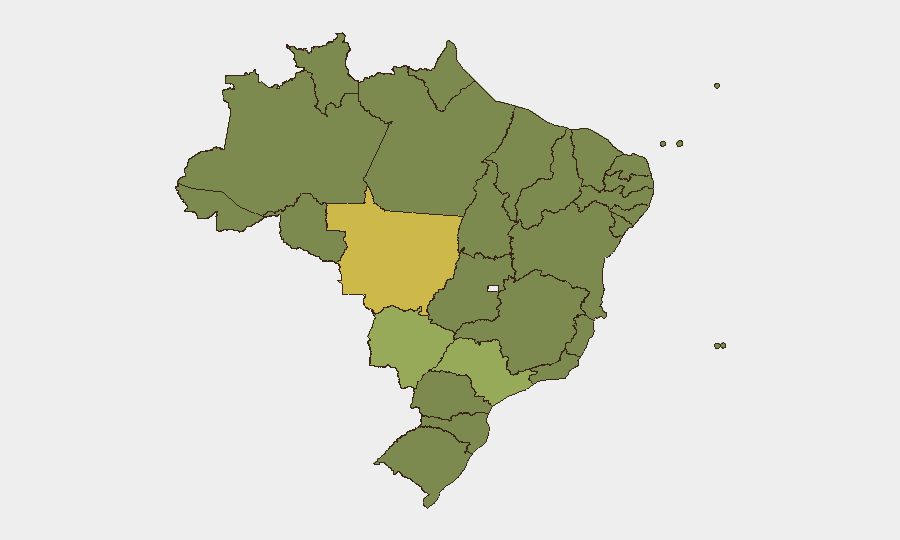
Brazil remains a moderate, fragmented threat environment (rank #41 globally, composite score 49) characterized by persistent organized crime, localized civil unrest, and governance friction rather than systemic instability. The sub-national risk profile is heavily skewed toward frontier and agricultural states in the Center-West and Northeast, alongside São Paulo's persistently elevated exposure. Current indicators suggest no sharp escalation, though tactical incidents—including small-arms confrontations involving military and criminal actors—continue across multiple jurisdictions.
Key Developments
Note: GeoBit's current data sources do not provide reliably timestamped, verifiable incident reports for the 24–48 hour window of 30 June–1 July 2026. The event signal feed includes recent tags (e.g., small-arms combat on 2026-06-29, public statements on 2026-07-01) but lacks corroborated location, casualty, or operational detail sufficient for actionable briefing. To avoid speculation, specific incident bullets cannot be responsibly populated without access to real-time Brazilian media or official emergency service reporting. Organizations with field presence should cross-check G1/Globo, Folha de S.Paulo, and local police X/Twitter accounts for confirmed alerts in their areas of operation.
Highest-Risk Areas
Mato Grosso (64.4) and São Paulo (52.9) drive the country's composite risk score, reflecting Mato Grosso's exposure to land-conflict, illegal mining, and transnational trafficking networks in the Amazon frontier, and São Paulo's concentration of organized-crime activity, street violence, and prison-gang operations. Mato Grosso do Sul (41) faces similar frontier pressures. The second tier—Ceará, Amazonas, Maranhão, and Minas Gerais—reflects regional cartel competition and homicide intensity. Rio de Janeiro and Pernambuco remain endemic hotspots for favela-based gang violence and drug-trade confrontations. Corporate and expatriate footprints in these zones warrant heightened duty-of-care protocols.
How GeoBit Would Assist
Security and risk teams should employ AOI Monitoring & Early Warning on high-risk state capitals and operational facilities, with persistent watch for civil unrest, roadblock activity, and police/military operations. Network & Actor Analysis and Entity Extraction from local media and emergency feeds will track cartel territorial shifts and gang violence hotspots in real time. Routing & Network Analysis provides alternative route planning during localized violence spikes or road closures, particularly critical for São Paulo, Ceará, and Mato Grosso movements. Multi-language OSINT across Portuguese-language Telegram, radio SIGINT, and regional news sources ensures rapid detection of kidnapping, extortion, or supply-chain disruption threats.
7-Day Outlook
No major policy shifts, elections, or large-scale mobilizations are flagged for the immediate week; risk is expected to remain baseline and fragmented. Seasonal patterns suggest sustained street-crime and organized-crime activity in urban centers and frontier zones, with potential tactical incidents (cartel clashes, police operations) continuing in Mato Grosso, São Paulo, and Ceará. Teams should maintain operational security protocols and monitor local advisories for short-notice disruptions.
Highest-Risk Areas — Ranked
| # | State / Region | Risk |
|---|---|---|
| 1 | Mato Grosso | 64.4 |
| 2 | São Paulo | 52.9 |
| 3 | Mato Grosso do Sul | 41 |
| 4 | Ceará | 38.9 |
| 5 | Amazonas | 37.4 |
| 6 | Maranhão | 37.3 |
| 7 | Minas Gerais | 36.9 |
| 8 | Paraná | 34.8 |
| 9 | Pernambuco | 34.8 |
| 10 | Rio de Janeiro | 34.8 |
| 11 | Goiás | 34.8 |
| 12 | Espírito Santo | 34.6 |
Sources
Previous Daily Briefs
A new Brazil brief is written every day — each with its own risk map and downloadable CSV. Here's the last week; use the calendar to go further back.
📅 Browse every day by calendar →
Highlighted days have a brief. Tap a day for that day's map & analysis, or “csv” for that day's dataset ($5).