Situation Summary
Georgia's composite threat level remains elevated at #92 globally, with zero tracked major incidents assigned in the formal scoring but significant underlying volatility across multiple security domains. The past seven days have seen a pronounced cluster of violent crime in Tbilisi, recurring infrastructure incidents in the Caucasus interior, sustained political protest mobilization, and a notable spike in Russian border crossings amid renewed conscription concerns. The security environment reflects concurrent pressures: criminal violence against foreign nationals, investigative actions targeting domestic business figures, unresolved political tensions around electoral legitimacy and detained activists, and persistent separatist-region instability.
Key Developments
- Tbilisi, 27–29 August: Three foreign nationals fatally stabbed in separate incidents within 48 hours, including a Russian dolphin trainer; one Armenian suspect detained at the Georgian-Armenian border in connection. This cluster suggests either organized predation or escalating opportunistic violence targeting visible non-citizens.
- Tbilisi, 29 August: Off-duty police officer discharged multiple rounds into a crowd outside Frozen Paradise Bar and Grill; responding law enforcement returned fire. Incident highlights rule-of-law and civilian safety risks even within capital security apparatus.
- Chitatskari village (interior), 31 August–1 September: Two explosions at a petrol station within 48 hours; two individuals transported in critical condition. Authorities have not disclosed cause; pattern suggests possible deliberate targeting or infrastructure sabotage rather than accident.
- Tbilisi, 1–2 September: Prominent businessman and animal-rights activist Tamaz Elizbarashvili detained during home search on administrative charges; subsequently declared hunger strike while in pre-trial detention, escalating political sensitivity and rule-of-law concerns.
- Tbilisi, 2 September: Three individuals detained in connection with death of Abkhaz blogger Daur Buava in Tbilisi apartment; foreign national suspect accused of involvement. Case underscores vulnerability of regional activists and cross-border criminal patterns.
- Tbilisi, 1–6 September: Pro-EU demonstrations continued uninterrupted for days 643–648, with renewed traffic-blocking marches on 6 September along Rustaveli Avenue and sustained demands for parliamentary election and detainee releases. Demonstrates persistent political mobilization around governance legitimacy.
- Batumi, 1 September: Physical assault and confrontation during anti-Russian protest near Constitutional Court; placard dispute escalated to violence, police intervened, Interior Ministry investigation opened.
- Batumi, 3 September: Joint U.S. Defense Threat Reduction Agency and Georgian State Security Service conducted NEXUS Georgia 2026 interagency field exercise targeting chemical and biological threat response—signaling elevated concern for CBRN vulnerabilities.
- Georgia–Russia border (Verkhniy Lars/Upper Lars), 1 September: Over 113,000 Russians crossed into Georgia within a single reporting window amid renewed mobilization fears, creating border congestion and transient-population security-vetting challenges.
- Abkhazia (Supreme Council area), 4 September: Verbal confrontation outside Supreme Council following National Movement briefing, indicating continued tension within separatist-region political space.
Highest-Risk Areas
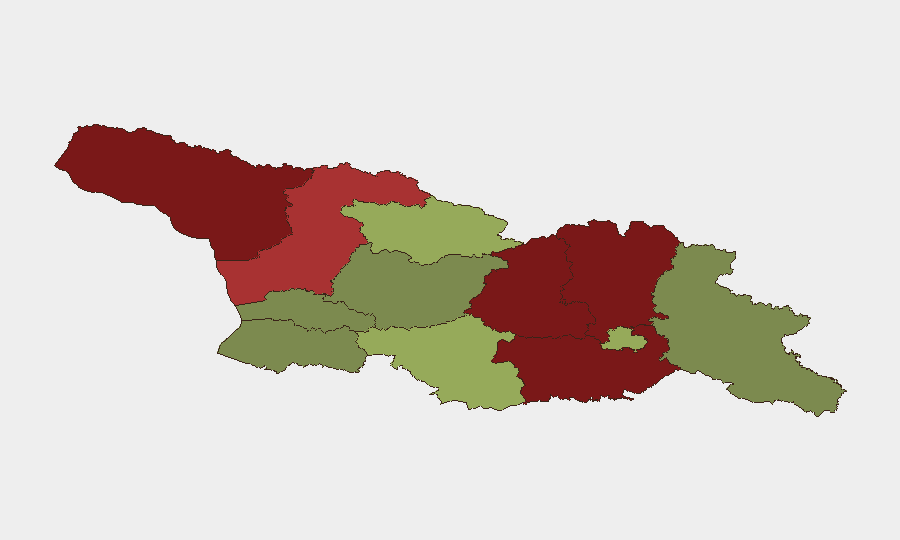
Abkhazia (risk 95) and Shida Kartli (risk 88) drive the composite threat ranking, reflecting unresolved occupation dynamics, weak state control, and historical conflict zones. Lower Kartli (85) and Mtskheta-Mtianeti (82) extend this belt of contested and high-volatility territory along the Russian border and South Ossetia periphery. By contrast, Tbilisi (45)—despite hosting the week's most visible violent incidents and sustained protests—rates below several interior regions, suggesting the capital's risk scoring reflects infrastructure resilience and law-enforcement presence offsetting acute criminal and political events. Samtskhe-Javakheti (48) and Samegrelo-Upper Svaneti (78) remain secondary concern areas tied to border proximity and ethnic-minority dynamics.
How GeoBit Would Assist
Security teams should deploy AOI Monitoring & Early Warning on Tbilisi's crime-prone districts, Chitatskari industrial/energy sites, and Abkhazia/South Ossetia boundaries to detect emerging violence or infrastructure targeting patterns. Multi-language OSINT and X/Twitter/Telegram intelligence will track protest escalation triggers, detainee-release demands, and cross-border actor coordination. Network & Actor Analysis combined with entity extraction can map foreign-national vulnerability clusters and transnational criminal connections behind the stabbing incidents.
7-Day Outlook
Protest momentum will likely persist through mid-September absent major political concessions or detainee releases; traffic disruption and localized street clashes should be expected. Criminal violence may recede from the acute cluster observed, but underlying vulnerabilities—foreign-national targeting, security-force discipline, infrastructure sabotage—remain. Monitor Russian cross-border flows and Abkhaz political friction for secondary destabilization signals.
Highest-Risk Areas — Ranked
| # | State / Region | Risk |
|---|---|---|
| 1 | Autonomous Republic of Abkhazia | 95 |
| 2 | Shida Kartli | 88 |
| 3 | Lower Kartli | 85 |
| 4 | Mtskheta-Mtianeti | 82 |
| 5 | Samegrelo-Upper Svaneti | 78 |
| 6 | Samtskhe-Javakheti | 48 |
| 7 | Tbilisi | 45 |
| 8 | Racha-Lechkhumi and Kvemo Svaneti | 42 |
| 9 | Kakheti | 38 |
| 10 | Autonomous Republic of Adjara | 35 |
| 11 | Imereti | 32 |
| 12 | Guria | 28 |
Sources
Previous Weekly Briefs
A new Georgia brief is written every Monday, covering the week — each with its own risk map and downloadable CSV. Use the calendar to go further back.
- September 3, 2026
- September 2, 2026
- September 1, 2026
- August 31, 2026
- August 30, 2026
- August 29, 2026
- August 28, 2026
📅 Browse past briefs by calendar →
Highlighted days have a brief. Tap a day for that day's map & analysis, or “csv” for that day's dataset ($5).
Atlas — our AI intelligence desk — emails them this snapshot personally. Nothing else, no list.