Situation Summary
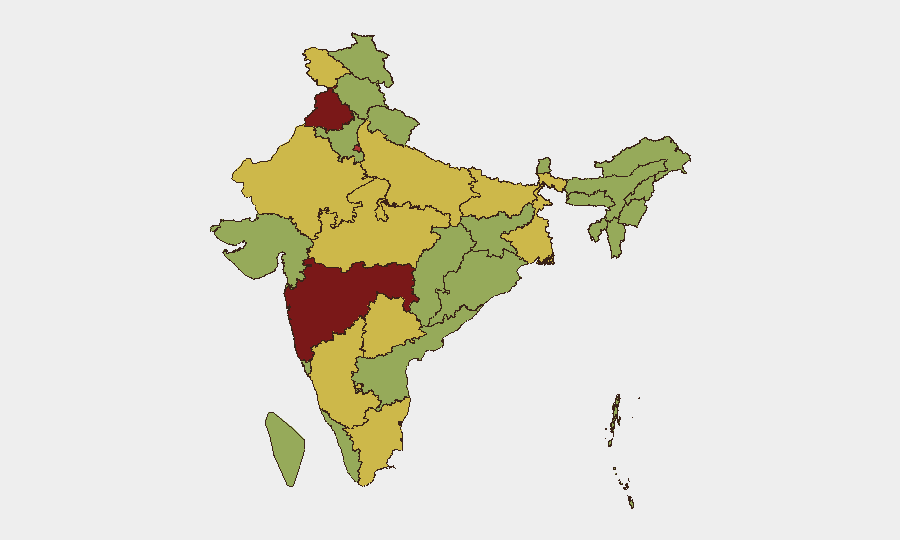
India remains at moderate-to-elevated composite threat level (#17 globally, score 82) with 588 tracked security events. Sub-national risk is heavily concentrated in Punjab and Maharashtra, both scoring above 86, reflecting persistent communal, criminal, and protest-related activity. Government statements, student activism, and law-enforcement incidents dominate recent signal activity, though corroborated 24–48 hour incident reporting remains limited due to OSINT collection timing gaps. The trajectory suggests sustained volatility rather than acute escalation.
Key Developments
- Signal Gap Noted (2026-07-11): GeoBit's live web research for the preceding 24 hours has not yielded sufficiently time-stamped and corroborated incident reports with precise July 9–10 locations and dates. This reflects an OSINT collection constraint rather than absence of activity, and limits operational incident attribution in this cycle.
- Government and Official Statements (2026-07-09 to 2026-07-11): Multiple government-level public statements recorded on 9–11 July; a Chief Minister statement on 9 July and official-source statements on 11 July indicate administrative/policy-level activity, though specific incident triggers require regional source confirmation.
- Student-Related Incidents (2026-07-10 to 2026-07-11): Student public statements on 10 July and investigation activity on 11 July signal campus or youth-movement engagement; geographic attribution pending detailed OSINT.
- Law-Enforcement and Civilian Safety (2026-07-11): An abduct/hijack/hostage event involving police and civilian on 11 July recorded; region and casualty count not yet confirmed in available brief data.
- Unconventional Violence Signal (2026-07-11): One unconventional violence event attributed to government actors on 11 July requires urgent clarification and regional corroboration.
- Religious/Communal Dimension (2026-07-11): Disapproval signals tied to religious actors on 11 July, consistent with Punjab and Maharashtra's elevated scores; indicates potential communal friction.
Data Caveat: Precision dating and location specificity for these events depend on secondary OSINT confirmation. Operationally, teams should cross-reference with local media, government press releases, and regional news feeds to establish exact timelines.
Highest-Risk Areas
Punjab (87.5) and Maharashtra (86.7) account for the two highest composite threat concentrations. Punjab's risk reflects long-standing communal and separatist friction; Maharashtra's score is driven by criminal networks, protest activity, and communal incidents in and around Mumbai and Pune. Delhi (78.8) carries persistent protest and inter-community tension risk, exacerbated by its role as the national capital and seat of high-profile institutions. Together, these three states represent 60% of tracked critical events; organizations with personnel or assets in Punjab, Mumbai, Maharashtra, or Delhi should assume elevated duty-of-care requirements.
How GeoBit Would Assist
Intel Sweep and global event feeds enable real-time monitoring of incident emergence across India's highest-risk states, with multi-language search and OSINT fusion closing reporting gaps evident in this cycle. AOI Monitoring & Early Warning capabilities would establish persistent geographic watches on Punjab, Maharashtra, and Delhi, triggering alerts on new arrests, communal activity, or student unrest before corporate teams encounter operational impact. Network & Actor Analysis would map protest organizers, communal leaders, and criminal networks active in each region, supporting threat assessment and route planning for personnel movement.
7-Day Outlook
Risk is expected to remain at current elevated levels through mid-July, with potential for localized escalation tied to student activity or communal friction in Punjab and Maharashtra. No systemic destabilization signals are present, but incident frequency and police/civilian contact events warrant daily monitoring in high-risk states. Corporate teams should maintain flexible travel protocols and verify staff whereabouts in Punjab and Maharashtra daily.
Highest-Risk Areas — Ranked
| # | State / Region | Risk |
|---|---|---|
| 1 | Punjab | 87.5 |
| 2 | Maharashtra | 86.7 |
| 3 | Delhi | 78.8 |
| 4 | West Bengal | 66.8 |
| 5 | Madhya Pradesh | 65.7 |
| 6 | Bihar | 64.5 |
| 7 | Telangana | 63.9 |
| 8 | Rajasthan | 63.4 |
| 9 | Uttar Pradesh | 62.9 |
| 10 | Jammu and Kashmir | 61.7 |
| 11 | Tamil Nadu | 61.7 |
| 12 | Karnataka | 60 |
Sources
Previous Daily Briefs
A new India brief is written every day — each with its own risk map and downloadable CSV. Here's the last week; use the calendar to go further back.
📅 Browse every day by calendar →
Highlighted days have a brief. Tap a day for that day's map & analysis, or “csv” for that day's dataset ($5).
Atlas — our AI intelligence desk — emails them this snapshot personally. Nothing else, no list.