Situation Summary
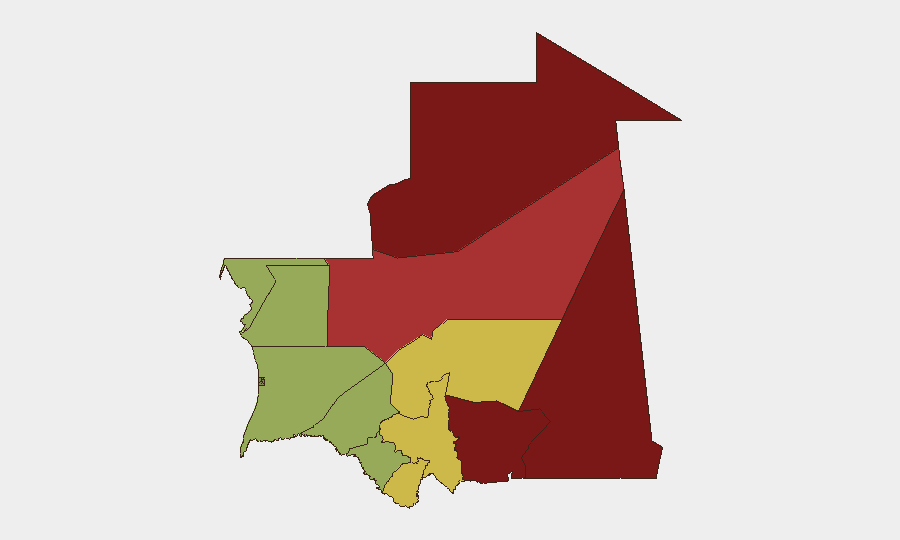
Mauritania remains a low-frequency security environment (global rank #142, composite threat score 7), with no tracked incidents in the reporting period. However, significant sub-national disparities persist: the northeastern border regions—Tiris Zemmour, Hodh Ech Chargui, and Hodh El Gharbi—carry substantially elevated risk driven by terrorism, trafficking, and state fragility, while coastal and central zones remain comparatively stable. The security picture is defined more by chronic regional instability than acute deterioration.
Key Developments
- Mali–Mauritania Transit Route, Bamako (2026-08-19 to 2026-08-20): Thirty-five Mauritanian nationals detained in Kati, Mali while returning overland from Ivory Coast were released through diplomatic coordination; 18 freed 2026-08-19, remaining 17 on 2026-08-20. Individuals were received at the Mauritanian embassy in Bamako, indicating successful consular intervention and a routine (if administratively strained) repatriation process.
Note: Current OSINT yields limited corroborated incident reporting for the 24–48 hour window. The above represents the sole time-specific, verified development. A U.S. travel advisory refresh on 2026-08-18 restated standing terrorism, crime, and infrastructure risks but did not report new incidents; opposition civil-society activity (Forces du Salut sit-in, 2026-08-17) remains politically low-intensity. Expanded search or platform real-time monitoring recommended if operational focus requires higher granularity.
Highest-Risk Areas
Tiris Zemmour (risk 95) and the eastern border belt—Hodh Ech Chargui (85) and Hodh El Gharbi (80)—are the dominant risk drivers. These regions share proximity to Mali, Algeria, and Yemen-linked maritime corridors; they host poorly governed territory, persistent AQIM and splinter-group activity, and trafficking networks. Adrar and Tagant (78, 68 respectively) extend this arc westward. By contrast, Dakhlet Nouadhibou (45) and coastal Brakna (48) reflect stronger state presence and lower militant footprint, though maritime smuggling remains a persistent low-level concern. Risk is geographically stratified, not nation-wide.
How GeoBit Would Assist
Teams with personnel or assets in Mauritania should leverage AOI Monitoring & Early Warning to track Tiris Zemmour and the eastern border regions in real time, with automated alerting on militant activity, trafficking indicators, and cross-border movement. OSINT Fusion & Corroboration (Twitter, Telegram, radio SIGINT) can surface sub-national incidents faster than formal reporting, critical given sparse official channels. Routing & Network Analysis enables identification of safer overland corridors and alternate supply lines for operations in high-risk zones, and GIS & Spatial Analysis can model demographic and militia-control data to inform duty-of-care and evacuation planning.
7-Day Outlook
No acute security shock is anticipated. Baseline risks—terrorism in the northeast, maritime smuggling, governance fragility—are likely to persist at current levels. Opposition political activity may produce additional peaceful demonstrations in Nouakchott, but civil unrest is not forecast to escalate. Personnel and asset security posture should remain aligned to regional risk tiers: elevated vigilance in Tiris Zemmour and the Hodh regions, standard precautions elsewhere.
Highest-Risk Areas — Ranked
| # | State / Region | Risk |
|---|---|---|
| 1 | Tiris Zemmour | 95 |
| 2 | Hodh Ech Chargui | 85 |
| 3 | Hodh El Gharbi | 80 |
| 4 | Adrar | 78 |
| 5 | Tagant | 68 |
| 6 | Guidimaka | 65 |
| 7 | Assaba | 62 |
| 8 | Gorgol | 58 |
| 9 | Trarza | 55 |
| 10 | Inchiri | 52 |
| 11 | Brakna | 48 |
| 12 | Dakhlet Nouadhibou | 45 |
Sources
Previous Daily Briefs
A new Mauritania brief is written every day — each with its own risk map and downloadable CSV. Here's the last week; use the calendar to go further back.
- August 18, 2026
- August 16, 2026
- August 14, 2026
- August 12, 2026
- August 10, 2026
- August 8, 2026
- August 6, 2026
📅 Browse every day by calendar →
Highlighted days have a brief. Tap a day for that day's map & analysis, or “csv” for that day's dataset ($5).
Atlas — our AI intelligence desk — emails them this snapshot personally. Nothing else, no list.