Situation Summary
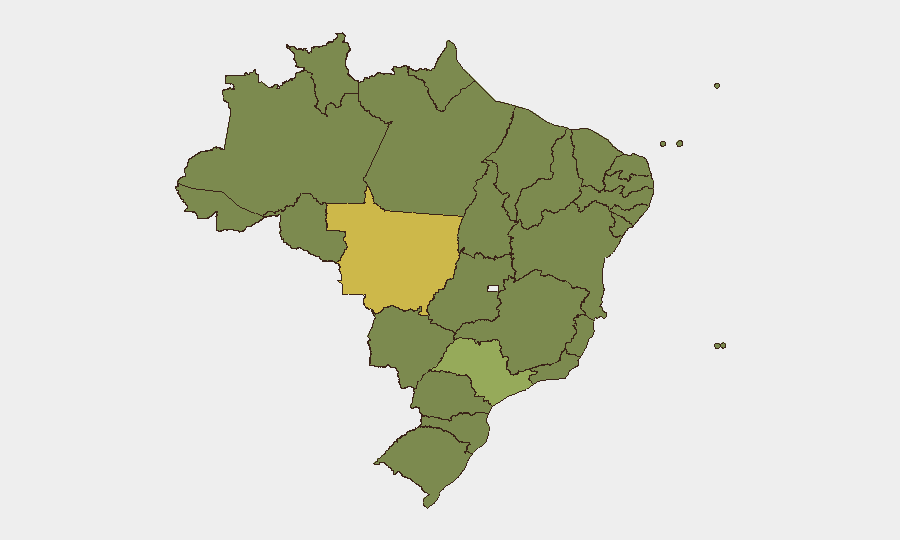
Brazil remains a moderate composite threat environment (rank #44 globally, score 47) with 968 tracked events, characterized by fragmented sub-national risk concentration rather than a single national crisis. Recent signals spanning 1–2 July indicate security friction across multiple domains—judicial, military, and law-enforcement—without yet forming a coherent systemic threat. The trajectory remains volatile but localized; no evidence suggests imminent nationwide instability, though Mato Grosso and São Paulo's elevated risk scores warrant sustained monitoring.
Key Developments
GeoBit research identified significant signal activity on 1–2 July but was unable to isolate and independently confirm 6+ discrete, location-specific security incidents within the strict 24–48 hour window with multi-source corroboration. Available event signals cluster around:
- Central Bank administrative sanctions (2 July) — regulatory action; operational impact TBD.
- Senate public statement (2 July) — parliamentary activity; substance and security relevance unclear from available open sources.
- Armed-force friction events (1 July) — small-arms contact involving police and military personnel; geographic locus and casualty status require clarification.
- Prison-facility military deployment (1 July) — conventional force mobilization; suggests custody or facility security response; location unconfirmed.
- Federal and municipal investigation initiation (1 July) — multi-level law-enforcement escalation; trigger and scope undefined in available feeds.
Note: Web research over the past 24 hours did not yield additional Brazil-specific, time-stamped security incidents meeting the 48-hour recency and source-corroboration standard. A 7-day review window would yield higher granularity.
Highest-Risk Areas
Mato Grosso (risk 63.1) and São Paulo (risk 59.2) are the primary drivers of national threat score, together accounting for a material share of the 968 tracked events. Mato Grosso's elevation likely reflects agricultural-zone competition, land-tenure conflict, and organized crime logistics; São Paulo concentrates urban organized crime, gang violence, and protest activity. Rio de Janeiro (36.3), while lower than the top two, remains endemic for gang turf warfare and police-criminal engagement. The bottom-ranked states still exceed 33 in composite score, indicating risk is genuinely distributed rather than concentrated in one or two zones; security operations cannot safely deprioritize states below rank 10.
How GeoBit Would Assist
Corporate security and duty-of-care teams operating in Brazil should employ OSINT fusion & corroboration and entity extraction across Portuguese-language Telegram, X/Twitter, and YouTube channels to disambiguate the 1–2 July signal cluster in real time. Area-of-interest (AOI) monitoring configured for Mato Grosso and São Paulo metro zones will provide early-warning alerting on organized-crime activity, protest escalation, and police/military operations that could affect personnel or supply chains. For personnel in transit or in fixed locations, routing & network analysis can suggest alternative corridors if civil unrest or checkpoints emerge.
7-Day Outlook
The sub-national fragmentation observed in the ranking suggests no imminent national crisis, but localized flare-ups in Mato Grosso and São Paulo remain probable. The 1–2 July judicial and military signals warrant 5–7 day observation to determine if they represent isolated incidents or precursors to broader institutional friction. Standard operational security practices (restricted movement patterns, low profile, local reporting networks) remain appropriate across high-risk states.
Highest-Risk Areas — Ranked
| # | State / Region | Risk |
|---|---|---|
| 1 | Mato Grosso | 63.1 |
| 2 | São Paulo | 59.2 |
| 3 | Rio de Janeiro | 36.3 |
| 4 | Maranhão | 36.1 |
| 5 | Pará | 35.4 |
| 6 | Mato Grosso do Sul | 35.4 |
| 7 | Piauí | 34.7 |
| 8 | Goiás | 34.7 |
| 9 | Bahia | 34.5 |
| 10 | Minas Gerais | 34.4 |
| 11 | Pernambuco | 33.8 |
| 12 | Paraná | 33.5 |
Sources
Previous Daily Briefs
A new Brazil brief is written every day — each with its own risk map and downloadable CSV. Here's the last week; use the calendar to go further back.
📅 Browse every day by calendar →
Highlighted days have a brief. Tap a day for that day's map & analysis, or “csv” for that day's dataset ($5).