Situation Summary
Georgia remains a low-threat destination globally (rank #95, composite score 18) with no tracked security incidents in the reporting week. However, sustained civil unrest centered on Euro-integration demands, political-prisoner releases, and opposition to perceived pro-Russian policy orientation has now reached 659 consecutive days of protest activity. An announced large anti-Russian march scheduled for 27 September poses localized travel-disruption risk, while judicial actions against former senior officials are intensifying political polarization. The frozen-conflict status of Abkhazia and South Ossetia continues to underpin elevated risk in the country's separatist-held territories and adjacent regions.
Key Developments
- Tbilisi, 15–17 September: Ongoing anti-government protests entered their 657th–659th consecutive day, with coordinated actions in Tbilisi and Batumi demanding release of political prisoners, repeal of "repressive" legislation, and a return to pro-EU/Euro-Atlantic policy. Demonstrations remained peaceful during this window but opposition figures called for scaling up mobilizations.
- Tbilisi, 16 September: A court sentenced former State Security Service chief Grigol Liluashvili to 13 years imprisonment on corruption-related bribery charges, following his December 2025 arrest. This judicial action is part of a broader crackdown on senior former officials and is expected to intensify opposition narratives of political persecution.
- Tbilisi, 17 September (announced event): Activists publicly announced a large anti-Russian march scheduled for 27 September, departing Tbilisi State University and proceeding to Heroes' Square under slogans including "Freedom for Georgia" and "Russia is the enemy." Heavy social-media circulation suggests potential for large crowds, counter-demonstrations, and localized traffic disruption on and around the march route.
- Georgia (countrywide), 18 September: EU diplomatic statement marking 18 years since the Russia–Georgia war reiterated condemnation of Russian recognition of Abkhazia and South Ossetia, reinforcing the politically charged status of frozen-conflict territories and their relevance to investment, travel, and regime-stability discourse.
Highest-Risk Areas
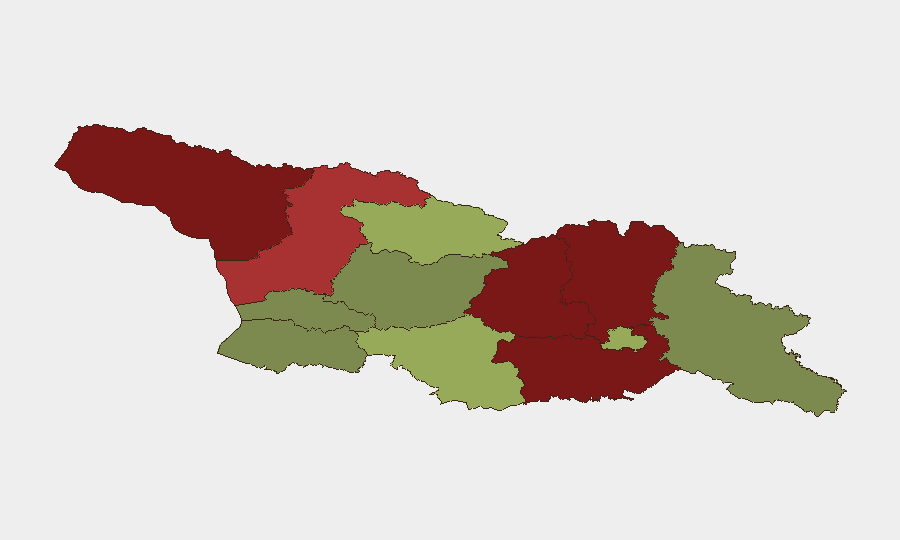
Abkhazia (risk 95) and Shida Kartli (88) pose the highest sub-national threats, driven by unresolved territorial status, proximity to active Russian military presence, and limited state control. Lower Kartli (85) and Mtskheta-Mtianeti (82) face similar dynamics along or near the South Ossetia boundary and Russian border. These four northern and eastern regions account for the vast majority of Georgia's internal risk profile. Tbilisi (45) and Samtskhe-Javakheti (48) carry moderate risk tied to protest activity and sensitivity to Russian influence respectively, while southern and western regions (Adjara, Imereti, Guria, Kakheti) remain substantially lower-risk.
How GeoBit Would Assist
Security teams protecting personnel or assets in Georgia should deploy AOI Monitoring & Early Warning on Tbilisi's protest corridors and the 27 September march route to track real-time crowd density, route changes, and police response. Multi-language OSINT fusion (X/Twitter, Telegram, YouTube) combined with sentiment & temporal analysis enables tracking of opposition mobilization intensity and opposition calls for escalation. For exposure in northern/eastern regions or frozen-conflict zones, satellite & imagery analysis and GIS spatial mapping support risk assessment of military posture and access-route viability.
7-Day Outlook
Protest activity will likely intensify around the 27 September anti-Russian march, creating elevated localized congestion and potential for confrontation in central Tbilisi. Judicial proceedings against senior officials will continue to fuel opposition mobilization and political rhetoric. No imminent armed or terrorist incidents are signaled, but sustained civil unrest and judicial actions maintain a volatile political environment through the coming week.
Highest-Risk Areas — Ranked
| # | State / Region | Risk |
|---|---|---|
| 1 | Autonomous Republic of Abkhazia | 95 |
| 2 | Shida Kartli | 88 |
| 3 | Lower Kartli | 85 |
| 4 | Mtskheta-Mtianeti | 82 |
| 5 | Samegrelo-Upper Svaneti | 78 |
| 6 | Samtskhe-Javakheti | 48 |
| 7 | Tbilisi | 45 |
| 8 | Racha-Lechkhumi and Kvemo Svaneti | 42 |
| 9 | Kakheti | 38 |
| 10 | Autonomous Republic of Adjara | 35 |
| 11 | Imereti | 32 |
| 12 | Guria | 28 |
Sources
Previous Weekly Briefs
A new Georgia brief is written every Monday, covering the week — each with its own risk map and downloadable CSV. Use the calendar to go further back.
- September 14, 2026
- September 7, 2026
- September 3, 2026
- September 2, 2026
- September 1, 2026
- August 31, 2026
- August 30, 2026
📅 Browse past briefs by calendar →
Highlighted days have a brief. Tap a day for that day's map & analysis, or “csv” for that day's dataset ($5).
Atlas — our AI intelligence desk — emails them this snapshot personally. Nothing else, no list.