Situation Summary
Indonesia remains a moderate-risk environment (global rank #40, composite score 52) characterized by macro-financial stress, ongoing security-sector messaging about institutional reform, and persistent regional instability in peripheral zones. Government signals over the past 72 hours—including prosecutorial action, presidential directives, and prison-sector statements—suggest active policy and administrative adjustment, though no discrete security incident of national impact has been confirmed in the past 24–48 hours. Underlying vulnerabilities in energy infrastructure (documented blackout stress in May–June) and currency weakness (flagged by Fitch on 1 July) create secondary risks to business continuity and supply-chain reliability.
Key Developments
Open-source verification of discrete security incidents within the past 24–48 hours with specific location and corroboration remains limited. The most recent GeoBit event signals reflect administrative and prosecutorial activity (arrests/detentions, sanctions in Jakarta, demand by prosecutor on 30 June; admin sanctions in Jakarta on 1 July) and government-level communications, but do not yet map to a clearly dated clash, protest surge, infrastructure failure, or threat spike. References to prison-sector and military statements (29–1 July) suggest ongoing inter-agency coordination on unspecified matters, possibly related to detention or security posture. Papua's long-running separatist violence and human-rights concerns persist as a chronic lower-level threat; no new major incident is confirmed in the past 48 hours. Financial-market signals (rupiah weakness, FX-reserve pressure as of 1 July) present macroeconomic rather than acute security risk. Corporate teams should monitor official Indonesian government and police channels for clarification on the scope and location of announced prosecutions and sanctions.
Highest-Risk Areas
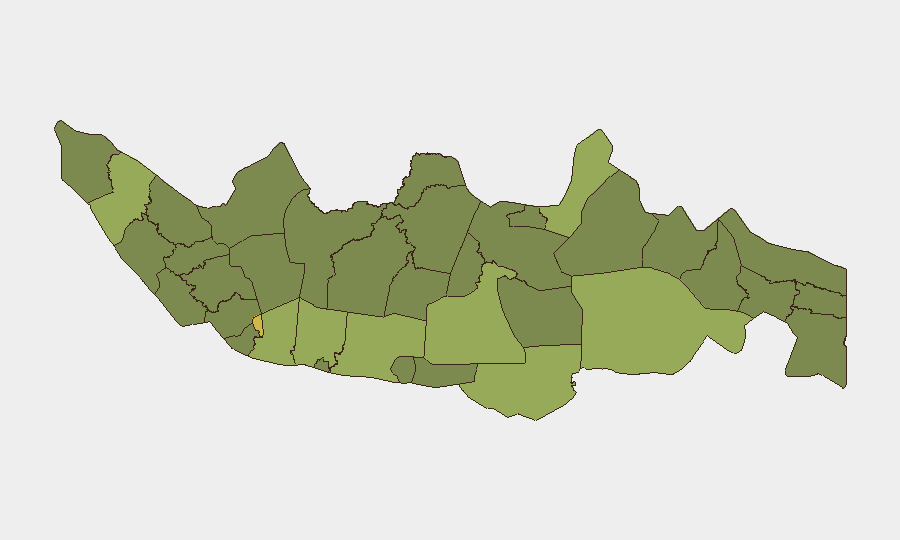
Jakarta (risk 66.7) dominates the sub-national landscape and is the locus of administrative and prosecutorial activity noted above; corporate and diplomatic presence there faces the highest composite risk. South Sulawesi (53.9), West Java (48.2), and the eastern cluster (North Sulawesi, Central Java, Maluku, East Java) represent secondary risk zones driven by ongoing militant activity, community tensions, and historical insurgency. Papua's chronic separatist insurgency and alleged human-rights violations elevate underlying unrest but do not appear to be accelerating in the past 48 hours. West Java's proximity to Jakarta and role as a transport/logistics hub amplify its operational relevance for supply-chain and personnel security.
How GeoBit Would Assist
Security teams monitoring Indonesia should use Intel Sweep and multi-language event feeds to track daily prosecutorial, government, and police announcements; OSINT fusion and corroboration to distinguish rumors from confirmed developments; and AOI Monitoring & Early Warning on Jakarta, West Java, and South Sulawesi to detect protest, transport disruption, or security-force mobilization. Economic & Trade analysis would clarify rupiah and FX-reserve dynamics and their impact on operational costs and cash management. Routing & Network Analysis supports contingency travel planning in light of infrastructure vulnerabilities.
7-Day Outlook
No major escalation is signaled in the immediate term; however, prosecutorial and administrative actions may clarify over the next 7 days, potentially affecting visa, business-licensing, or personnel-movement conditions. Macro-financial stress and energy-infrastructure vulnerabilities warrant heightened monitoring of supply-chain resilience and rupiah-hedging strategies. Regional tensions in Papua and Sulawesi remain chronic and are unlikely to spike sharply absent a specific trigger.
Highest-Risk Areas — Ranked
| # | State / Region | Risk |
|---|---|---|
| 1 | Special capital Region of Jakarta | 66.7 |
| 2 | South Sulawesi | 53.9 |
| 3 | West Java | 48.2 |
| 4 | North Sulawesi | 44.1 |
| 5 | Central Java | 44.1 |
| 6 | Maluku | 43.6 |
| 7 | East Java | 43.6 |
| 8 | North Sumatra | 41.7 |
| 9 | East Nusa Tenggara | 40.4 |
| 10 | Riau | 38.4 |
| 11 | Special Region of Yogyakarta | 38.4 |
| 12 | Banten | 37.8 |
Sources
Previous Daily Briefs
A new Indonesia brief is written every day — each with its own risk map and downloadable CSV. Here's the last week; use the calendar to go further back.
📅 Browse every day by calendar →
Highlighted days have a brief. Tap a day for that day's map & analysis, or “csv” for that day's dataset ($5).