Situation Summary
Solomon Islands remains a low-global-threat environment (rank #151, composite score 9) with no major violence, armed clashes, or infrastructure disruption reported in the past seven days. However, the country faces a fragile political situation centered on elite contestation over security alignments and the domestic fallout from a withdrawn no-confidence motion against Prime Minister Matthew Wale. A single notable incident involved police use of less-lethal force against an armed foreign national in Honiara on 10 September; concurrent announcements of Australian and U.S. security engagement suggest sustained external interest but also potential for domestic political friction around foreign policy choices.
Key Developments
- Honiara, 10 September – RSIPF deployed bean-bag rounds to subdue an Australian citizen who allegedly threatened a shopkeeper with a weapon and resisted police interception; methamphetamine-use equipment was later found in his vehicle. Illustrates ongoing concern about armed and drug-related crime in the capital.
- Honiara, 10–11 September – Media confirmation that the no-confidence motion against PM Wale (withdrawn 6 September) has eased immediate political pressure; several MPs have joined his coalition. Wale remains in office but Parliament remains indefinitely adjourned, signaling sustained political instability.
- Honiara/National, 8–10 September – Australian and Solomon Islands governments confirmed "in-principle agreement" on a billion-dollar security and defence treaty, including expanded cooperation on policing and maritime security. No domestic protests or unrest reported, but the agreement is politically sensitive.
- Honiara, 9 September – Deputy Prime Minister Sade clarified that an Australian High Commissioner briefing on treaty progress was routine and not intended for domestic political purposes, indicating sensitivity around foreign security deals and potential for future controversy.
- Honiara, 11 September – U.S. State Department announced provision of four aircraft rescue and firefighting vehicles to Honiara Airport, marginally improving aviation emergency response and safety infrastructure for international travel.
- Honiara/Regional, 10–11 September – Analysis notes that PM Wale's need to leave the Pacific Islands Forum summit in Palau to manage the no-confidence crisis has disrupted regional security coordination and highlighted Solomon Islands' domestic political fragility.
- Regional/Solomon Islands, 13 September – Solomon Islands was among PIF leaders absent from the regional summit; the Forum only "acknowledged" rather than endorsed Solomon Islands' proposed Blue Pacific Ocean of Peace regional security treaty, deferring decision and signaling diplomatic isolation risk.
- Honiara, 14 September – Political analysts describe the situation as "highly unstable" despite the temporary easing of the no-confidence crisis, citing ongoing contestation over security alignments with China, Australia, and the U.S., plus indefinite parliamentary adjournment.
- Solomon Islands/Regional, 14 September – U.S. Pacific Command senior officer visited Palau, Solomon Islands, and Indonesia to discuss security cooperation, elevating U.S. geopolitical engagement in the region.
Highest-Risk Areas
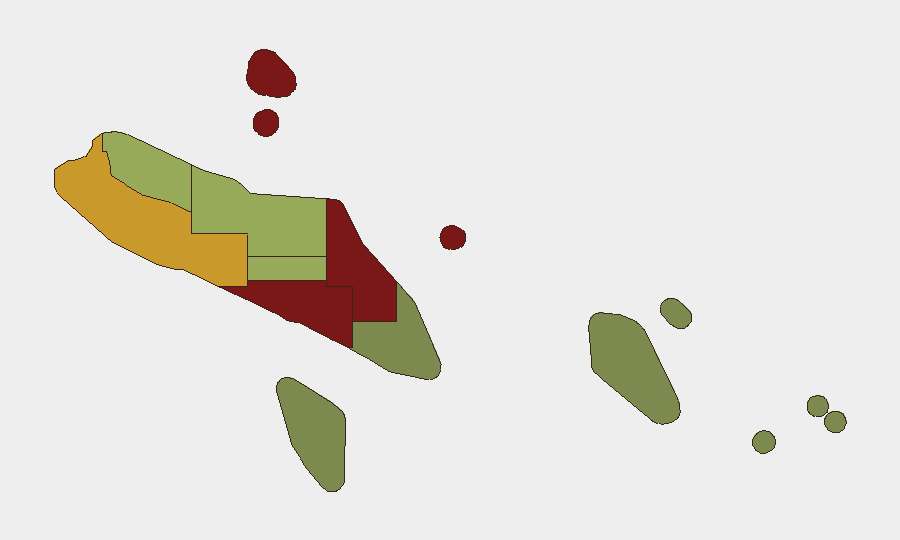
Honiara and Guadalcanal (risk scores 92 and 88 respectively) dominate the threat profile. The capital remains the locus of armed and drug-related crime, police incidents, and elite political maneuvering; the surrounding Guadalcanal province shares the same governance and criminal-justice fragmentation. Malaita Province (risk 85) historically reflects communal tensions and policing gaps. These three areas collectively account for the country's security burden; the Western Province (risk 72) shows secondary risk driven by maritime trafficking and organized crime concerns. All other provinces carry materially lower risk and are suitable for standard corporate travel protocols.
How GeoBit Would Assist
Security teams monitoring Solomon Islands would deploy AOI Monitoring & Early Warning on Honiara and Guadalcanal to detect street-level unrest, protests, or criminal incidents; Intel Sweep and OSINT Fusion to track elite political statements, parliamentary moves, and external security-treaty negotiations; and Conflict & Military analysis to interpret geopolitical posturing and foreign military presence. Network & Actor Analysis would map political factions and their international backers, enabling predictive assessment of policy shifts affecting corporate operations.
7-Day Outlook
The political crisis is unlikely to escalate into street-level violence in the immediate term, as the no-confidence motion has been withdrawn and Wale has consolidated coalition support. However, indefinite parliamentary adjournment and unresolved contestation over foreign-security alignments create sustained medium-term risk of elite instability, policy reversals, or renewed parliamentary crises within 2–4 weeks. Armed and drug-related crime in Honiara will remain the primary duty-of-care concern for resident staff and operations.
Highest-Risk Areas — Ranked
| # | State / Region | Risk |
|---|---|---|
| 1 | Honiara | 92 |
| 2 | Guadalcanal | 88 |
| 3 | Malaita | 85 |
| 4 | Western | 72 |
| 5 | Choiseul | 58 |
| 6 | Isabel | 52 |
| 7 | Central Province | 48 |
| 8 | Makira-Ulawa | 38 |
| 9 | Rennell and Bellona | 22 |
| 10 | Temotu | 18 |
Sources
Previous Weekly Briefs
A new Solomon Islands brief is written every Monday, covering the week — each with its own risk map and downloadable CSV. Use the calendar to go further back.
- September 8, 2026
- September 2, 2026
- August 31, 2026
- August 28, 2026
- August 26, 2026
- August 24, 2026
- August 22, 2026
📅 Browse past briefs by calendar →
Highlighted days have a brief. Tap a day for that day's map & analysis, or “csv” for that day's dataset ($5).
Atlas — our AI intelligence desk — emails them this snapshot personally. Nothing else, no list.