Situation Summary
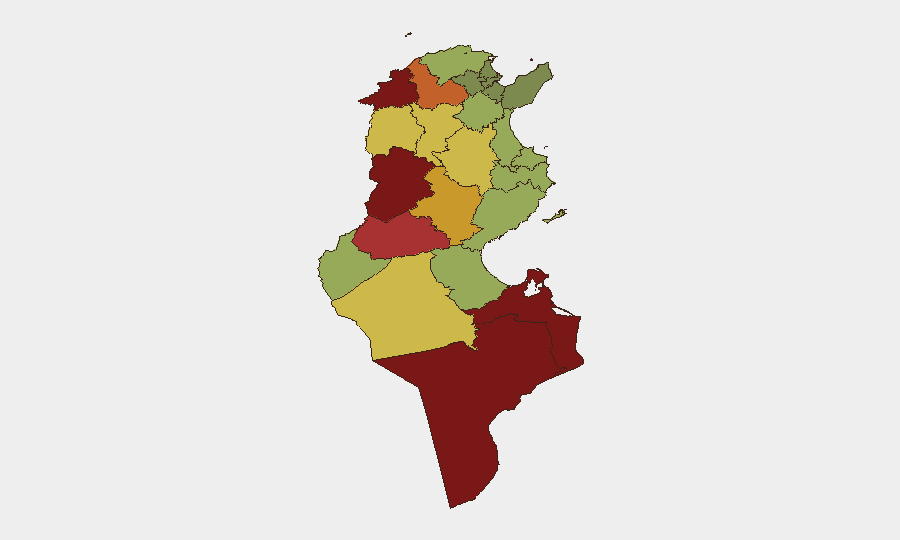
Tunisia maintains an elevated but stable security posture as of early August 2026, with no confirmed discrete security incidents in the last 24–48 hours. Structural risks persist across multiple domains—terrorism in western mountain regions, migration and border tensions with Libya, and recurrent protest activity in urban centers—but these represent ongoing patterns rather than acute escalations. The composite national threat score remains relatively low (17), though sub-national disparities are significant, with southwestern and western border regions substantially outpacing coastal and central areas in measured risk.
Key Developments
No clearly time-stamped security incidents have been independently confirmed for August 1–3, 2026. Available open-source reporting does not provide sufficiently dated, corroborated events meeting the 24–48-hour window requirement. General advisories and background patterns are documented (see Highest-Risk Areas and 7-Day Outlook), but these do not constitute discrete new developments for this reporting period.
Highest-Risk Areas
Kasserine (risk 92) and Jendouba (risk 88) dominate Tunisia's sub-national threat landscape, driven by active terrorism and armed-group presence in the Jebel Chaambi–Jebel Selloum mountainous belt straddling the western border with Algeria. Tataouine (85), Médenine (83), and Gafsa (78) face compounding risks from both terrorism and Libya-border volatility, including ongoing migration pressures and periodic security incidents at the Ras Jdir crossing. These five governorates account for the majority of measurable armed-group, cross-border, and intercommunal tension; by contrast, coastal and capital-region governorates score substantially lower, reflecting more stable security environments but not immunity to localized protest activity.
How GeoBit Would Assist
Intel Sweep and multi-language OSINT would systematically track Arabic-language and social-media reporting from Kasserine, Jendouba, and southern border zones to detect emerging incidents ahead of English-language confirmation. AOI Monitoring & Early Warning on Ras Jdir, Jebel Chaambi, and major Tunis protest venues would provide automated alerting on renewed clashes, border closures, or demonstration escalation. Conflict & Military force-structure and Network & Actor Analysis capabilities would map active terrorist and armed-group nodes, enabling security teams to forecast high-risk movement corridors and adjust personnel routing accordingly.
7-Day Outlook
No imminent, specific threat escalation is evident in available reporting, but the absence of discrete incidents in the last 48 hours does not indicate diminished baseline risk. Continued vigilance is warranted around Ras Jdir border operations, western mountain routes, and Tunis urban centers where demonstrations may resume without warning. Personnel and asset managers should maintain standard heightened-awareness protocols in Kasserine, Jendouba, and southern governorates; routine border-crossing monitoring and social-media sentiment tracking remain essential for early detection of deterioration.
Highest-Risk Areas — Ranked
| # | State / Region | Risk |
|---|---|---|
| 1 | Kasserine | 92 |
| 2 | Jendouba | 88 |
| 3 | Tataouine | 85 |
| 4 | Médenine | 83 |
| 5 | Gafsa | 78 |
| 6 | Béja | 75 |
| 7 | Sidi Bouzid | 72 |
| 8 | Al Kaf | 70 |
| 9 | Kébili | 68 |
| 10 | Kairouan | 65 |
| 11 | Siliana | 62 |
| 12 | Tozeur | 58 |
Sources
Previous Daily Briefs
A new Tunisia brief is written every day — each with its own risk map and downloadable CSV. Here's the last week; use the calendar to go further back.
📅 Browse every day by calendar →
Highlighted days have a brief. Tap a day for that day's map & analysis, or “csv” for that day's dataset ($5).
Atlas — our AI intelligence desk — emails them this snapshot personally. Nothing else, no list.