Situation Summary
Uruguay maintains its status as a regional outlier on security, ranking #135 globally with composite threat score 12, but localized violence and organized-crime activity continue to generate acute risks in Montevideo and surrounding departments. The past week saw seven recorded violent incidents (homicides, robbery, armed burglary) alongside concurrent police operations targeting narcotrafficking infrastructure, suggesting both street-level gang activity and supply-chain enforcement remain active. A labor dispute at the country's primary container terminal has created secondary disruption risk to supply chains and port operations. Overall trajectory remains contained but volatile in high-risk urban zones.
Key Developments
- Montevideo port (TCP), September 29–30: Labor dispute over dockworker conditions and container-terminal operations escalated, then reportedly reached pre-agreement in principle on September 30, involving 197 workers and scheduling changes; risk of renewed disruption remains if formal settlement stalls.
- Montevideo, near Palacio Peñarol, September 29: An adolescent sustained a gunshot wound to the face during Peñarol's 135th-anniversary celebrations; victim transferred to Hospital Maciel; circumstances under investigation.
- Montevideo, October 2: Operation Los Sueños (Montevideo Departmental Anti-Drug Brigade) resulted in six arrests, seizure of firearms, ammunition, suspected drugs, and cash in investigation targeting drug sales and weapons stockpiling.
- Multiple departments (unspecified), October 2: Operation Golfo concluded with 32 searches and 32 arrests nationwide, targeting criminal structures linked to narcotrafficking.
- Nationwide, September 29–October 4: Inumet issued heavy-rain and severe-storm warnings; risks included rapidly rising streams, wind damage to electrical infrastructure, reduced visibility, and hazardous secondary-road conditions during the period.
- Montevideo, September 26: Fatal homicide reported at Punta de Rieles; 39-year-old male victim.
- Montevideo (unspecified neighborhood), September 22: Armed residential burglary in which suspect fled across adjoining rooftops carrying firearms; police discovered additional antique rifles, shotguns, and other weapons at the scene.
- Montevideo area, September 21: Eleven individuals (eight aged 14–17, three adults) detained following "piranha" group robbery of a supermarket; all suspects apprehended.
Highest-Risk Areas
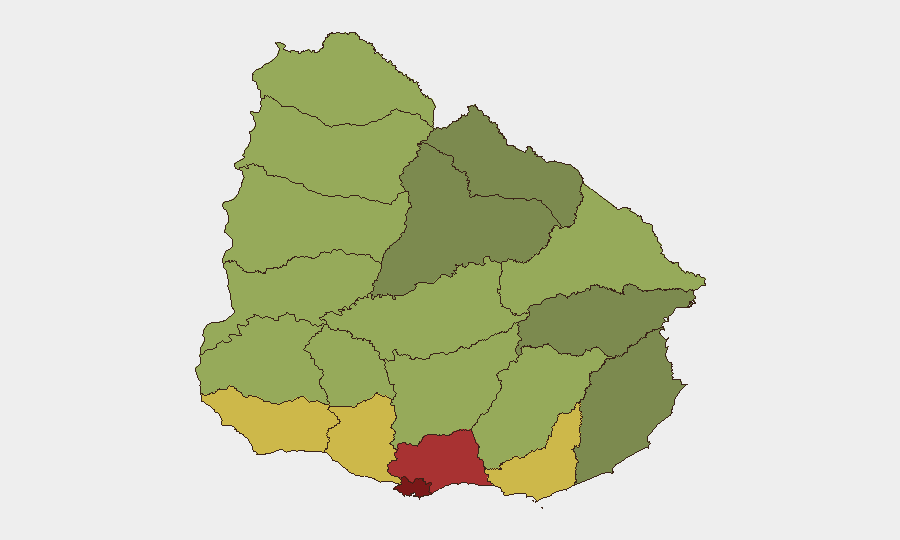
Montevideo (risk 92) dominates the sub-national ranking and accounts for the majority of recorded violent incidents and organized-crime operations this week. Canelones (78) and Maldonado (68) follow as secondary concentrations of risk, reflecting drug-trafficking transit corridors and organized-crime presence in the greater metropolitan and eastern coastal zones. San José, Colonia, and Soriano (64, 62, 58 respectively) show elevated scores consistent with historical smuggling and organized-crime activity along western and border regions. Corporate and duty-of-care focus should remain on Montevideo as the principal threat node, with secondary attention to northern border departments (Artigas, Salto, Paysandú) where narco-transit activity persists.
How GeoBit Would Assist
Security teams operating in Uruguay should deploy AOI Monitoring & Early Warning on Montevideo's highest-risk neighborhoods and port facilities to detect clustering of violent incidents and labor disputes before escalation. Network & Actor Analysis and OSINT fusion (X/Twitter, Telegram, event feeds) would enable real-time tracking of criminal-organization activity and narcotrafficking operations signaled by police raids. Routing & Network Analysis supports alternative supply-chain and personnel-movement planning around port disruptions and areas of acute violence.
7-Day Outlook
Port labor negotiations will likely remain volatile; formal resolution is not guaranteed, and supply disruptions may resume. Organized-crime enforcement operations (Operation Golfo, Operation Los Sueños) suggest sustained police pressure on narcotrafficking infrastructure, which may temporarily displace street-level violence or trigger retaliatory incidents. Weather-related hazards are expected to diminish by mid-week; monitoring for secondary disruption to utilities and secondary roads remains warranted.
Highest-Risk Areas — Ranked
| # | State / Region | Risk |
|---|---|---|
| 1 | Montevideo | 92 |
| 2 | Canelones | 78 |
| 3 | Maldonado | 68 |
| 4 | San José | 64 |
| 5 | Colonia | 62 |
| 6 | Soriano | 58 |
| 7 | Río Negro | 56 |
| 8 | Salto | 54 |
| 9 | Artigas | 52 |
| 10 | Paysandú | 50 |
| 11 | Florida | 48 |
| 12 | Flores | 46 |
Sources
Previous Weekly Briefs
A new Uruguay brief is written every Monday, covering the week — each with its own risk map and downloadable CSV. Use the calendar to go further back.
- September 28, 2026
- September 21, 2026
- September 14, 2026
- September 7, 2026
- September 2, 2026
- September 1, 2026
- August 31, 2026
📅 Browse past briefs by calendar →
Highlighted days have a brief. Tap a day for that day's map & analysis, or “csv” for that day's dataset ($5).
Atlas — our AI intelligence desk — emails them this snapshot personally. Nothing else, no list.