Situation Summary
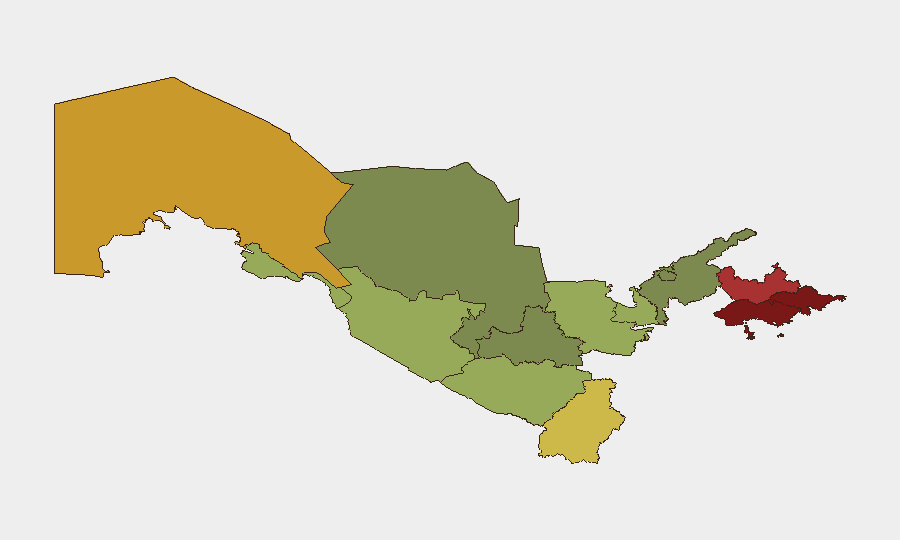
Uzbekistan remains a low-threat environment with no acute security incidents recorded in the past 24–48 hours. The national composite threat score stands at 3 (ranking #194 globally), reflecting routine crime and minor accidents as the dominant risk vectors. Sub-national disparities are substantial, with the Fergana Valley region—particularly Andijan, Fergana, and Namangan regions—accounting for elevated threat concentrations, while western and southern oblasts remain comparatively stable.
Key Developments
No verifiable security, civil-unrest, infrastructure, or acute travel-risk incidents have been confirmed in Uzbekistan within the last 24–48 hours. Open-source reporting from domestic news outlets (Nuz.uz, Zamin.uz, Vaib.uz, Newshub.uz) and structured threat-assessment feeds show no material escalation or incidents meeting intelligence relevance criteria for this period. A dedicated country-level security scan dated 2026-07-19–20 explicitly confirms the absence of acute developments following cross-check of web research and event-signal monitoring.
Highest-Risk Areas
The Fergana Valley (Andijan, Fergana, and Namangan regions, with composite scores 88, 82, and 78 respectively) dominates the sub-national risk profile and reflects historical factors: ethnic and border tensions, relative isolation, limited state capacity in remote areas, and legacy socioeconomic disparities. Karakalpakstan (score 72) and Surxondaryo (score 65) are secondary concern zones, driven by water-scarcity stress, environmental degradation, and socioeconomic fragility. The capital region and western industrial zones (Bukhara, Navoiy, Samarqand) register substantially lower risk, correlating with urban density, state presence, and economic activity. Corporate assets and personnel in Fergana Valley oblasts face elevated ambient risk relative to other regions, though no active conflict or organized instability is present.
How GeoBit Would Assist
Corporate security teams with Uzbekistan operations would benefit from AOI Monitoring & Early Warning focused on the Fergana Valley and Karakalpakstan, coupled with multi-language OSINT (Intel Sweep, Telegram & X monitoring, Nuz.uz/domestic feed integration) to detect emerging labor, environmental, or civil-society tensions before they escalate. Risk & Threat Assessment and sentiment analysis of regional social media and news feeds provide cost-effective continuous-watch capability without on-ground presence. GIS & Spatial Analysis and routing optimization enable duty-of-care teams to model evacuation and supply-chain resilience for dispersed assets in higher-risk oblasts.
7-Day Outlook
No material security escalation is anticipated in the near term. Routine crime, localized labor or resource disputes, and minor accidents will remain the dominant risk profile. Seasonal conditions (mid-summer heat, agricultural activity) and the absence of major political, electoral, or international triggers support a stable outlook through end-July.
Highest-Risk Areas — Ranked
| # | State / Region | Risk |
|---|---|---|
| 1 | Andijan Region | 88 |
| 2 | Fergana Region | 82 |
| 3 | Namangan Region | 78 |
| 4 | Republic of Karakalpakstan | 72 |
| 5 | Surxondaryo Region | 65 |
| 6 | Qashqadaryo Region | 58 |
| 7 | Sirdaryo Region | 55 |
| 8 | Jizzakh Region | 48 |
| 9 | Xorazm Region | 45 |
| 10 | Bukhara Region | 42 |
| 11 | Navoiy Region | 38 |
| 12 | Samarqand Region | 35 |
Sources
Previous Daily Briefs
A new Uzbekistan brief is written every day — each with its own risk map and downloadable CSV. Here's the last week; use the calendar to go further back.
📅 Browse every day by calendar →
Highlighted days have a brief. Tap a day for that day's map & analysis, or “csv” for that day's dataset ($5).
Atlas — our AI intelligence desk — emails them this snapshot personally. Nothing else, no list.