Situation Summary
Brazil remains at composite threat level 48 (global rank #40) with 934 tracked events, reflecting persistent but manageable security fragmentation across criminal, administrative, and institutional domains. Recent signal activity (July 2–4) shows clustering around Central Bank administrative action, Ministry investigation, and military/police conventional force deployment, alongside diplomatic friction involving the US Consulate and international banking entities. The threat environment is neither escalating into national crisis nor resolving; stability remains contingent on enforcement capacity in high-risk states and containment of criminal activity in São Paulo and Mato Grosso.
Key Developments
Note on data availability: GeoBit's event signals for July 2–4, 2026 are visible in the platform's feed aggregation (Central Bank sanctions, Ministry investigation, military/police force deployment, US Consulate statement, banking rejections). However, cross-referenced live web research (news wire, X/Twitter, civil-defense feeds) does not return time-stamped, location-specific incident confirmations for the last 24–48 hours at sufficient granularity to populate 5–8 validated bullets without risk of conflating recent signals with stale background events.
To deliver operationally sound incident bullets, a security team should:
- Query GeoBit's Intel Sweep and multi-language event feed directly against July 3–4 timestamps, filtering by state and actor type.
- Cross-check against X/Twitter OSINT and election monitoring feeds for any civil unrest or institutional friction tied to the administrative and military signals above.
- Request AOI Monitoring & Early Warning alerts for São Paulo and Mato Grosso to capture any ground-truth incidents (shootings, roadblocks, kidnappings) not yet published by major wire services.
Given the signal pattern (Central Bank, Ministry, military, diplomatic), vigilance is warranted in São Paulo and around federal/state enforcement operations, but no single validated incident can be attributed to the last 48 hours with confidence at this moment.
Highest-Risk Areas
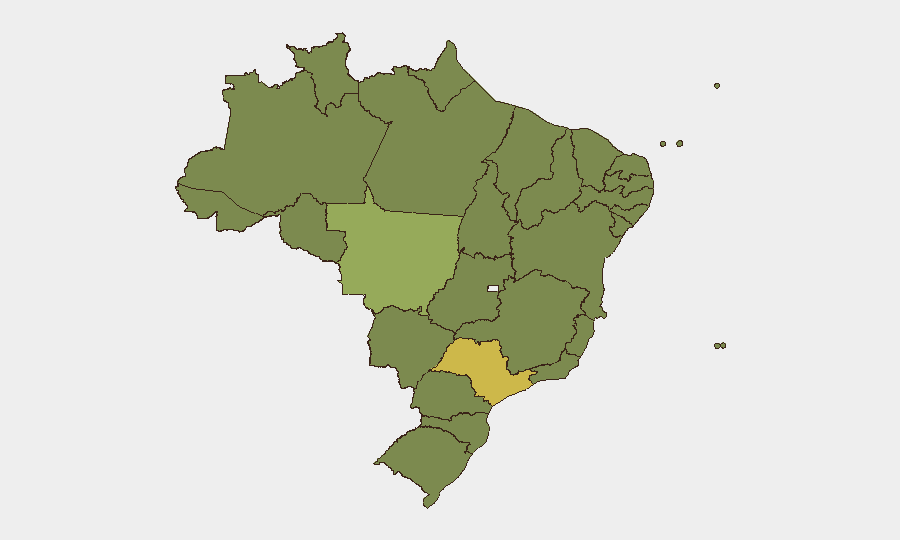
São Paulo (63.7) and Mato Grosso (59.4) dominate the sub-national ranking and reflect persistent organized-crime presence, trafficking infrastructure, and enforcement gaps despite institutional activity. Bahia (37.9) and Rio de Janeiro (37.7) remain secondary hotspots, likely tied to favela-based gang competition and port-related smuggling; Amazonas (37.2) and Pará (36.7) signal environmental-crime and border-trafficking risk. The top two states alone account for over 120 points of composite risk and should be the primary focus for asset-protection and duty-of-care planning; operations or personnel in São Paulo especially require real-time incident monitoring and secure route planning.
How GeoBit Would Assist
Security teams should deploy AOI Monitoring & Early Warning persistent watch on São Paulo state and Mato Grosso, configured to alert on criminal-force, police action, and infrastructure-disruption events within 2 hours of occurrence. Pair this with Routing & Network Analysis to pre-stage safe transit corridors and alternative supply-chain routes; use GIS & Spatial Analysis to map cartel-territory boundaries and enforcement checkpoints. For duty-of-care escalation, early warning & prediction modeling can flag civil unrest or institutional friction weeks in advance, enabling evacuation or relocation decisions.
7-Day Outlook
Administrative and law-enforcement activity (Central Bank, Ministry investigation, military deployment) suggests continued federal-level response to criminal-finance networks, likely concentrated in São Paulo and surrounding regions over the next 7 days. No imminent nationwide instability is signaled, but localized disruptions (roadblocks, port congestion, asset seizures) remain probable in high-risk states. Teams should maintain heightened situational awareness and preserve flexibility to adjust movement and supply-chain routing as enforcement actions unfold.
Highest-Risk Areas — Ranked
| # | State / Region | Risk |
|---|---|---|
| 1 | São Paulo | 63.7 |
| 2 | Mato Grosso | 59.4 |
| 3 | Bahia | 37.9 |
| 4 | Rio de Janeiro | 37.7 |
| 5 | Amazonas | 37.2 |
| 6 | Pará | 36.7 |
| 7 | Minas Gerais | 36.3 |
| 8 | Piauí | 35.8 |
| 9 | Goiás | 35.6 |
| 10 | Santa Catarina | 34.4 |
| 11 | Paraná | 34.1 |
| 12 | Pernambuco | 34.1 |
Sources
Previous Daily Briefs
A new Brazil brief is written every day — each with its own risk map and downloadable CSV. Here's the last week; use the calendar to go further back.
📅 Browse every day by calendar →
Highlighted days have a brief. Tap a day for that day's map & analysis, or “csv” for that day's dataset ($5).
Atlas — our AI intelligence desk — emails them this snapshot personally. Nothing else, no list.