Situation Summary
Guinea-Bissau remains in political transition following military intervention in September 2026, with security fundamentals stable but institutional tensions elevated. The past week saw intra-military friction within the presidential guard, a high-profile political challenge from exiled former President Embaló, and renewed AU pressure for inclusive dialogue—all occurring under an active ban on political gatherings. While no armed clashes, terrorism, or major criminal incidents were recorded, the combination of restricted political space, military consolidation, and elite polarization creates conditions for rapid escalation if dialogue breaks down.
Key Developments
- Bissau, 28–29 September: Reports of discontent and reassignments within the presidential guard, including claims of disarming of some troops; authorities characterized moves as routine and called for calm, though social media reported persistent unrest.
- Guinea-Bissau (political center Bissau), 29 September: Exiled former President Umaro Sissoco Embaló announced he would return to contest the December 6 presidential election, directly challenging the military-led transition and heightening political tension.
- Bissau, 2–3 October: Transitional military authorities blocked Embaló's planned return on grounds of national security and public order; junta reaffirmed restrictions on political demonstrations, rallies, and meetings.
- Bissau, 1 October: African Union Peace and Security Council issued statement calling for stronger AU engagement, inclusive political dialogue, improved media engagement, and movement toward constitutional order, signaling international concern over the pace and inclusiveness of transition.
Highest-Risk Areas
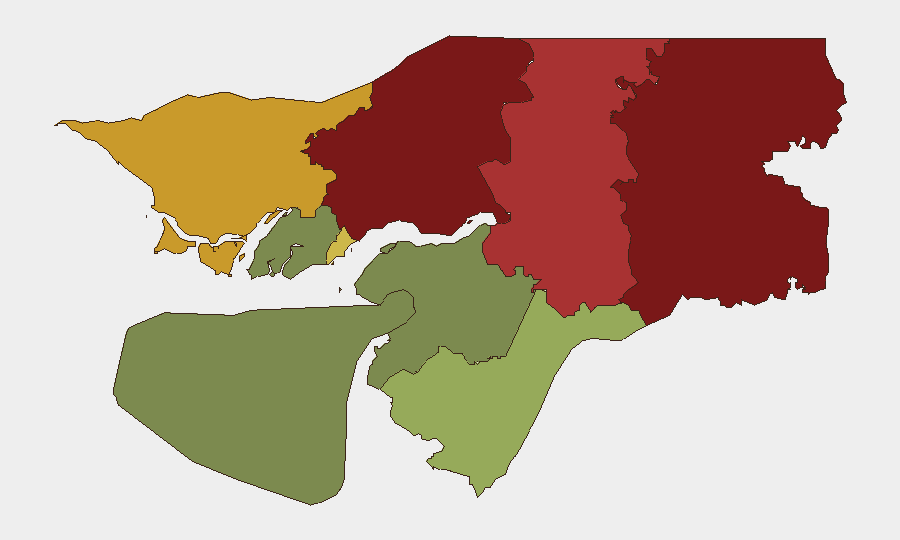
Gabu, Oio, and Bafatá regions in the eastern interior (risk scores 92, 85, and 78 respectively) significantly outpace risk in other areas, likely reflecting a combination of illicit-commodity trafficking, limited state presence, and cross-border instability with Senegal and Guinea. Cacheu Region (72) shows elevated risk; Bissau Autonomous Sector (68)—where political leadership and security forces are concentrated—remains the institutional epicenter but trails the eastern regions in composite risk, suggesting that armed trafficking, smuggling, and transnational crime networks pose material concern independent of the capital's political dynamics. Southern regions (Tombali, Quinara) and Bolama Island show substantially lower risk profiles.
How GeoBit Would Assist
Security teams monitoring Guinea-Bissau should employ AOI Monitoring & Early Warning for Gabu, Oio, and Bafatá to track cross-border movement and illicit-network activity; Network & Actor Analysis to map elite and military factions driving political and institutional risk; OSINT fusion (social-media feeds, radio SIGINT, and multi-language search) to detect early signals of intra-military friction or civil unrest before mainstream reporting; and Election Monitoring capabilities ahead of the December 6 ballot. Routing & Network Analysis supports contingency planning for personnel in high-risk eastern regions and the capital.
7-Day Outlook
The military's blocking of Embaló's return likely reduces immediate street-level political mobilization, but his declared candidacy ensures December elections will be a flashpoint for regime-opposition friction. Expect continued AU and international diplomatic engagement to push for dialogue, political opening, and electoral inclusion; resistance by the junta or further elite polarization could trigger renewed guard instability or civil unrest in Bissau by late October. The eastern regions will remain zones of concern for criminal and trafficking networks independent of political developments.
Highest-Risk Areas — Ranked
| # | State / Region | Risk |
|---|---|---|
| 1 | Gabu Region | 92 |
| 2 | Oio Region | 85 |
| 3 | Bafatá Region | 78 |
| 4 | Cacheu Region | 72 |
| 5 | Bissau Autonomous Sector | 68 |
| 6 | Tombali Region | 45 |
| 7 | Quinara Region | 38 |
| 8 | Biombo Region | 32 |
| 9 | Bolama Region | 15 |
Sources
Previous Weekly Briefs
A new Guinea-Bissau brief is written every Monday, covering the week — each with its own risk map and downloadable CSV. Use the calendar to go further back.
- September 28, 2026
- September 21, 2026
- September 14, 2026
- September 7, 2026
- September 1, 2026
- August 30, 2026
- August 28, 2026
📅 Browse past briefs by calendar →
Highlighted days have a brief. Tap a day for that day's map & analysis, or “csv” for that day's dataset ($5).
Atlas — our AI intelligence desk — emails them this snapshot personally. Nothing else, no list.