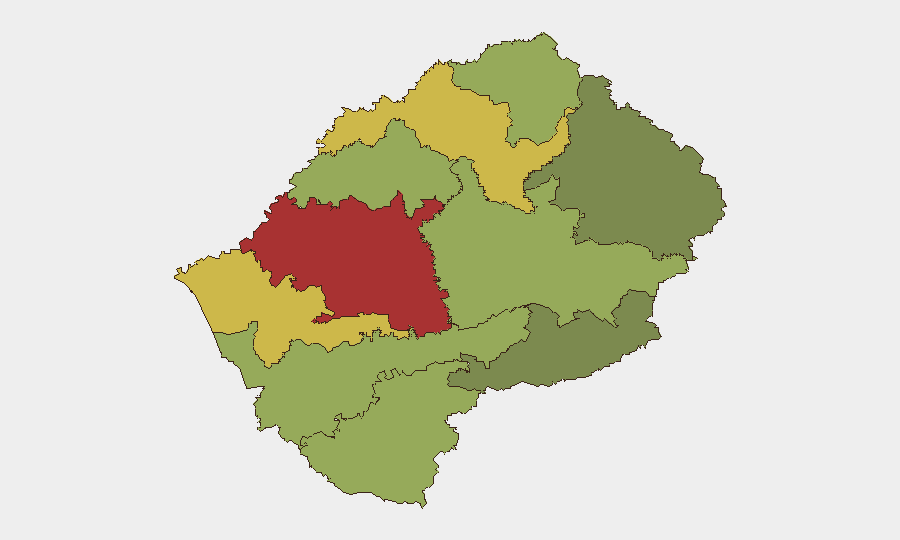
Situation Summary
Lesotho remains a low-intensity threat environment with a composite national risk score of 6 (global rank #154) and no discrete security events currently tracked in open-source reporting. Sub-national risk is concentrated in urban and border-adjacent districts, particularly Maseru, where political reform tensions and localized crime persist as baseline stressors. No escalation or acute security incident has been confirmed in the last 24–48 hours. The operating environment for corporate and humanitarian assets remains stable, subject to standard crime-mitigation and political-monitoring protocols.
Key Developments
No major security incidents have been confirmed in Lesotho in the last 24–48 hours (25–26 August 2026) at the level of specificity and recency required for inclusion in this brief. Ongoing political tensions—including opposition-party boycotts of national reform initiatives (dated 20 August)—reflect persistent institutional friction but do not constitute a newly reported acute event. Crime and infrastructure vulnerabilities (including reports of malicious damage to public facilities in Maseru district on 20 August) remain baseline concerns rather than escalations.
Security teams are advised to confirm any localized incidents directly via embassy reporting, in-country contacts, and real-time geolocation monitoring of Maseru and border areas, as open-source visibility in Lesotho can be intermittent.
Highest-Risk Areas
Maseru District (risk score 78) dominates the sub-national threat profile, driven by crime density, political activity, and infrastructure-targeting incidents. Mafeteng and Leribe districts (scores 65 and 62 respectively) represent secondary concentrations along trade corridors and border zones. Risk in these districts reflects a mix of organized property crime, political unrest, and cross-border smuggling networks. Southern and eastern districts (Qacha's Nek, Mokhotlong) carry lower baseline risk but remain subject to border-transit vulnerabilities and seasonal informal-economy disruptions.
How GeoBit Would Assist
Intel Sweep and OSINT fusion would systematize daily monitoring of Lesotho news wires, X/Twitter geolocation streams, and regional security advisories to detect early warning of political escalation, crime waves, or cross-border incidents before they impact operations. AOI monitoring with alerting on Maseru, Mafeteng, and other high-risk districts would flag real-time incidents (protests, infrastructure damage, security force activity) and enable duty-of-care teams to adjust travel and asset positioning proactively. Network and actor analysis combined with election monitoring would track political-faction movements and reform-process developments that could trigger unrest.
7-Day Outlook
Lesotho's political reform process and opposition boycott suggest sustained institutional tension over the near term, but no trigger for acute escalation is evident in the current window. Crime and border-transit pressures are expected to remain at baseline levels, with seasonal autumn weather potentially easing informal cross-border activity. Continued routine monitoring of Maseru and engagement with in-country contacts is advised; no heightened alert status is warranted at present.
Highest-Risk Areas — Ranked
| # | State / Region | Risk |
|---|---|---|
| 1 | Maseru District | 78 |
| 2 | Mafeteng District | 65 |
| 3 | Leribe District | 62 |
| 4 | Berea District | 58 |
| 5 | Mohale's Hoek District | 52 |
| 6 | Butha-Buthe District | 48 |
| 7 | Thaba-Tseka District | 45 |
| 8 | Quthing District | 42 |
| 9 | Mokhotlong District | 38 |
| 10 | Qacha's Nek District | 28 |
Sources
Previous Daily Briefs
A new Lesotho brief is written every day — each with its own risk map and downloadable CSV. Here's the last week; use the calendar to go further back.
- August 24, 2026
- August 22, 2026
- August 20, 2026
- August 18, 2026
- August 15, 2026
- August 13, 2026
- August 11, 2026
📅 Browse every day by calendar →
Highlighted days have a brief. Tap a day for that day's map & analysis, or “csv” for that day's dataset ($5).
Atlas — our AI intelligence desk — emails them this snapshot personally. Nothing else, no list.