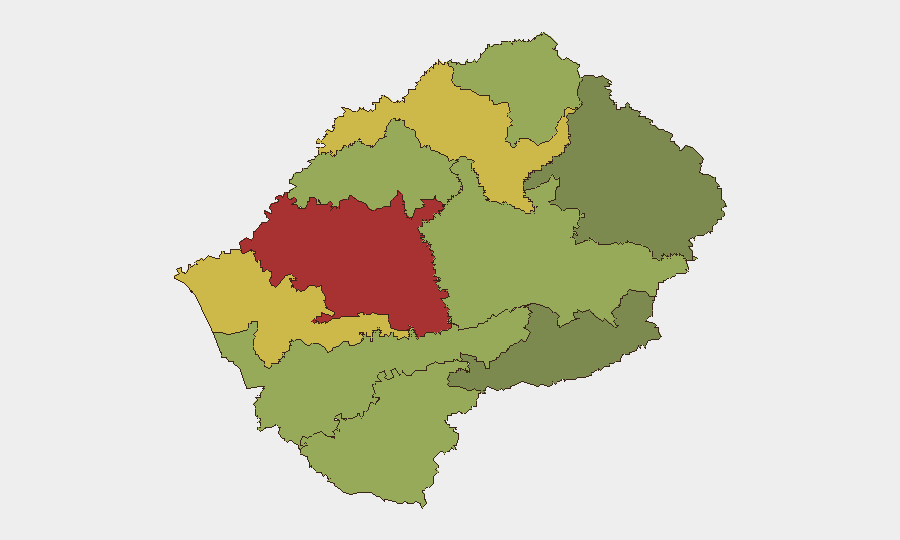
Situation Summary
Lesotho remains a low-frequency threat environment (global rank #158, composite score 8) with no confirmed discrete security incidents recorded in the past seven days. The country's security posture is shaped by chronic cross-border criminal activity—particularly livestock theft and arms trafficking via South Africa—and persistent governance fragility, but acute instability indicators are absent. Risk remains concentrated in the capital region and western districts bordering South Africa, with minimal activity or reporting from eastern and southern zones.
Key Developments
- 7 October — Lesotho/Eswatini (location unspecified): Lesotho and Eswatini announced a bilateral cooperation agreement to combat cyber threats. Limited operational detail is available; no active cyber incident or immediate tactical impact has been confirmed.
- 7 October — Bergville/Stulwane, South Africa (Lesotho border region): South African police arrested three individuals and recovered unlicensed firearms and ammunition during an intelligence-led operation targeting suspected cross-border criminal networks involved in livestock theft. This activity underscores persistent arms and contraband transit vulnerability along the western frontier.
- No other Lesotho-specific events confirmed for 7–13 October 2026. Reporting gaps and reliance on South African media indicate limited visibility into internal Lesotho security incidents; absence of reports does not confirm absence of activity.
Highest-Risk Areas
Maseru District (risk score 78) and Mafeteng District (risk score 65) drive the country's composite threat profile, reflecting capital-region governance capacity constraints, informal settlement expansion, and proximity to South African criminal networks. Leribe and Berea districts (scores 62 and 58) form a secondary risk band along the northern border corridor, where livestock rustling, cross-border smuggling, and limited law-enforcement reach create persistent vulnerability. Eastern and southern districts (Mokhotlong, Qacha's Nek) show materially lower risk, suggesting threat concentration is geographic and tied to border permeability and urban density rather than dispersed across the territory.
How GeoBit Would Assist
Security teams operating in Lesotho should employ AOI Monitoring & Early Warning focused on Maseru District and border crossing points to detect trafficking spikes or enforcement operations before they escalate. Network & Actor Analysis applied to cross-border criminal groups operating via South Africa—combined with OSINT fusion of regional law-enforcement reporting—would establish baseline patterns and flag anomalies in arms, livestock, and drug movement. Routing & Network Analysis can identify alternative transit corridors and safe zones for personnel or supply movement during periods of elevated activity in high-risk districts.
7-Day Outlook
No imminent destabilization is anticipated. The bilateral cyber-cooperation agreement suggests state-level governance continuity, and the absence of mass-casualty incidents, political turmoil announcements, or security-force clashes indicates stable near-term conditions. Routine cross-border criminal activity will persist, particularly in western districts; organizations should maintain standard duty-of-care protocols and avoid high-risk corridors during peak trafficking periods (typically dusk to dawn).
Highest-Risk Areas — Ranked
| # | State / Region | Risk |
|---|---|---|
| 1 | Maseru District | 78 |
| 2 | Mafeteng District | 65 |
| 3 | Leribe District | 62 |
| 4 | Berea District | 58 |
| 5 | Mohale's Hoek District | 52 |
| 6 | Butha-Buthe District | 48 |
| 7 | Thaba-Tseka District | 45 |
| 8 | Quthing District | 42 |
| 9 | Mokhotlong District | 38 |
| 10 | Qacha's Nek District | 28 |
Sources
Previous Weekly Briefs
A new Lesotho brief is written every Monday, covering the week — each with its own risk map and downloadable CSV. Use the calendar to go further back.
- October 6, 2026
- September 29, 2026
- September 22, 2026
- September 15, 2026
- September 8, 2026
- September 2, 2026
- August 31, 2026
📅 Browse past briefs by calendar →
Highlighted days have a brief. Tap a day for that day's map & analysis, or “csv” for that day's dataset ($5).
Atlas — our AI intelligence desk — emails them this snapshot personally. Nothing else, no list.