Situation Summary
Lesotho remains a low-threat environment (global rank #157) with no recorded security incidents during the reporting week. The country's 60th Independence Anniversary was observed peacefully on October 4, though senior officials have publicly acknowledged structural vulnerabilities—unemployment, poverty, and corruption—that risk undermining democratic stability ahead of 2027 elections. Food insecurity poses the most immediate humanitarian concern, with seven of ten districts projected to face "Crisis" phase conditions through March 2027. Cross-border gang violence in South Africa affects Basotho migrant workers and remains an indirect regional security consideration.
Key Developments
- Maseru, October 2: Prime Minister Ntsokoane Matekane called for completion of electoral reforms before 2027 elections, signaling planned governance adjustments. Independence Day celebrations and associated traffic events were announced for the capital.
- Maseru, Setsoto Stadium, October 4: Lesotho's 60th Independence Anniversary commemoration proceeded without reported incident, attended by national and regional officials. The event was characterized as a formal state ceremony.
- Maseru, October 5: National Assembly Speaker Tlohang Sekhamane cautioned that public dissatisfaction over unemployment, poverty, and corruption poses a risk to democratic confidence. The warning was delivered during an electoral-system review and inter-party dialogue session.
- Nationwide food security, October 4: The Lesotho Vulnerability Assessment Committee projected that seven districts will experience IPC Phase 3 "Crisis" food insecurity between October 2026 and March 2027. The EU committed M2.7 million in drought-response assistance.
- Mokhotlong, October 1: Local authorities opened temporary shelter facilities for gender-based-violence survivors at Mokhotlong Police Station and a waiting-mothers facility at Mapholaneng Health Centre. This represents service-delivery expansion, not a security incident.
- Rural nationwide, October 5: Lesotho's electricity regulator approved exemptions for seven mini-grid projects expected to extend power access to approximately 70 villages. Infrastructure resilience improvements in remote areas may reduce service vulnerability.
- Cross-border (Wedela, Gauteng, South Africa), referenced October 2: The Migrant Workers Association of Lesotho appealed for intervention following a September 26 tavern shooting in Wedela that killed 18 and wounded 15. While occurring outside Lesotho, gang-related violence in South African transit and labor-destination areas poses indirect occupational risk to Basotho nationals.
Highest-Risk Areas
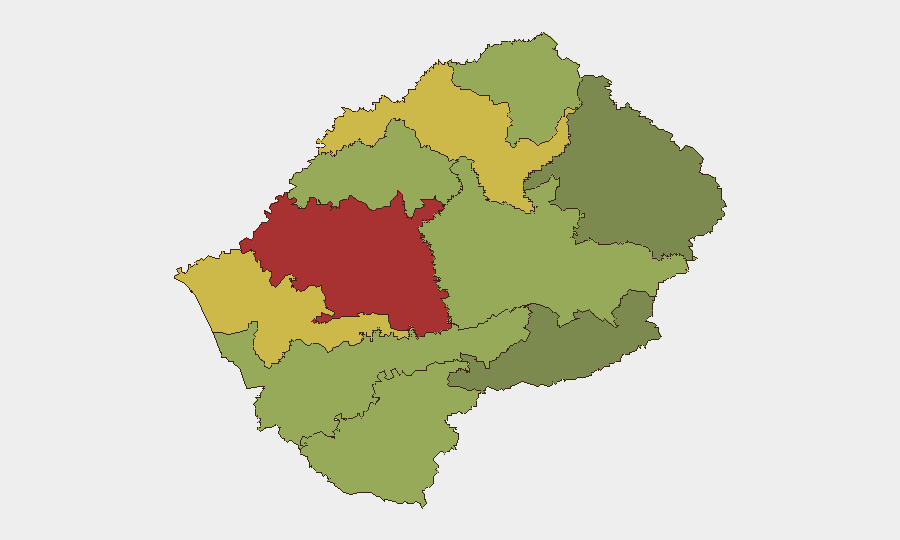
Maseru District dominates sub-national risk (score 78), reflecting the capital's concentration of political activity, cross-border movement, and urban crime vectors. Mafeteng (65) and Leribe (62) follow, likely driven by proximity to South Africa, labor-migration patterns, and limited law-enforcement capacity in secondary urban centers. Remote districts—Qacha's Nek (28), Mokhotlong (38), Quthing (42)—show lower composite scores, though they face acute food-insecurity and service-delivery constraints that could generate civil unrest if humanitarian conditions deteriorate further through the austral summer.
How GeoBit Would Assist
Security teams operating in Lesotho should use AOI Monitoring & Early Warning on Maseru and Mafeteng districts to track political developments and cross-border security shifts ahead of 2027 elections. Multi-language OSINT and X/Twitter intelligence enable real-time sentiment analysis of unemployment and corruption narratives that Speaker Sekhamane identified as stability risks. Humanitarian & NGO data and Environmental & Health capabilities provide early visibility into food-insecurity escalation in the seven identified districts, allowing duty-of-care teams to adjust staffing, supply chains, and contingency protocols before humanitarian stress translates into civil unrest.
7-Day Outlook
No immediate security escalation is anticipated. Electoral-reform discussions and Independence Day observances suggest a measured political calendar through late October. Food insecurity will intensify as austral winter progresses, potentially driving rural migration to Maseru and South African labor destinations; humanitarian organizations and cross-border monitoring should heighten awareness of displacement signals and surge in informal settlements.
Highest-Risk Areas — Ranked
| # | State / Region | Risk |
|---|---|---|
| 1 | Maseru District | 78 |
| 2 | Mafeteng District | 65 |
| 3 | Leribe District | 62 |
| 4 | Berea District | 58 |
| 5 | Mohale's Hoek District | 52 |
| 6 | Butha-Buthe District | 48 |
| 7 | Thaba-Tseka District | 45 |
| 8 | Quthing District | 42 |
| 9 | Mokhotlong District | 38 |
| 10 | Qacha's Nek District | 28 |
Sources
Previous Weekly Briefs
A new Lesotho brief is written every Monday, covering the week — each with its own risk map and downloadable CSV. Use the calendar to go further back.
- September 29, 2026
- September 22, 2026
- September 15, 2026
- September 8, 2026
- September 2, 2026
- August 31, 2026
- August 29, 2026
📅 Browse past briefs by calendar →
Highlighted days have a brief. Tap a day for that day's map & analysis, or “csv” for that day's dataset ($5).
Atlas — our AI intelligence desk — emails them this snapshot personally. Nothing else, no list.