Situation Summary
Mauritania remains a low-frequency threat environment (rank #106 globally) with no tracked conflict or terrorism events in the current window. The past week saw routine law-enforcement operations, infrastructure incidents, and political-dialogue activity concentrated in the capital and central regions, with no indicators of imminent civil unrest or armed activity. The sub-national threat profile remains dominated by the Saharan and border-adjacent regions (Tiris Zemmour, Hodh Ech Chargui, Hodh El Gharbi), where cross-border militant activity and ungoverned space pose residual risk; Nouakchott and central Mauritania remain operationally stable but face low-level organized crime and aging infrastructure vulnerabilities.
Key Developments
- Nouakchott 1 (2026-09-08): Gendarmerie dismantled a clandestine liquor manufacturing and distribution network, arresting two suspects (one foreign national) and seizing a primitive processing plant, psychotropic substances, and over 1,000 pills; reflects ongoing organized-crime enforcement activity.
- Nouakchott city-wide (2026-09-03): Coordinated National Gendarmerie operations arrested 15 suspects in networks distributing narcotics, psychotropic substances, and illicit alcohol; no violence reported.
- Nouakchott—Carrefour area (2026-09-03): SOMELEC reported serious damage to electrical supply infrastructure caused by uncoordinated excavation works by the National Sanitation Office, resulting in service disruption and highlighting coordination gaps in critical-infrastructure projects.
- Mal, Brakna region (2026-09-03): Fuel station building collapsed, killing multiple persons and injuring others; presidential delegation visited to offer condolences, indicating a civil-safety incident rather than security-related event.
- R'Kebt (2026-09-02): Transparency Comprehensive organization called for investigation into electrical cables installed before fires at two power stations, alleging potential negligence or irregularities; remains unverified.
- Nouakchott—SOMAGAZ headquarters (2026-09-02): Domestic-gas distributors protested new pricing structure; signals socio-economic tension around fuel supply and potential labor-relations friction.
- National political sphere (2026-09-04): Ruling coalition announced accession of two political formations into presidential-support ranks; opposition figure Mohamed Ould Maouloud warned of national "crisis" and called for inclusive dialogue, citing concern about regional spill-over (reported ethnic killings by Malian and Russian forces in Mali); no domestic unrest reported.
Highest-Risk Areas
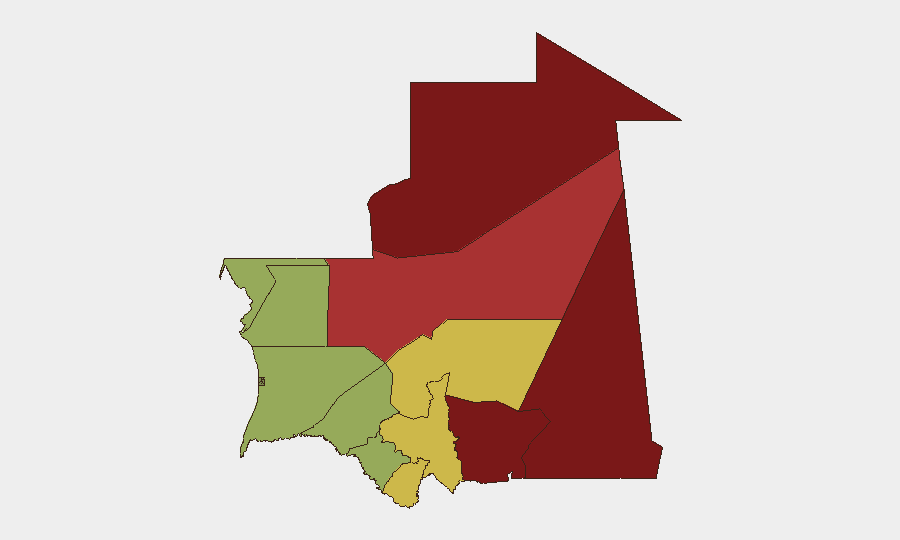
Tiris Zemmour (risk 95) and the eastern Hodh regions (Ech Chargui 85, El Gharbi 80) drive the national threat composite, reflecting proximity to the Mali-Mauritania border, ungoverned Saharan terrain, and historical cross-border militant infiltration. Adrar (78) and Tagant (68) extend risk along interior trade and pastoral routes. These areas contrast sharply with the capital (Nouakchott) and southern regions, where governance and security-force presence are denser; however, Nouakchott's crime networks and aging infrastructure present localized operational challenges for corporate and NGO personnel.
How GeoBit Would Assist
Security teams operating in Mauritania should employ AOI Monitoring & Early Warning for high-risk eastern and border regions (Tiris Zemmour, Hodh Ech Chargui) to detect cross-border militant movement and armed activity before escalation. Conflict & Military force-structure and Network & Actor Analysis tools help track Saharan militant groups and their leadership, while OSINT fusion (multi-language search, sentiment analysis, Telegram/X monitoring) provides continuous visibility on political rhetoric and organizational activity. Routing & Network Analysis and GIS & Spatial Analysis assist in alternative-route planning for personnel and supply chains, circumventing high-risk zones identified in the sub-national rankings.
7-Day Outlook
No major escalation is anticipated in the near term. Organized-crime enforcement will likely continue in Nouakchott. Political dialogue is expected to proceed without street mobilization. The residual risk remains concentrated in eastern and border regions; corporate and humanitarian teams should maintain standard vigilance protocols and avoid Tiris Zemmour and remote Hodh areas pending further monitoring.
Highest-Risk Areas — Ranked
| # | State / Region | Risk |
|---|---|---|
| 1 | Tiris Zemmour | 95 |
| 2 | Hodh Ech Chargui | 85 |
| 3 | Hodh El Gharbi | 80 |
| 4 | Adrar | 78 |
| 5 | Tagant | 68 |
| 6 | Guidimaka | 65 |
| 7 | Assaba | 62 |
| 8 | Gorgol | 58 |
| 9 | Trarza | 55 |
| 10 | Inchiri | 52 |
| 11 | Brakna | 48 |
| 12 | Dakhlet Nouadhibou | 45 |
Sources
Previous Weekly Briefs
A new Mauritania brief is written every Monday, covering the week — each with its own risk map and downloadable CSV. Use the calendar to go further back.
- September 2, 2026
- August 31, 2026
- August 28, 2026
- August 26, 2026
- August 24, 2026
- August 22, 2026
- August 20, 2026
📅 Browse past briefs by calendar →
Highlighted days have a brief. Tap a day for that day's map & analysis, or “csv” for that day's dataset ($5).
Atlas — our AI intelligence desk — emails them this snapshot personally. Nothing else, no list.