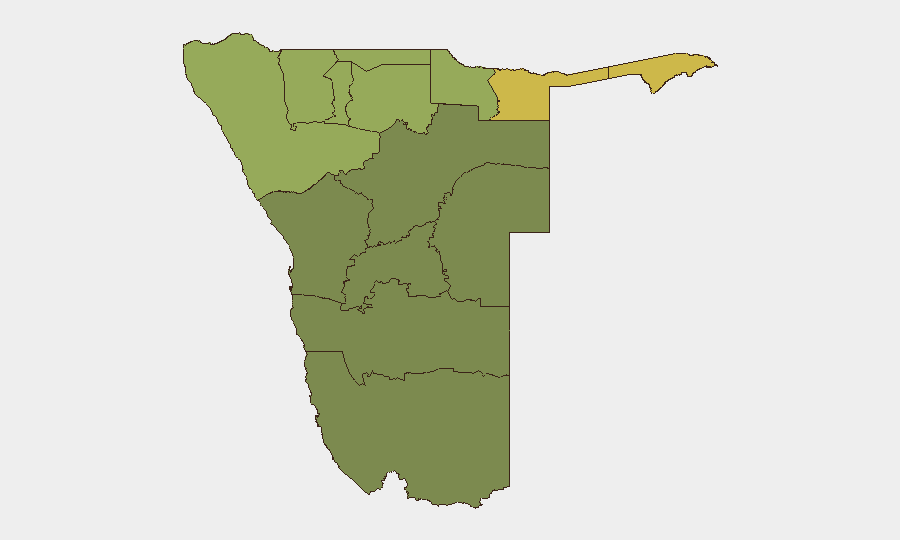
Situation Summary
Namibia remains a low-threat environment globally (ranked #105), with a composite threat score of 14 and no tracked active crises. However, sub-national risk variation is significant: the northern border regions (Zambezi, Kavango East/West) and northwestern areas present elevated threat profiles, driven primarily by organized crime, trafficking, and interpersonal violence rather than political instability. Recent event signals show isolated incidents of cyber fraud and interpersonal homicide rather than coordinated unrest or systemic breakdown. The security picture is stable but regionally differentiated.
Key Developments
GeoBit's live web research (24–48 hours ending 2026-08-15) did not surface any new, independently confirmed security incidents in Namibia dated 2026-08-14 to 2026-08-15. Earlier signals from 2026-08-07 to 2026-08-09 include:
- Cyberattack incidents (2026-08-08, nationwide): NamPol fraud investigations confirmed unauthorized electronic banking withdrawals totaling at least N$160,840 across multiple victims, indicating active retail-banking compromise and potential credential theft or malware deployment affecting financial-services clients.
- Interpersonal violence (2026-08-07 to 2026-08-09, Karasburg and other locations): Three fatal stabbing incidents within a 48-hour period, all resolved with same-day arrests, reflecting elevated but localized interpersonal conflict rather than organized violence.
No verified reports of protests, civil unrest, infrastructure disruption, or border-security events in the last 24–48 hours have been identified by GeoBit. The cyber-fraud cluster warrants monitoring for broader compromises affecting corporates operating banking or e-commerce platforms in Namibia.
Highest-Risk Areas
Zambezi Region (risk 68) and Kavango East (risk 62) drive the country's sub-national threat profile, followed by Kavango West (58) and Kunene (52). These northern and northwestern border regions are characterized by trafficking networks, organized crime, and limited state capacity, creating persistent risk to supply chains, personnel transit, and asset security. Kunene and Ohangwena regions, while lower-ranked, remain relevant for operations near the Angola and Botswana borders. Central and southern regions (Omaheke, Hardap, Otjozondjupa) present significantly lower risk and are suitable for routine operations with standard precautions.
How GeoBit Would Assist
Security teams operating in Namibia should employ AOI Monitoring & Early Warning on high-risk northern regions (Zambezi, Kavango) to detect emerging trafficking, protest, or criminal activity before operational impact. Intel Sweep and multi-language OSINT (including X, Telegram, and local Namibian media) provide real-time visibility on cyber-fraud evolution, border incidents, and labor disputes that may affect workforce or supply-chain stability. GIS & Spatial Analysis and alternative route/journey planning enable duty-of-care teams to avoid high-risk corridors and optimize personnel routing around Zambezi and Kavango transit zones.
7-Day Outlook
No acute escalation is anticipated in the near term. Cyber-fraud targeting financial-services users will likely persist at current levels, requiring enhanced endpoint and credential security across corporate banking operations. Northern border regions will remain elevated but stable, with seasonal trafficking and organized-crime activity continuing at baseline. Standard regional risk protocols should remain in place; no condition changes warrant immediate escalation.
Highest-Risk Areas — Ranked
| # | State / Region | Risk |
|---|---|---|
| 1 | Zambezi | 68 |
| 2 | Kavango East | 62 |
| 3 | Kavango West | 58 |
| 4 | Kunene Region | 52 |
| 5 | Oshikoto | 48 |
| 6 | Ohangwena | 45 |
| 7 | Omusati | 42 |
| 8 | Oshana | 40 |
| 9 | Otjozondjupa | 35 |
| 10 | Erongo Region | 32 |
| 11 | Hardap | 28 |
| 12 | Omaheke | 25 |
Sources
Previous Daily Briefs
A new Namibia brief is written every day — each with its own risk map and downloadable CSV. Here's the last week; use the calendar to go further back.
- August 13, 2026
- August 11, 2026
- August 9, 2026
- August 7, 2026
- August 5, 2026
- August 4, 2026
- August 2, 2026
📅 Browse every day by calendar →
Highlighted days have a brief. Tap a day for that day's map & analysis, or “csv” for that day's dataset ($5).
Atlas — our AI intelligence desk — emails them this snapshot personally. Nothing else, no list.