Situation Summary
Uzbekistan remains a low-priority global security concern (composite threat score 3; no tracked events), with stable governance and minimal recent incident activity. However, sub-national risk is sharply concentrated in the Fergana Valley and its periphery, where historical ethno-regional tensions, informal governance, and cross-border dynamics create persistent vulnerabilities. A prison-related arrest or detention event was logged on 2026-07-20, though details remain limited. Overall trajectory is stable, but localized risks in the northeast demand targeted attention from organizations with personnel or assets in those regions.
Key Developments
- 2026-07-20 · Arrest/Detention · Uzbekistan (unspecified location): Prison-related arrest or detention event recorded; further specifics unavailable from current sources. No corroborated reports of escalation or systemic impact.
- Web research conducted 2026-07-21–22 yielded no reliably dated, Uzbekistan-specific security incidents within the past 48 hours beyond the above event. General news feeds, diplomatic developments (e.g., India–Uzbekistan relations), and regional terrorism commentary were indexed but lack precise time-stamps or verifiable recent occurrence in-country.
Assessment: Current open-source reporting does not support identification of active security incidents, infrastructure disruptions, travel restrictions, or mass-casualty events within the last 24–48 hours. This reflects either genuine stability or limited reporting visibility; further targeted OSINT collection (Telegram, local Uzbek news outlets, official channels) recommended if operational decisions depend on real-time incident confirmation.
Highest-Risk Areas
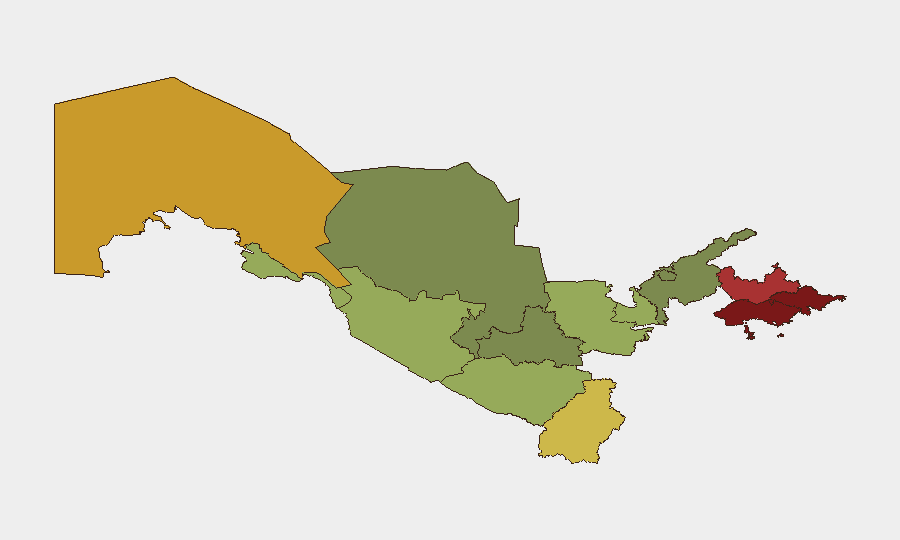
The Fergana Valley and its constituent regions—Andijan (risk 88), Fergana (82), and Namangan (78)—dominate Uzbekistan's sub-national threat profile. These areas combine historical inter-ethnic sensitivities (Tajik-Uzbek border disputes, Kyrgyz enclaves), informal cross-border networks, and weaker state penetration, making them vulnerable to localized unrest, smuggling, and spillover from regional instability. Karakalpakstan (72) presents a secondary concern due to geographic isolation, water-security tensions, and demographic grievances. The southern and western regions (Bukhara, Navoiy, Xorazm) carry materially lower composite risk, reflecting tighter state control and less volatile ethnic geography.
How GeoBit Would Assist
Organizations with operations in Andijan, Fergana, or Namangan regions should employ AOI Monitoring & Early Warning to detect emerging unrest, border incidents, or security-force activity; pair this with multi-language Telegram and X/Twitter OSINT to track informal networks, grievance narratives, and real-time incident reporting ahead of official channels. Conflict mapping and entity extraction across Uzbek-language media (Kun.uz, Gazeta.uz, Newshub.uz) would establish baseline activity patterns and flag anomalies. For duty-of-care teams, alternative route and journey planning via GIS tools mitigates exposure to high-risk corridors during periods of elevated tension.
7-Day Outlook
No imminent escalation is forecast over the next 7 days. Uzbekistan's security apparatus remains effective at suppressing large-scale unrest, and diplomatic relations with neighbors are largely stable. However, the Fergana Valley warrants continuous low-level monitoring; minor incidents (localized protests, border friction, detention actions) are routine but can cascade unpredictably in ethnically sensitive pockets. Organizations should maintain baseline OSINT collection and pre-positioned contingency plans for personnel in risk-ranked regions 1–3.
Highest-Risk Areas — Ranked
| # | State / Region | Risk |
|---|---|---|
| 1 | Andijan Region | 88 |
| 2 | Fergana Region | 82 |
| 3 | Namangan Region | 78 |
| 4 | Republic of Karakalpakstan | 72 |
| 5 | Surxondaryo Region | 65 |
| 6 | Qashqadaryo Region | 58 |
| 7 | Sirdaryo Region | 55 |
| 8 | Jizzakh Region | 48 |
| 9 | Xorazm Region | 45 |
| 10 | Bukhara Region | 42 |
| 11 | Navoiy Region | 38 |
| 12 | Samarqand Region | 35 |
Previous Daily Briefs
A new Uzbekistan brief is written every day — each with its own risk map and downloadable CSV. Here's the last week; use the calendar to go further back.
📅 Browse every day by calendar →
Highlighted days have a brief. Tap a day for that day's map & analysis, or “csv” for that day's dataset ($5).
Atlas — our AI intelligence desk — emails them this snapshot personally. Nothing else, no list.