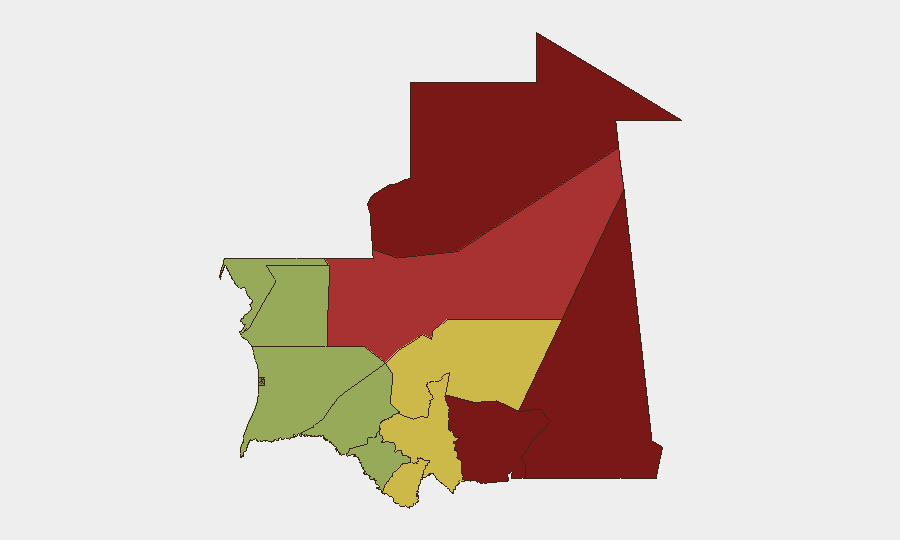
Situation Summary
Mauritania remains a low-frequency event environment (0 tracked security incidents in the current week) with a composite threat score of 16, ranking #112 globally. The security landscape is dominated by persistent militia and terrorist activity in remote northeastern and eastern regions—particularly Tiris Zemmour and the Hodh zones—rather than by acute incidents in the capital or populated western zones. No significant escalation or de-escalation signals emerged in the week of 16–22 September 2026. The overall risk posture for international personnel and operations remains stable but regionally differentiated.
Key Developments
- Nouakchott (Trarza region), 16–17 September: Power outages disrupted electricity supply across central Nouakchott neighborhoods including Carrefour, Arafat, and Teyarett/Tensoueilem, with some areas without power for over 24 hours. One outage in Arafat was attributed to damage from a severed power cable during private construction work. No security implications were reported.
- Guerou, Assaba region, 16 September: Mauritanian authorities officially inaugurated a new emergency-services and crisis-management facility, signaling civil-protection infrastructure development and improved emergency-response capacity.
Note: Available sources yielded only two corroborated in-country events for the 16–22 September window. No direct-action security incidents (armed clashes, kidnappings, bombings, armed robbery, or criminal violence) were documented inside Mauritania during this period.
Highest-Risk Areas
Tiris Zemmour (risk 95) and the two Hodh regions—Ech Chargui (85) and El Gharbi (80)—drive the national risk profile. These remote northeastern and eastern zones host Al-Qaeda–affiliated and Islamic State–affiliated militant cells with episodic cross-border activity originating in Mali and Algeria; they remain inaccessible to reliable international monitoring and are de facto ungoverned in stretches. Adrar (78) and Tagant (68) present secondary-tier risks. In contrast, the coastal and western regions (Dakhlet Nouadhibou, Brakna, Trarza, Gorgol) remain substantially lower-risk and more stable, hosting most foreign business and diplomatic presence; Nouakchott itself has not been a primary target in the current cycle.
How GeoBit Would Assist
Teams with operations or personnel in Mauritania should deploy AOI Monitoring & Early Warning on the high-risk northeastern and eastern wilayas (Tiris Zemmour, Hodh Ech Chargui, Hodh El Gharbi) to capture early signals of cross-border militant activity or displacement. Intel Sweep and multi-language OSINT (X, Telegram, regional Arabic forums, radio SIGINT) provide persistent awareness of militia announcements, recruitment, and operational planning. GIS & Spatial Analysis and Routing & Network Analysis enable alternative-route and journey-planning assessments for any field operations in transitional or border-adjacent zones, while Satellite & Imagery Analysis can confirm on-the-ground conditions and force postures in lower-visibility areas.
7-Day Outlook
No immediate escalation is forecast. Mauritania's threat landscape remains chronic and spatially contained; mainland security concerns center on the capacity and coordination of armed groups in the far northeast rather than on sudden incidents in or near population centers. Attention should remain on cross-border spillover from Mali and on any unusual diplomat or official movement that might signal a shift in national security posture.
Highest-Risk Areas — Ranked
| # | State / Region | Risk |
|---|---|---|
| 1 | Tiris Zemmour | 95 |
| 2 | Hodh Ech Chargui | 85 |
| 3 | Hodh El Gharbi | 80 |
| 4 | Adrar | 78 |
| 5 | Tagant | 68 |
| 6 | Guidimaka | 65 |
| 7 | Assaba | 62 |
| 8 | Gorgol | 58 |
| 9 | Trarza | 55 |
| 10 | Inchiri | 52 |
| 11 | Brakna | 48 |
| 12 | Dakhlet Nouadhibou | 45 |
Sources
Previous Weekly Briefs
A new Mauritania brief is written every Monday, covering the week — each with its own risk map and downloadable CSV. Use the calendar to go further back.
- September 15, 2026
- September 8, 2026
- September 2, 2026
- August 31, 2026
- August 28, 2026
- August 26, 2026
- August 24, 2026
📅 Browse past briefs by calendar →
Highlighted days have a brief. Tap a day for that day's map & analysis, or “csv” for that day's dataset ($5).
Atlas — our AI intelligence desk — emails them this snapshot personally. Nothing else, no list.