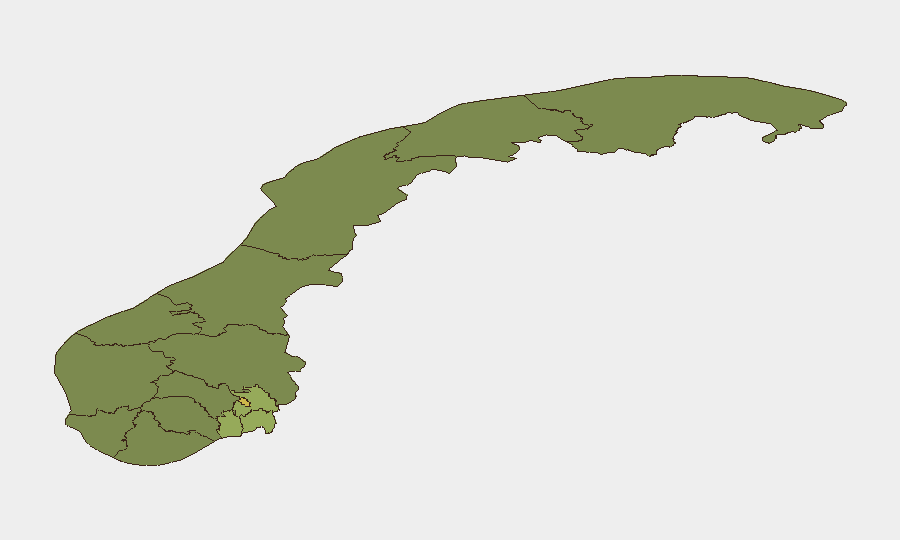
Situation Summary
Norway remains a low-threat environment globally (ranked #49) with no tracked major security events, but recent incidents signal localized disorder in urban centers and emerging border-security sensitivities in the Arctic. Oslo continues to drive national risk assessment, with a scheduled end to Armed Forces support to police on 15 August potentially affecting operational capacity during a period of elevated vigilance tied to regional geopolitical tensions. The last 48 hours have seen one confirmed border-security incident and continued scattered street-level violence in Oslo and surrounding counties, reflecting an established pattern rather than acute escalation.
Key Developments
- Russian soldier detained at Arctic border (14 August, 01:00 local time). Military border guards apprehended a Russian serviceman in his late 20s, reportedly a Ukraine-war veteran, after illegal crossing near Grense Jakobselv and Korpfjell, Finnmark. Police confirmed detention on suspicion of illegal border crossing; situation handled without incident. Reflects heightened attention to Arctic security channels and geopolitical sensitivity in Norway's far north.
- Armed Forces support to Oslo Police District formally ends (15 August 2026). Assistance requested in response to Middle East conflict and Ukraine war fallout is being withdrawn as scheduled. Police have stated readiness to manage demand independently, though this represents a reduction in available security resources during a period of demonstrated street-level volatility in the capital and surrounding regions.
- Scattered violence incidents in Oslo metropolitan area (7–9 August). Police responded to multiple reports: threat situation on bus in Trondheim (8 August), violence in Lindeberg, Oslo with one person detained (9 August), and armed robbery with weapons threat on Ågerøya, Lillesand (9 August, with two arrests). Pattern reflects endemic urban crime rather than organized campaign, but concentration in Oslo-Akershus corridor aligns with elevated sub-national risk scores.
- Knife-wielding fugitive manhunt in central Norway (11 August). A dangerous individual escaped from an institution in Lesja with a knife; police manhunt status unclear as of latest reporting. Incident highlights vulnerability of detention facilities and potential for acute public-safety incidents in smaller municipalities.
- Infrastructure resilience demonstrated: ID-Porten DDoS attack (3 August). Norwegian government digital-identity and e-service gateway experienced temporary disruption from distributed denial-of-service attack; service continuity maintained and no data breach reported. Reflects persistent cyber-threat surface facing critical Norwegian infrastructure.
Highest-Risk Areas
Oslo (risk 68) and surrounding Akershus county (52) dominate the national risk profile, driven by concentration of reported violence, robbery, and threat incidents. Østfold (48) and Vestfold (42) counties extend this pattern along the eastern and southwestern approaches to the capital, suggesting transit-corridor vulnerability. Risk scores correlate with urban population density and incident reporting density rather than organized criminal activity or political instability; however, the scheduled end of Armed Forces support to Oslo Police on 15 August may compress available response capacity during a period when street-level incidents remain active.
How GeoBit Would Assist
Organizations operating in Norway should deploy AOI Monitoring & Early Warning (persistent watch on Oslo, Akershus, and Østfold with configurable alerting for specific crime categories); Intel Sweep and multi-language OSINT fusion (real-time aggregation of police reports, local media, and regional feeds to filter signal from noise); and Routing & Network Analysis (alternative travel planning to avoid documented incident hotspots, particularly in Oslo metropolitan area and around Finnmark border zones). Maritime operators should monitor Arctic incident feeds given the Russian border crossing and ongoing geopolitical sensitivities in Norway's northern waters.
7-Day Outlook
Street-level violence and opportunistic robbery are expected to continue at current baseline levels in Oslo and surrounding counties; no acute escalation is forecast. Border vigilance in Finnmark will likely remain elevated given the recent Russian crossing. The removal of Armed Forces support to Oslo Police on 15 August may introduce a temporary operational adjustment, but police readiness statements suggest capacity continuity.
Highest-Risk Areas — Ranked
| # | State / Region | Risk |
|---|---|---|
| 1 | Oslo | 68 |
| 2 | Akershus | 52 |
| 3 | Østfold | 48 |
| 4 | Vestfold | 42 |
| 5 | Rogaland | 38 |
| 6 | Buskerud | 35 |
| 7 | Trøndelag | 32 |
| 8 | Telemark | 28 |
| 9 | Vestland | 27 |
| 10 | Agder | 26 |
| 11 | Møre og Romsdal | 22 |
| 12 | Innlandet | 20 |
Sources
Previous Daily Briefs
A new Norway brief is written every day — each with its own risk map and downloadable CSV. Here's the last week; use the calendar to go further back.
- August 14, 2026
- August 13, 2026
- August 12, 2026
- August 11, 2026
- August 10, 2026
- August 9, 2026
- August 8, 2026
📅 Browse every day by calendar →
Highlighted days have a brief. Tap a day for that day's map & analysis, or “csv” for that day's dataset ($5).
Atlas — our AI intelligence desk — emails them this snapshot personally. Nothing else, no list.