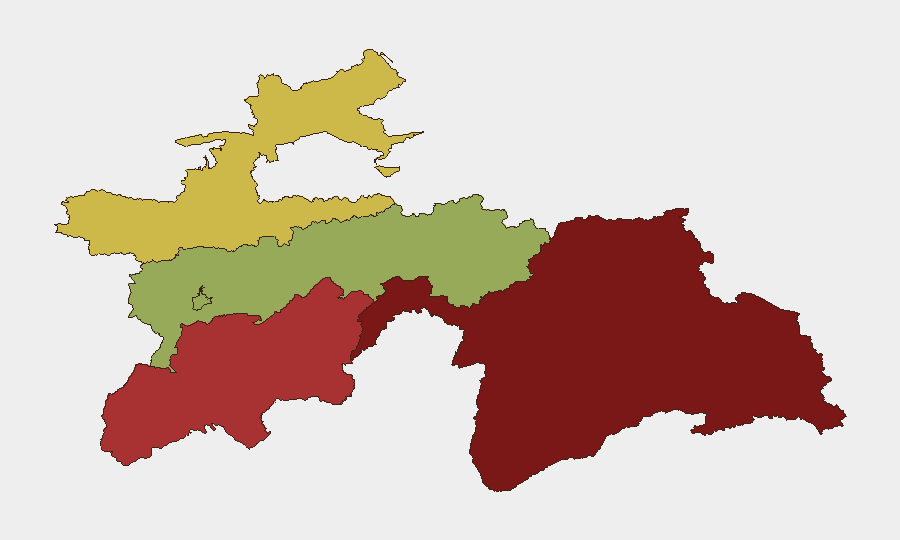
Situation Summary
Tajikistan maintains a stable, low-threat security environment as of 16 July 2026, with no confirmed security incidents, civil unrest, or infrastructure disruption reported in the last 24–48 hours. The country's composite threat score of 6 places it at rank #133 globally, reflecting persistent but manageable border-region vulnerabilities rather than acute nationwide instability. Risk concentration remains heavily skewed toward the Afghan border zone and Gorno-Badakhshan Autonomous Region, while the capital and populated lowland regions continue to operate under normal conditions.
Key Developments
- No confirmed discrete security incidents reported in Tajikistan during 16–15 July 2026. Open-source corroboration across diplomatic guidance, regional media, and social-intelligence channels identified no new clashes, attacks, protests, infrastructure failures, or crime events meeting verification thresholds in the last 24–48 hours.
- Afghan border areas (Gorno-Badakhshan, GBAO) – pattern alert, not new incident. Armed clashes, drug-trafficking violence, and sporadic militant activity along the Tajikistan–Afghanistan border remain documented as ongoing risks (first-half 2026 cumulative), but no verifiable new engagement or attack has been reported since 14 July.
- National political environment stable. Foreign-ministry and regional analysis confirm no active demonstrations, protests, or government crackdowns as of mid-July 2026; no credible social-media or news reports contradict this baseline.
- Energy-sector stress noted as medium-term vulnerability, not acute disruption. Regional energy reporting indicates Tajikistan faces fuel-reserve and supply pressure linked to upstream Russian-sector disruptions, but no sudden outage, fuel shortage event, or security-related infrastructure incident was reported on 14–15 July.
Highest-Risk Areas
Gorno-Badakhshan Autonomous Region (risk 92) and Khatlon Region (risk 78) dominate sub-national threat exposure, both driven by proximity to the porous Afghanistan border and associated drug-trafficking, armed-group activity, and sporadic cross-border clashes. Sughd Region (risk 65) faces secondary risk from similar border dynamics and transit-corridor vulnerabilities. Dushanbe (risk 42) and central Districts of Republican Subordination remain substantially lower-risk, reflecting state-police presence and urban-governance capacity. Organizations with operations in or movement through GBAO and southern Khatlon should treat border-zone travel and asset-location as persistent-risk items regardless of current incident absence.
How GeoBit Would Assist
Security and risk teams operating in Tajikistan would leverage GeoBit's AOI Monitoring & Early Warning capability to maintain persistent surveillance of GBAO and Afghan border crossings, enabling alert-based detection of emerging clashes or trafficking activity before broader intelligence surfaces. Intel Sweep, multi-language OSINT, and Telegram/X intelligence provide continuous situational awareness across diaspora reporting, local media, and activist networks, surfacing early signals of political instability or unrest. Routing & Network Analysis supports duty-of-care planning by identifying alternative movement corridors and real-time assessment of border-crossing and inter-regional transit risk, reducing exposure in high-risk sub-national zones.
7-Day Outlook
No indicators suggest deterioration in Tajikistan's security posture over the next seven days; the political and security baseline is expected to remain stable barring external shocks (e.g., major cross-border escalation from Afghanistan). Border-region volatility will persist as a chronic, managed risk rather than an acute threat driver. Monitoring should continue to focus on Afghan border activity, energy-sector strain, and any signals of political friction, with particular attention to GBAO transit corridors.
Highest-Risk Areas — Ranked
| # | State / Region | Risk |
|---|---|---|
| 1 | Gorno-Badakhshan Autonomous Region | 92 |
| 2 | Khatlon Region | 78 |
| 3 | Sughd Region | 65 |
| 4 | Districts of Republican Subordination | 58 |
| 5 | Dushanbe | 42 |
Sources
Previous Daily Briefs
A new Tajikistan brief is written every day — each with its own risk map and downloadable CSV. Here's the last week; use the calendar to go further back.
📅 Browse every day by calendar →
Highlighted days have a brief. Tap a day for that day's map & analysis, or “csv” for that day's dataset ($5).
Atlas — our AI intelligence desk — emails them this snapshot personally. Nothing else, no list.