Situation Summary
Tunisia remains at global threat rank #75 with a composite threat score of 21, driven primarily by ongoing insurgency and terrorism concerns in border and interior regions. No discrete security incidents have been confirmed in the current 24–48-hour window; however, persistent structural vulnerabilities in the western and southern governorates maintain elevated sub-national risk. The national security posture is stable relative to historical volatility, though border-adjacent zones and economically stressed interior regions continue to warrant heightened monitoring.
Key Developments
Current 24–48-hour event confirmation is limited by available intelligence; no independently verified new incidents have been identified within this window. Civil Protection recorded 646 interventions nationwide between 4–5 August 2026, including 164 firefighting operations, though these do not constitute discrete security or civil unrest events. Background reporting suggests ongoing environmental and public-health concerns in Gabès (pollution crisis with 200+ hospitalizations) and a reported security-related closure at Ras Jdir crossing, but neither item carries a precise recent timestamp from supplied sources. Security teams should note that absence of reported events does not indicate reduced threat; western border zones retain elevated activity and organizational capability. Recommend real-time AOI monitoring and Intel Sweep refresh to capture emerging developments in Kasserine, Jendouba, and Tataouine.
Highest-Risk Areas
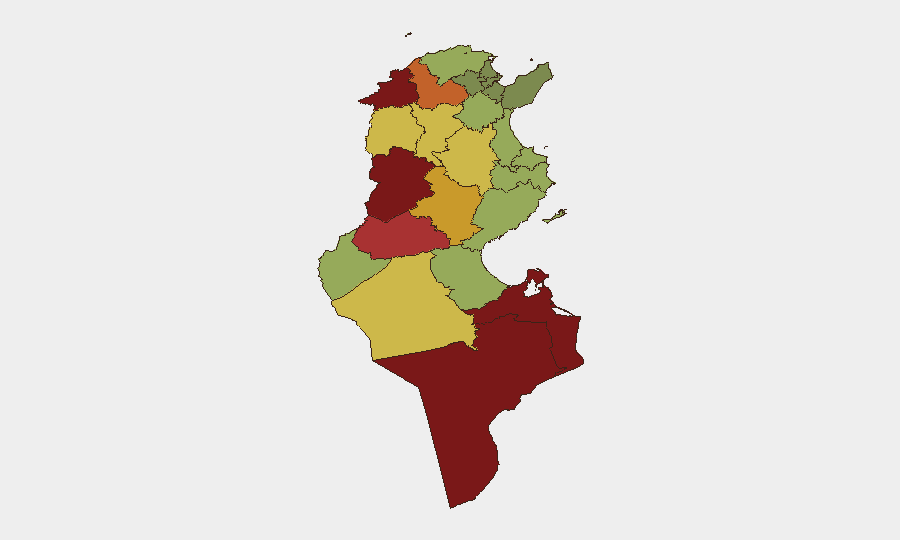
Kasserine, Jendouba, and Tataouine drive the composite risk ranking (scores 92, 88, and 85 respectively), reflecting persistent insurgent presence, cross-border supply networks, and limited state capacity in remote terrain. Médenine and Gafsa (83 and 78) extend the high-risk corridor southward through the Saharan interior, where smuggling routes, weapons proliferation, and extremist recruitment remain endemic. These six governorates account for nearly all sub-national threat density; by contrast, coastal and central zones (Tunis, Sfax, Sousse) register substantially lower composite scores. Risk concentration in the western and southern interior reflects both geography—proximity to Libyan and Algerian borders, terrain favoring non-state actors—and socioeconomic drivers: unemployment, limited services, and historical grievance.
How GeoBit Would Assist
Security teams managing personnel or assets in Tunisia should employ AOI Monitoring & Early Warning on Kasserine, Jendouba, and Tataouine to detect shifts in activity, movement, or operational tempo before incidents escalate. Intel Sweep and X/Telegram OSINT provide continuous horizon-scanning across Arabic-language and jihadist media channels, complemented by multi-language sentiment and temporal analysis to flag emerging narratives or recruitment signals. For asset protection and movement planning, Routing & Network Analysis can model safe corridors and identify choke points in high-risk governorates; GIS & Spatial Analysis supports facility siting and perimeter assessment in border-adjacent locations.
7-Day Outlook
No significant escalation is anticipated in the immediate term; however, summer seasonality often correlates with increased insurgent activity in remote zones as operational conditions improve. Monitoring should remain elevated in Kasserine and Jendouba through mid-August. Border crossings and civilian infrastructure in the southern interior remain vulnerable to opportunistic attack; duty-of-care protocols should be refreshed for any personnel transiting or stationed in ranked zones 1–5.
Highest-Risk Areas — Ranked
| # | State / Region | Risk |
|---|---|---|
| 1 | Kasserine | 92 |
| 2 | Jendouba | 88 |
| 3 | Tataouine | 85 |
| 4 | Médenine | 83 |
| 5 | Gafsa | 78 |
| 6 | Béja | 75 |
| 7 | Sidi Bouzid | 72 |
| 8 | Al Kaf | 70 |
| 9 | Kébili | 68 |
| 10 | Kairouan | 65 |
| 11 | Siliana | 62 |
| 12 | Tozeur | 58 |
Sources
Previous Daily Briefs
A new Tunisia brief is written every day — each with its own risk map and downloadable CSV. Here's the last week; use the calendar to go further back.
📅 Browse every day by calendar →
Highlighted days have a brief. Tap a day for that day's map & analysis, or “csv” for that day's dataset ($5).
Atlas — our AI intelligence desk — emails them this snapshot personally. Nothing else, no list.