Situation Summary
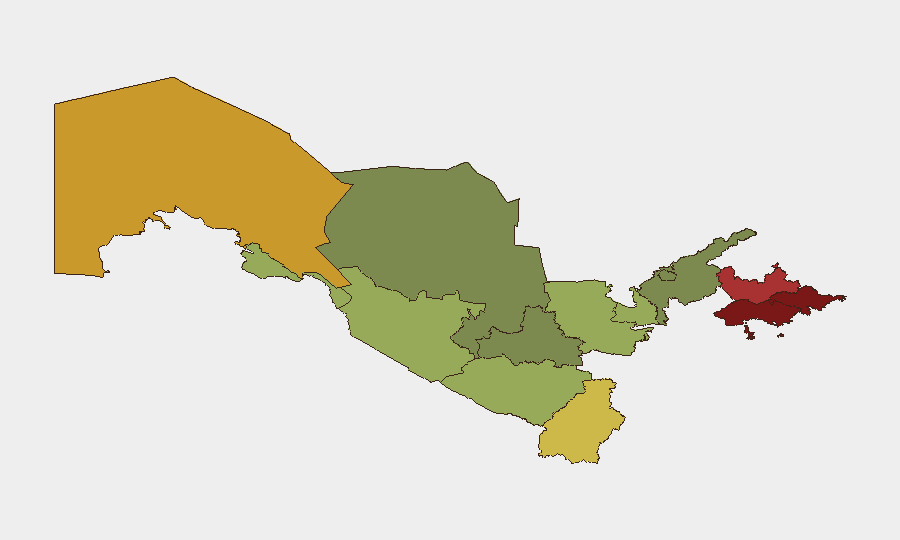
Uzbekistan remains stable with no acute nationwide security incidents reported in the last 24–48 hours. Current risk is concentrated in the Fergana Valley (Andijan, Fergana, and Namangan regions), where composite threat scores of 78–88 reflect historical terrorism, border tensions, and transnational crime networks. Routine infrastructure disruptions in Tashkent and localized crime incidents do not signal systemic instability; however, elevated activity in neighboring Afghanistan and Pakistan is prompting Uzbekistan to recalibrate regional trade routes and deepen security cooperation with China.
Key Developments
- Tashkent city – power supply disruptions | 26 Jul 2026
A special commission was formed to investigate electricity outages affecting parts of Tashkent's grid. The Ministry of Energy confirmed fuel reserves are adequate for 2–3 months, indicating a grid-management or generation issue rather than fuel shortage. Short-term business and residential service risk.
- Tashkent city – infrastructure collapse | 26 Jul 2026
A ground collapse at a construction site ruptured a main sewer line, triggering emergency service deployment and localized utility service disruption. No fatalities reported; isolated urban-safety incident.
- Jizzakh region – corruption enforcement | 26 Jul 2026
A road inspection officer was fined 20.6 million soum for accepting a 100,000 soum bribe. Reflects ongoing anti-corruption enforcement activity; no broader civil-unrest dimension.
- Tashkent city – extortion case | 26 Jul 2026
Police detained a suspect accused of blackmailing an 18-year-old woman and demanding USD 300. Routine crime incident; no systemic security implications.
- China–Uzbekistan security cooperation statement | 24–25 Jul 2026
Chinese Foreign Minister Wang Yi met his Uzbek counterpart in Beijing and called for deeper counter-terrorism and regional-stability cooperation. Reflects strategic concern about Afghanistan and the broader Central Asian environment, not an immediate incident inside Uzbekistan.
- Afghanistan–Uzbekistan border economic talks | 25–26 Jul 2026
Uzbekistan's Deputy PM met Afghanistan's Deputy PM in Kabul to discuss transit, customs, and energy projects, including a proposed USD 50 million zinc plant in Hairatan. Indicates closer cross-border infrastructure engagement; may affect future border-security dynamics.
- Pakistan–Uzbekistan–China trade rerouting | 24–26 Jul 2026
Pakistan and Uzbekistan agreed to redirect part of bilateral trade through China due to deteriorating security on traditional Afghanistan and Iran routes. Reflects elevated risk in neighboring states; does not signal new internal Uzbek instability.
Highest-Risk Areas
The Fergana Valley—comprising Andijan (risk 88), Fergana (82), and Namangan (78) regions—accounts for the highest sub-national threat scores. These areas have long-standing vulnerability to militant recruitment, cross-border trafficking, and clan-based disputes. Karakalpakstan (risk 72) and Surxondaryo (risk 65) carry secondary concerns related to border permeability and economic marginalization. Southern and central regions (Samarqand, Bukhara, Navoiy) remain substantially lower-risk, reflecting better economic integration and state capacity.
How GeoBit Would Assist
Teams with staff or supply chains in Uzbekistan should deploy Intel Sweep and multi-language OSINT to monitor Fergana Valley actors, militant networks, and border-trafficking indicators on an ongoing basis. AOI Monitoring & Early Warning on high-risk regions (particularly Andijan and Hairatan border) combined with Network & Actor Analysis of transnational criminal and extremist groups would provide advance notice of escalation. Routing & Network Analysis can identify secure, alternative supply-chain and personnel-movement corridors if traditional routes become compromised.
7-Day Outlook
No indicators suggest imminent nationwide escalation. However, deepening Uzbek–Chinese security cooperation and Afghanistan–Uzbekistan border engagement may increase cross-border enforcement activity and checkpoint scrutiny over the near term. Personnel and logistics teams should anticipate possible temporary transit delays at Hairatan and other border crossings as new coordination mechanisms are operationalized.
Highest-Risk Areas — Ranked
| # | State / Region | Risk |
|---|---|---|
| 1 | Andijan Region | 88 |
| 2 | Fergana Region | 82 |
| 3 | Namangan Region | 78 |
| 4 | Republic of Karakalpakstan | 72 |
| 5 | Surxondaryo Region | 65 |
| 6 | Qashqadaryo Region | 58 |
| 7 | Sirdaryo Region | 55 |
| 8 | Jizzakh Region | 48 |
| 9 | Xorazm Region | 45 |
| 10 | Bukhara Region | 42 |
| 11 | Navoiy Region | 38 |
| 12 | Samarqand Region | 35 |
Sources
Previous Daily Briefs
A new Uzbekistan brief is written every day — each with its own risk map and downloadable CSV. Here's the last week; use the calendar to go further back.
📅 Browse every day by calendar →
Highlighted days have a brief. Tap a day for that day's map & analysis, or “csv” for that day's dataset ($5).
Atlas — our AI intelligence desk — emails them this snapshot personally. Nothing else, no list.