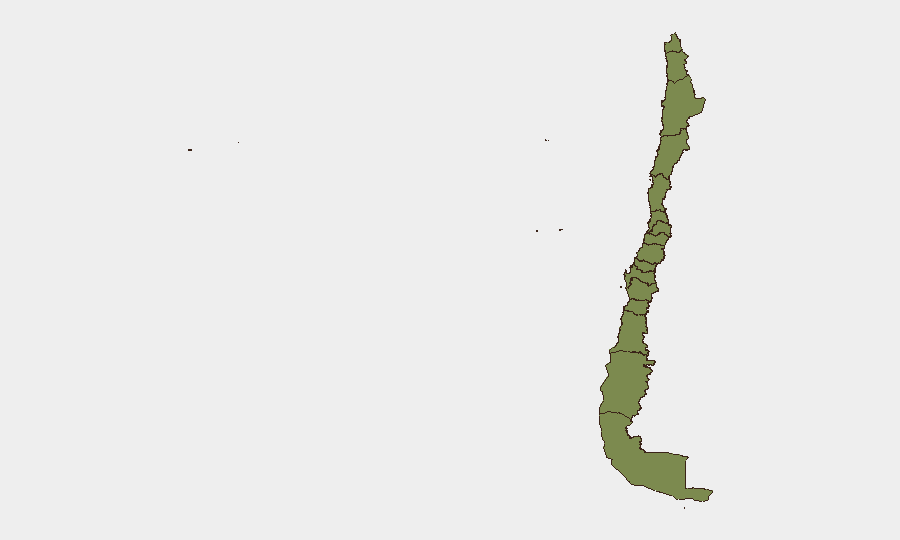
Situation Summary
Chile remains a low-threat environment globally (composite score 13; rank #null), with security conditions characterized by routine crime, police operations, and localized civil-order incidents rather than systemic instability or organized conflict. Risk is heavily concentrated in Santiago Metropolitan Region (score 31.3), which accounts for the majority of tracked threat events, while 11 other regions show minimal but comparable baseline risk (1.3–2.1 each). Recent government reporting (late July) indicates operational gains—17% drop in homicides, 45% reduction in kidnappings, and 60% increase in drug seizures—alongside ongoing police and rescue operations in flood-affected areas. The security trajectory remains stable, with no indicators of escalating civil unrest or transnational conflict spilling into Chilean territory at this time.
Key Developments
- Santiago Metropolitan Region, 27 July 2026 (reported): Government released national security balance showing a major operation against a 3D-printed-weapons network, resulting in ~100 judicial orders, 58 arrests, and ~90 firearms seized across recent weeks. Operational scope suggests sustained PDI and prosecutorial focus on illegal arms trafficking networks.
- Multiple regions, up to 27 July 2026: Police and aerial rescue operations ongoing in flood-affected areas following heavy rains, with more than 20 aerial rescues and approximately 60 evacuations documented. Indicates active disaster-response demand on security and emergency services.
- Maule Region (Talca), late July 2026: Two stabbing incidents under PDI homicide investigation; one fatality and one serious injury recorded. Precise date within the last 48 hours cannot be confirmed from available sources.
- Nationwide, July 2026 (specific date not confirmed): PDI and Public Prosecutor's Office conducted joint operation dismantling a faction of the Aragua Train, arresting more than 30 members. Operation reflects continued prosecutorial action against transnational criminal networks.
Data Caveat: Open-source and accessible web signals do not provide sufficient precise time-stamping to confidently isolate specific security incidents occurring on 30 July–1 August 2026. The events listed above are recent (late July) and operationally relevant, but cannot be rigorously confirmed as having occurred within the last 24–48 hours. Duty-of-care teams should rely on real-time alerts and direct liaison channels for sub-24-hour incident confirmation.
Highest-Risk Areas
Santiago Metropolitan Region dominates Chile's threat profile with a composite risk score of 31.3—more than eight times higher than Antofagasta Region (3.8), the second-ranked area. This concentration reflects Santiago's size, population density, and density of criminal networks, cash flows, and institutional targets. Antofagasta, Biobio, and the five northern/southern regions with scores of 1.3–2.1 show baseline crime and civil-order activity but do not present elevated or differentiated risk. For corporate operations and personnel, Santiago remains the primary geographic focus for protective measures; other regions warrant standard duty-of-care vigilance but do not require heightened alert posture at this time.
How GeoBit Would Assist
Corporate security and risk teams operating in Chile should use Intel Sweep and global event feeds to track real-time crime, police operations, and civil-order incidents at the sub-national level, combined with AOI Monitoring & Early Warning for persistent watch over Santiago and key logistics hubs. Network & Actor Analysis would map criminal organizations (e.g., Aragua Train factions, arms networks) and their operational geography, while GIS & Spatial Analysis and alternative routing capabilities would support duty-of-care planning and contingency access routes around high-risk zones. Sentiment & temporal analysis across Spanish-language social media and local news feeds would provide early signals of protest activity or civil unrest before escalation.
7-Day Outlook
No significant escalation in national or regional security conditions is anticipated over the next seven days. Routine police operations, flood-recovery efforts, and baseline crime activity will likely continue; Santiago will remain the primary area of operational focus. Duty-of-care teams should maintain standard monitoring protocols and update personnel on localized incidents via real-time feeds.
Highest-Risk Areas — Ranked
| # | State / Region | Risk |
|---|---|---|
| 1 | Santiago Metropolitan Region | 31.3 |
| 2 | Antofagasta Region | 3.8 |
| 3 | Biobio Region | 2.1 |
| 4 | Valparaiso Region | 1.3 |
| 5 | Coquimbo Region | 1.3 |
| 6 | Atacama Region | 1.3 |
| 7 | Aysen del General Carlos Ibanez del Campo Region | 1.3 |
| 8 | Los Lagos Region | 1.3 |
| 9 | Magallanes and Chilean Antarctica Region | 1.3 |
| 10 | O'Higgins Region | 1.3 |
| 11 | Maule Region | 1.3 |
| 12 | Nuble Region | 1.3 |
Sources
Previous Daily Briefs
A new Chile brief is written every day — each with its own risk map and downloadable CSV. Here's the last week; use the calendar to go further back.
📅 Browse every day by calendar →
Highlighted days have a brief. Tap a day for that day's map & analysis, or “csv” for that day's dataset ($5).
Atlas — our AI intelligence desk — emails them this snapshot personally. Nothing else, no list.