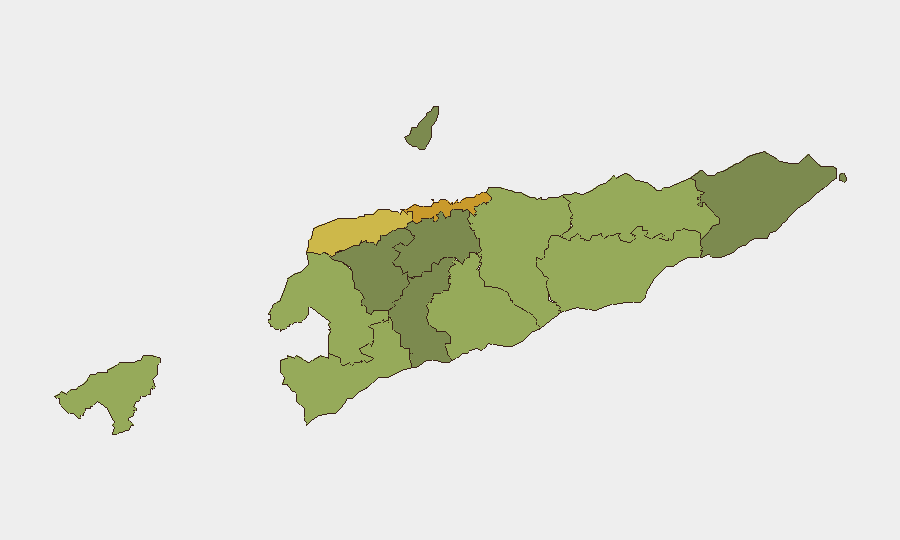
Situation Summary
East Timor remains a stable, low-threat environment with no significant security incidents reported in the last 24–48 hours. The country's composite threat score of 4 (global rank #177) reflects a generally benign baseline; routine crime and localized social friction occur but do not pose widespread destabilizing risk to foreign nationals or corporate operations. The security landscape is concentrated in Dili and western border districts, where historical clan tensions and petty crime warrant standard duty-of-care protocols rather than elevated alert.
Key Developments
No clearly documented, verifiable security, crime, civil unrest, or infrastructure incidents were identified in open-source reporting for 24–48 hours ending 2026-08-23. Standard monitoring channels (government announcements, major news outlets, social media) have not surfaced new incidents in this window. Routine low-level crime and minor local disturbances may occur but are not being captured in available reporting. Personnel and asset security measures should remain calibrated to baseline protocols rather than incident-driven response.
Highest-Risk Areas
Dili (risk score 72) and Liquiçá (62) drive the country's overall risk profile, reflecting higher concentrations of petty theft, street crime, and occasional interpersonal violence typical of urban and semi-urban centers. Baucau (58) and Cova Lima (55) in the east and west respectively show elevated but secondary risk, largely tied to border proximity, informal settlement tensions, and limited police capacity in remote areas. Remaining districts score below 50, indicating substantially lower incident frequency. Risk concentration in capital and border zones is a function of population density, informal economies, and historical inter-community friction rather than organized political instability or terrorism.
How GeoBit Would Assist
Intel Sweep and OSINT Fusion would enable continuous monitoring of Dili, Liquiçá, and border districts for early signals of gang activity, protest organizing, or clan-related incidents, synthesizing open-source media, social platforms (X, Telegram), and local radio traffic. AOI Monitoring & Early Warning on the western border (Cova Lima, Oecussi-Ambeno) and Dili's high-crime neighborhoods would provide persistent watch with automated alerting of new incidents, reducing response latency for duty-of-care teams. Network & Actor Analysis would map informal power structures, criminal networks, and community leaders in high-risk zones, enabling security teams to anticipate localized friction and route personnel or assets away from flashpoints in real time.
7-Day Outlook
No indicators of escalating instability or near-term incidents are evident. The security picture is expected to remain stable, with baseline crime and minor community-level disputes the primary risk to operations. Standard corporate security protocols—incident reporting from field staff, liaison with local authorities, personnel movement coordination in Dili and Liquiçá—remain appropriate and sufficient for the foreseeable week.
Highest-Risk Areas — Ranked
| # | State / Region | Risk |
|---|---|---|
| 1 | Dili | 72 |
| 2 | Liquiçá | 62 |
| 3 | Baucau | 58 |
| 4 | Cova Lima | 55 |
| 5 | Bobonaro | 53 |
| 6 | Oecussi-Ambeno | 48 |
| 7 | Manufahi | 45 |
| 8 | Viqueque | 42 |
| 9 | Manatuto | 40 |
| 10 | Ainaro | 38 |
| 11 | Ermera | 36 |
| 12 | Aileu | 32 |
Sources
Previous Daily Briefs
A new East Timor brief is written every day — each with its own risk map and downloadable CSV. Here's the last week; use the calendar to go further back.
- August 20, 2026
- August 18, 2026
- August 16, 2026
- August 14, 2026
- August 12, 2026
- August 10, 2026
- August 8, 2026
📅 Browse every day by calendar →
Highlighted days have a brief. Tap a day for that day's map & analysis, or “csv” for that day's dataset ($5).
Atlas — our AI intelligence desk — emails them this snapshot personally. Nothing else, no list.