Situation Summary
Estonia remains a low-threat jurisdiction globally (rank #94, composite score 13) with no active tracked security events as of 2026-08-07. However, recent reporting indicates elevated migration-enforcement activity and localized natural-disaster response, concentrated in border regions and major urban centers. The security picture reflects routine administrative and weather-related incidents rather than systemic instability, though migration pressure and border-zone volatility merit continued monitoring.
Key Developments
- Narva, 4 Aug — Police detained a man accused of vandalism after he allegedly smashed windows and glass doors of retail and service businesses with a hammer; suspect held in custody pending investigation.
- Tallinn (Central), 4 Aug — Police apprehended approximately ten individuals with no legal basis to remain in Estonia; reporting noted Somali nationals were among those detained, reflecting recent migration pressure.
- Nõmme (Tallinn suburb), 6 Aug (reported 7 Aug) — Estonian police (PPA) detained 15 suspected illegal migrants; police statement indicated the incident was not isolated and similar cases had occurred elsewhere.
- Mõisaküla, Viljandi County, 6 Aug — Police detained a man on suspicion of violence against a public official; court authorized his arrest pending trial.
- Nationwide enforcement surge, 6–7 Aug reporting — Police reported apprehending 99 individuals over the preceding two weeks whom they assessed had no legal right to be in Estonia; additional identity and status checks were being conducted across the country.
- South-eastern border zone, 7 Aug — Authorities completed two additional sections of land-border infrastructure with Russia, framed as a security measure against migration pressure.
- Tõrva, 4–5 Aug — Emergency services evacuated ten residents following heavy rainfall and localized flooding; no casualties reported.
- Countrywide, 4 Aug — Four separate traffic crashes across Estonia injured seven people; incidents classified as routine road-safety events.
Highest-Risk Areas
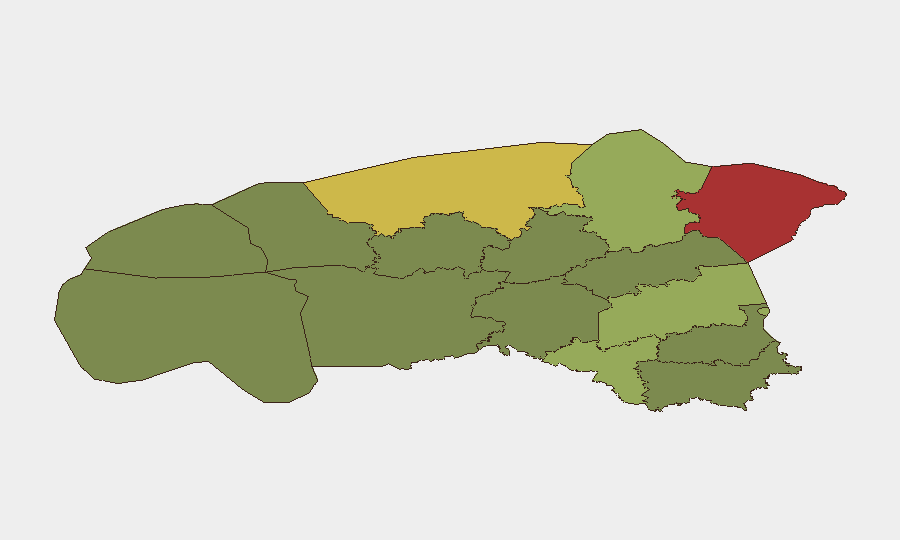
Ida-Viru County (risk 78) and Harju County (risk 68) drive Estonia's sub-national risk profile. Ida-Viru's elevated score reflects its proximity to the Russian border and established patterns of cross-border migration pressure, as evidenced by recent border-infrastructure investment and enforcement activity. Harju County, which encompasses greater Tallinn, concentrates national administrative, economic, and population density and has seen the highest volume of recent migrant-detention incidents. Tartu County (58) and Valga County (55) also warrant monitoring as secondary corridors for migration and cross-border movement. All other counties register materially lower risk and reflect baseline administrative and weather exposure only.
How GeoBit Would Assist
Security teams operating in Estonia would benefit from AOI Monitoring & Early Warning on border regions (Ida-Viru, Valga) and entry hubs (Tallinn/Harju) to detect emerging migration flows, enforcement surges, or border incidents in near-real time. OSINT and multi-language search across Estonian media, government announcements, and social platforms would provide continuous situational awareness of policy changes, enforcement operations, and incident trends. Sentiment & temporal analysis on local news and official channels would flag escalation patterns or shifts in threat posture that might affect duty-of-care obligations for staff or assets in high-risk counties.
7-Day Outlook
Migration enforcement and border-zone activity will likely remain the primary security driver over the coming week, with continued police operations and infrastructure investment signaling sustained pressure on the Russia–Estonia boundary. Weather-related incidents (flooding, transport disruption) may recur if rainfall patterns persist in southern and eastern regions. No indicators suggest imminent large-scale unrest or systemic instability; the environment remains permissive for routine business continuity in lower-risk counties.
Highest-Risk Areas — Ranked
| # | State / Region | Risk |
|---|---|---|
| 1 | Ida-Viru County | 78 |
| 2 | Harju County | 68 |
| 3 | Tartu County | 58 |
| 4 | Valga County | 55 |
| 5 | Lääne-Viru County | 52 |
| 6 | Pärnu County | 35 |
| 7 | Rapla County | 32 |
| 8 | Jõgeva County | 30 |
| 9 | Järva County | 28 |
| 10 | Viljandi County | 25 |
| 11 | Põlva County | 22 |
| 12 | Võru County | 18 |
Sources
Previous Daily Briefs
A new Estonia brief is written every day — each with its own risk map and downloadable CSV. Here's the last week; use the calendar to go further back.
📅 Browse every day by calendar →
Highlighted days have a brief. Tap a day for that day's map & analysis, or “csv” for that day's dataset ($5).
Atlas — our AI intelligence desk — emails them this snapshot personally. Nothing else, no list.