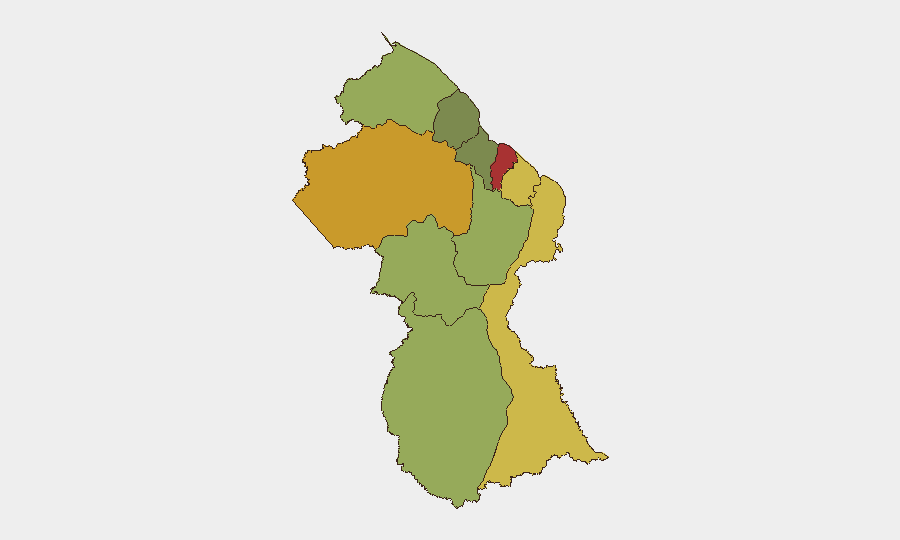
Situation Summary
Guyana remains a low-threat environment globally (rank #108), but is experiencing acute political-security tension following a joint police and coast guard operation on the Demerara River late 25 August that resulted in the detention of opposition leader Azruddin Mohamed and subsequent arrest of opposition MP Natasha Singh-Lewis on firearms charges. The incident has triggered opposition allegations of state abuse of power and heightened sensitivity around detention authorities. A suspected arson attack on a residential property in Corentyne on 26 August and an unspecified operational pause at an ExxonMobil offshore facility add to a pattern of localized instability, though no mass civil unrest has been reported as of 27 August.
Key Developments
- Demerara River, Friendship wharf (East Bank Demerara) – 25–26 August: Joint Services intercepted a high-speed "go-fast" vessel operated by opposition leader Azruddin Mohamed at approximately 9:45 p.m. on 25 August; vessel failed to stop when signalled and was pursued and detained for missing registration, fitness certificate, and captain's licence. Mohamed was taken into custody and released on GYD 100,000 bail on 26 August. A bag reportedly thrown overboard during pursuit remains outstanding.
- Farm Police Station (East Bank Demerara) – early morning 26 August: Opposition MP Natasha Singh-Lewis arrested approximately 1:30 a.m. after police discovered a firearm in her vehicle during follow-up operations; released on GYD 200,000 bail. This arrest compounds political tensions linked to the Demerara River operation.
- Friendship, East Bank Demerara – night of 25–26 August: Six-hour confrontation between Joint Services personnel and opposition figures at the wharf; opposition statements allege harassment and intimidation, while official releases frame it as lawful enforcement. The episode has triggered a political standoff between opposition and security forces.
- Corentyne, Berbice – night of 26 August: Family of six escaped a suspected firebomb attack on their home; no injuries reported, but incident represents a targeted property attack with clear safety implications in that locality.
- Offshore Guyana (ExxonMobil facility) – 25 August: Government announced probe into onboard incident with floating production vessel; operations suspended with all personnel accounted for and no injuries reported. Likely to trigger increased regulatory scrutiny of offshore energy infrastructure.
- National level (Georgetown media) – 26–27 August: Editorial commentary warns against potential abuse of extended detention powers (up to 90 days under security law provisions); growing regional and domestic concern over the political use of security apparatus, particularly given opposition leader Mohamed's position as head of the second-largest party by vote share.
Highest-Risk Areas
Demerara-Mahaica (risk 78) and Cuyuni-Mazaruni (risk 72) are the highest-risk sub-national zones, reflecting concentration of economic, political, and maritime activity in the coastal Demerara region and interior mining/trafficking exposure in the hinterland. The Demerara River interception and subsequent arrests occur in Demerara-Mahaica, the country's political and commercial centre; the Corentyne arson attack falls within East Berbice-Corentyne (risk 62), a border region historically exposed to trafficking and transnational crime. Together, these locations account for the bulk of organized crime, drug-trafficking, and political instability signals.
How GeoBit Would Assist
A corporate security team monitoring Guyana would deploy AOI Monitoring & Early Warning on Demerara-Mahaica and Cuyuni-Mazaruni to flag emerging tension around opposition activity, detention, and potential retaliation. Network & Actor Analysis and OSINT Fusion (X/Twitter, local media, Telegram) would track political-security actor statements and sentiment shifts in real time. Maritime & Aviation Tracking and Shodan surveillance of port and offshore facility access would provide early warning of further joint-services operations or security incidents affecting personnel or supply chains.
7-Day Outlook
The political temperature is expected to remain elevated over the next week as bail conditions, investigations, and opposition responses unfold. If additional arrests or detention orders occur, or if the offshore energy sector faces supply-chain disruption, risk to corporate operations will escalate. Absent major new provocations or civil mobilization, the situation is likely to stabilize into a slower-burn political dispute by early September.
Highest-Risk Areas — Ranked
| # | State / Region | Risk |
|---|---|---|
| 1 | Demerara-Mahaica | 78 |
| 2 | Cuyuni-Mazaruni | 72 |
| 3 | Mahaica-Berbice | 65 |
| 4 | East Berbice-Corentyne | 62 |
| 5 | Upper Demerara-Berbice | 58 |
| 6 | Potaro-Siparuni | 48 |
| 7 | Barima-Waini | 45 |
| 8 | Upper Takutu-Upper Essequibo | 42 |
| 9 | Pomeroon-Supenaam | 38 |
| 10 | Essequibo Islands | 35 |
Sources
Previous Daily Briefs
A new Guyana brief is written every day — each with its own risk map and downloadable CSV. Here's the last week; use the calendar to go further back.
- August 25, 2026
- August 23, 2026
- August 21, 2026
- August 19, 2026
- August 17, 2026
- August 15, 2026
- August 13, 2026
📅 Browse every day by calendar →
Highlighted days have a brief. Tap a day for that day's map & analysis, or “csv” for that day's dataset ($5).
Atlas — our AI intelligence desk — emails them this snapshot personally. Nothing else, no list.