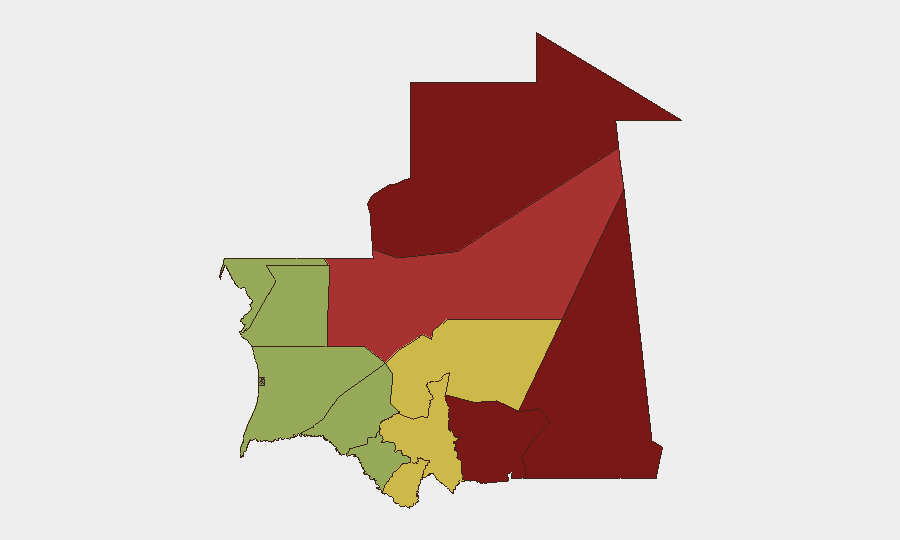
Situation Summary
Mauritania remains a low-frequency event environment with a global threat ranking of #114 (composite score 16). The past week produced no reportable security incidents; the country's risk profile is dominated by persistent transnational threats in remote border regions rather than acute domestic instability. Government activity centered on diplomatic engagement (UN General Assembly statements, International Day of Peace programming) and infrastructure priorities, with no indication of immediate internal security degradation.
Key Developments
- Nouakchott — September 28: Government continued balancing diplomatic relations with Algeria and Morocco while pursuing transport-infrastructure upgrades, signaling stable internal governance but ongoing sensitivity to regional geopolitical positioning.
- Nouakchott — September 26: Foreign Minister Mohamed Salem Ould Merzouk addressed the UN General Assembly on Security Council reform and Middle Eastern diplomacy, reflecting Mauritania's current diplomatic posture without evidence of domestic security concerns.
- Nouakchott — September 23–29: Government and UN partners conducted International Day of Peace activities across Nouakchott, Bassikounou, and Rosso, indicating routine civic programming with no reported unrest or incident.
Highest-Risk Areas
Tiris Zemmour (risk 95), Hodh Ech Chargui (85), and Hodh El Gharbi (80) collectively drive Mauritania's sub-national threat profile. These eastern and southeastern border regions face entrenched exposure to transnational threats—armed group activity, smuggling networks, and cross-border militant transit—linked to instability in Mali, Algeria, and Libya. Adrar (78) and Tagant (68) extend this risk corridor along the northern and central Sahel margins. Infrastructure in these areas remains sparse, governance presence limited, and monitoring capability constrained. Western regions (Trarza, Brakna, Dakhlet Nouadhibou) present significantly lower but non-trivial risk, primarily from coastal trafficking and petty crime rather than militant activity.
How GeoBit Would Assist
Security teams operating in or responsible for Mauritania should leverage AOI Monitoring & Early Warning with persistent watch over Tiris Zemmour and the Hodh regions to flag cross-border movement, armed-group positioning, and trafficking routes; Intel Sweep and multi-language OSINT fusion to detect early signals of destabilization, smuggling-network activity, or militant presence before they escalate; and GIS & Spatial Analysis to map safe routing, assess access to key sites, and understand geographic constraints on movement and resupply. Complementary Network & Actor Analysis on regional militant and criminal organizations will clarify threat proximity and capability relative to specific assets or personnel.
7-Day Outlook
No acute deterioration is expected in the near term. The country's diplomatic engagement and infrastructure focus suggest functional governance stability. Risk trajectory remains driven by chronic, slow-moving transnational threats in border zones rather than sudden internal shocks; security teams should sustain baseline vigilance on cross-border smuggling, militia activity in the east, and periodic banditry, without anticipating imminent systemic crisis. Monitoring of regional instability in Mali and Libya will remain the primary early-warning indicator for secondary spillover into Mauritania.
Highest-Risk Areas — Ranked
| # | State / Region | Risk |
|---|---|---|
| 1 | Tiris Zemmour | 95 |
| 2 | Hodh Ech Chargui | 85 |
| 3 | Hodh El Gharbi | 80 |
| 4 | Adrar | 78 |
| 5 | Tagant | 68 |
| 6 | Guidimaka | 65 |
| 7 | Assaba | 62 |
| 8 | Gorgol | 58 |
| 9 | Trarza | 55 |
| 10 | Inchiri | 52 |
| 11 | Brakna | 48 |
| 12 | Dakhlet Nouadhibou | 45 |
Sources
Previous Weekly Briefs
A new Mauritania brief is written every Monday, covering the week — each with its own risk map and downloadable CSV. Use the calendar to go further back.
- September 22, 2026
- September 15, 2026
- September 8, 2026
- September 2, 2026
- August 31, 2026
- August 28, 2026
- August 26, 2026
📅 Browse past briefs by calendar →
Highlighted days have a brief. Tap a day for that day's map & analysis, or “csv” for that day's dataset ($5).
Atlas — our AI intelligence desk — emails them this snapshot personally. Nothing else, no list.