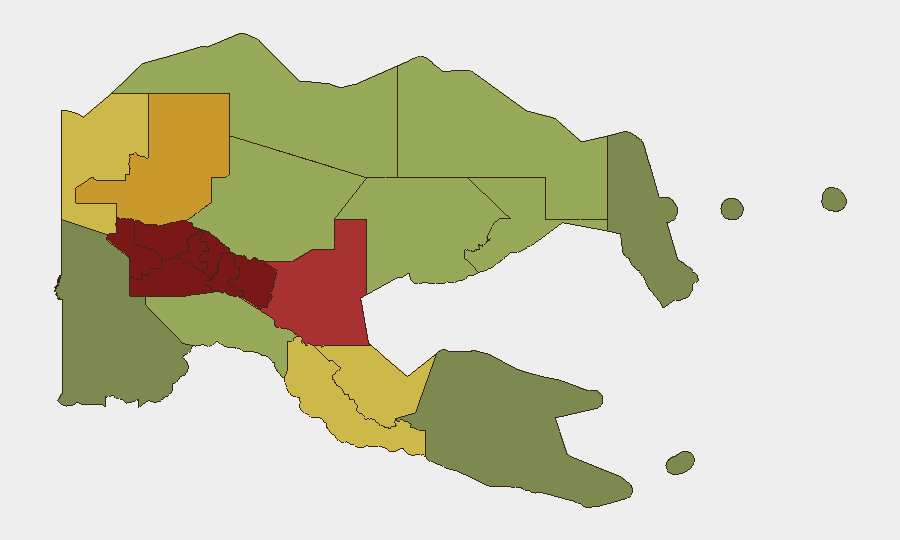
Situation Summary
Papua New Guinea remains a stable but fragmented security environment, ranked #83 globally with a composite threat score of 21. No major national-level incidents have been reported in the last 24–48 hours; however, localised tribal violence and youth crime continue as persistent baseline threats, particularly in the Highlands provinces and Port Moresby. The country's primary vulnerabilities stem from porous law enforcement capacity, inter-communal tensions, and geographic fragmentation rather than coordinated insurgency or organised crime networks.
Key Developments
- West New Britain Province – Offshore seismic activity, 24–25 August 2026. Two magnitude 5.0 and 4.9 earthquakes were recorded off Kimbe and near Panguna (Bougainville) on 24–25 August. No tsunami, casualties, or major infrastructure damage have been reported in open sources; maritime and port operations may experience brief operational delays.
- Enga Province – Judicial sentencing in ongoing tribal-violence cycle, 25 August 2026. A 22-year-old man from Laiagam was sentenced to 50 years' imprisonment for two killings linked to tribal retaliation. The Provincial Police Commander publicly warned that law enforcement will "not permit retaliatory killings," signalling official acknowledgment of continuing communal violence and intent to escalate deterrence.
- Port Moresby – Student violence uptick confirmed, statement dated 21 August 2026. The NCD Metropolitan Command issued a public statement condemning a "recent increase in school fights and violent behaviour involving students" in the capital, indicating a trend of youth-focused assaults and gang activity rather than a discrete 24–48-hour incident.
- Enga Province – Unconfirmed tribal fatality report, timing unclear. One media aggregation references five people killed in a "bloody tribal fight" in Enga, but the exact incident date cannot be independently verified from available snippets and may predate the 24–48-hour window; treat as indicative pending source confirmation.
Highest-Risk Areas
The Southern Highlands, Enga, Hela, and Eastern Highlands provinces form a high-risk belt across PNG's Highlands region, with composite risk scores ranging from 98 to 92. This concentration reflects entrenched tribal and inter-communal conflict, limited state police presence, and cycles of retaliatory violence that courts and law enforcement struggle to interrupt. The National Capital District (risk 85) remains elevated due to urban gang activity, youth violence, and petty crime; Morobe and East Sepik represent mid-tier risks from similar dynamics. Coastal and maritime regions show lower intrinsic risk but remain vulnerable to natural hazards and disruption from seismic activity.
How GeoBit Would Assist
Security teams operating in PNG should deploy AOI Monitoring & Early Warning on Highlands provinces and Port Moresby to detect emerging violence clusters and tribal clashes before they escalate; multi-language OSINT and social-media intelligence (X/Twitter, Facebook, WhatsApp aggregation where available) will improve detection speed relative to formal media. GIS & Spatial Analysis linked to Conflict & Military mapping capabilities can help identify temporal and geographic patterns in tribal incidents and correlate them with provincial police deployments, enabling duty-of-care teams to avoid high-risk corridors and time asset movements to lower-threat windows.
7-Day Outlook
No major national security escalation is anticipated in the next seven days. Tribal violence in the Highlands will likely persist at baseline intensity; seismic activity in offshore zones may continue but poses low risk to overland transport and population centers. Corporate security should maintain routine vigilance in Port Moresby and the Highlands, monitor local law-enforcement announcements, and use alternative-route planning if operations depend on road or port transit in affected provinces.
Highest-Risk Areas — Ranked
| # | State / Region | Risk |
|---|---|---|
| 1 | Southern Highlands | 98 |
| 2 | Enga | 96 |
| 3 | Hela | 94 |
| 4 | Eastern Highlands | 92 |
| 5 | Western Highlands | 90 |
| 6 | Jiwaka | 88 |
| 7 | National Capital District | 85 |
| 8 | Simbu | 82 |
| 9 | Morobe | 78 |
| 10 | East Sepik | 72 |
| 11 | Sandaun | 68 |
| 12 | Oro | 66 |
Sources
Previous Daily Briefs
A new Papua New Guinea brief is written every day — each with its own risk map and downloadable CSV. Here's the last week; use the calendar to go further back.
- August 23, 2026
- August 21, 2026
- August 19, 2026
- August 17, 2026
- August 15, 2026
- August 13, 2026
- August 11, 2026
📅 Browse every day by calendar →
Highlighted days have a brief. Tap a day for that day's map & analysis, or “csv” for that day's dataset ($5).
Atlas — our AI intelligence desk — emails them this snapshot personally. Nothing else, no list.