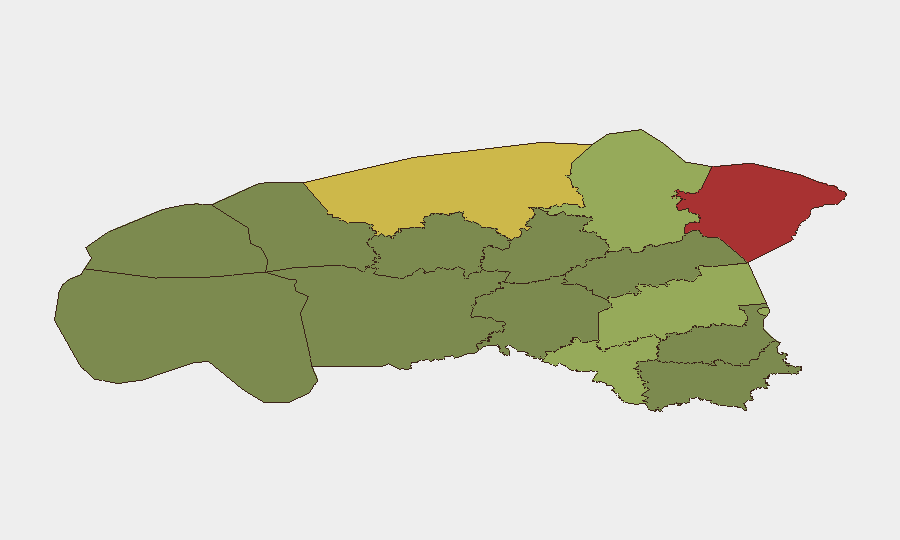
Situation Summary
Estonia remains at low global threat rank (#101, composite score 13) with no tracked security events of national significance. However, sustained illegal migration pressure along the Latvia–Belarus border and associated detention-facility management challenges are driving elevated risk in the capital region and eastern counties. Border hardening infrastructure and cross-border police cooperation with Latvia continue as active responses. The threat environment is stable but operationally demanding for law-enforcement and border-security resources.
Key Developments
- Southeastern border infrastructure (Tapa area, 8 Aug 2026) — Two sections totaling 26 km of Estonia's border barrier reached completion, advancing the final phase of border-hardening works initiated in response to migration pressure.
- Illegal migrant apprehensions surge (nationwide, 31 Jul–7 Aug 2026) — Estonian police reported 99 individuals apprehended over a two-week period with no legal basis to remain in Estonia; most recent cohorts include Somali and Ethiopian nationals, with apprehensions concentrated in Tallinn and Nõmme districts.
- Cross-border enforcement coordination (Ikla crossing, 5 Aug 2026) — Eight Ethiopian migrants intercepted at the Ikla crossing were handed to Latvian border guards following illegal entry via the Latvia–Belarus route; Estonia deployed a third rotating police unit to Latvia to strengthen joint enforcement.
- Detention facility management (Tallinn area, 7 Aug 2026) — Disputes reported among detainees at a Tallinn detention facility holding recent illegal-migration apprehends; situation described as manageable with no escalation to major disturbance, though resource strain is evident.
- Environmental/industrial security (Lüganuse Parish, Aidu quarry, 8 Aug 2026) — Climate Ministry placed conditions on a planned explosives factory to ensure no groundwater contamination or hindrance to ecological recovery at the former mine site, reflecting ongoing scrutiny of industrial-hazard risk in sensitive areas.
- Minor transport incidents (Läänemaa and Tartu, 6–7 Aug 2026) — A traffic crash injured one individual (Läänemaa, 7 Aug) and an electric vehicle fire was reported during charging in Raadi (Tartu, 6 Aug); both incidents are isolated and show no signs of broader public-safety systemic failure.
Highest-Risk Areas
Ida-Viru County (risk 78) and Harju County (risk 68) dominate the sub-national ranking, driven primarily by migration-related law-enforcement activity, detention pressures, and proximity to the Latvia–Belarus transit corridor. Ida-Viru's significantly higher score reflects its northeastern border position and persistent cross-border mobility challenges. Tartu County (risk 58) and Valga County (risk 55) show elevated secondary risk tied to southern-border enforcement and transit-route exposure. Tallinn and its suburbs (within Harju) are the operational epicenter of detention and apprehension activity, concentrating corporate and government asset exposure.
How GeoBit Would Assist
Corporate security teams would employ AOI Monitoring & Early Warning to track migration-related law-enforcement activity and detention-facility capacity in high-risk counties, with automated alerting for incidents affecting operations or staff. Border & Disputed-Territory Search and multi-language OSINT feeds would provide early signals of cross-border enforcement escalation or route changes. GIS & Spatial Analysis would map apprehension and detention clusters against office and personnel locations, enabling duty-of-care risk mitigation and travel advisory updates.
7-Day Outlook
Migration enforcement intensity is likely to sustain or increase as border infrastructure completion accelerates and cross-border coordination with Latvia deepens. Detention-facility management remains a pressure point; further incidents could trigger operational disruptions. No indication of broader civil unrest, cyber, or geopolitical escalation is present.
Highest-Risk Areas — Ranked
| # | State / Region | Risk |
|---|---|---|
| 1 | Ida-Viru County | 78 |
| 2 | Harju County | 68 |
| 3 | Tartu County | 58 |
| 4 | Valga County | 55 |
| 5 | Lääne-Viru County | 52 |
| 6 | Pärnu County | 35 |
| 7 | Rapla County | 32 |
| 8 | Jõgeva County | 30 |
| 9 | Järva County | 28 |
| 10 | Viljandi County | 25 |
| 11 | Põlva County | 22 |
| 12 | Võru County | 18 |
Sources
Previous Daily Briefs
A new Estonia brief is written every day — each with its own risk map and downloadable CSV. Here's the last week; use the calendar to go further back.
📅 Browse every day by calendar →
Highlighted days have a brief. Tap a day for that day's map & analysis, or “csv” for that day's dataset ($5).
Atlas — our AI intelligence desk — emails them this snapshot personally. Nothing else, no list.