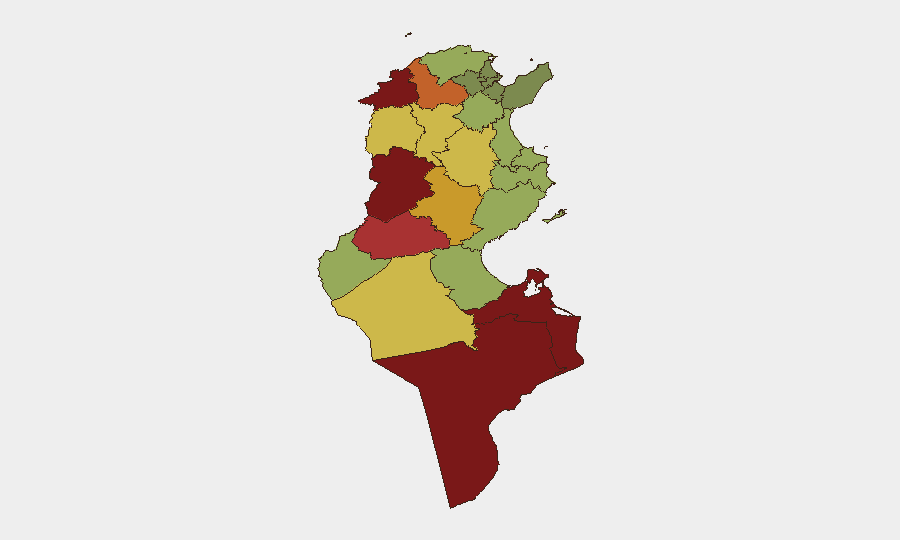
Situation Summary
Tunisia remains at composite threat rank #72 globally, with civil unrest as the primary driver. The country has experienced coordinated police operations in the capital, supply-chain disruptions along critical coastal corridors, and a significant public-health incident linked to industrial pollution. The security environment is characterized by localized volatility rather than systemic instability, but northwestern and south-central regions face substantially elevated risk.
Key Developments
- 2026-08-09 | Gafsa/Gabes region – Over 200 civilians hospitalized following pollution exposure from a phosphate processing facility; public pressure for plant closure mounting. This is the most recent confirmed incident and carries reputational and operational risk for employers in the phosphate sector.
- 2026-08-06 | Tunis (multiple districts) – Police conducted coordinated evening sweeps across Bab Souika, Bab Saadoun, Halfaouine, and Bab Jedid, arresting 15 actively-wanted individuals. Operation reflects continued law-enforcement activity in the capital's older quarters.
- 2026-08-04 | Main coastal highway (Tripoli–Tunisia border) – Critical supply and transport corridor closed due to active security operations and armed clashes. This disruption affects westbound logistics and remains unresolved as of the latest available reports.
Highest-Risk Areas
Kasserine (risk 92), Jendouba (88), and Tataouine (85) dominate the sub-national risk landscape. These northwestern and south-central governorates reflect a concentration of civil unrest, likely linked to economic marginalization, unemployment, and proximity to ungoverned or under-governed border areas. Médenine and Gafsa (83 and 78 respectively) also warrant elevated monitoring; Gafsa is now compounded by the industrial pollution crisis and associated civilian grievance. The capital (Tunis) and coastal centers register lower scores but have seen recent police activity and supply disruptions. Organizations with personnel or assets in Kasserine, Jendouba, or Tataouine face the highest residual risk.
How GeoBit Would Assist
GeoBit's AOI Monitoring & Early Warning service would track the highest-risk governorates—particularly Kasserine, Jendouba, and Gafsa—for emerging unrest, arrests, or industrial incidents, with configurable alerts for corporate operations. Intel Sweep and X/Twitter & Telegram OSINT would capture real-time signals (labor action, protest announcements, security-force movements) ahead of mainstream reporting, enabling duty-of-care teams to adjust travel and staffing. Routing & Network Analysis would identify alternative transport corridors and supply routes around the closed coastal highway, reducing dependency on disrupted logistics. Concurrent Sentiment & Temporal Analysis on phosphate-sector messaging would flag escalating public pressure or regulatory action affecting industrial operations.
7-Day Outlook
The coastal highway closure is likely to persist for the near term, and alternative routing should be assumed as standard. Phosphate-sector unrest and public health narratives will probably intensify, especially if hospitalization numbers or demands for facility closure increase. Police operations in Tunis may continue sporadically; overall risk remains localized to the identified high-risk zones rather than national in scope. Organizations should maintain heightened situational awareness in Kasserine and Jendouba and update supply-chain contingency plans.
Highest-Risk Areas — Ranked
| # | State / Region | Risk |
|---|---|---|
| 1 | Kasserine | 92 |
| 2 | Jendouba | 88 |
| 3 | Tataouine | 85 |
| 4 | Médenine | 83 |
| 5 | Gafsa | 78 |
| 6 | Béja | 75 |
| 7 | Sidi Bouzid | 72 |
| 8 | Al Kaf | 70 |
| 9 | Kébili | 68 |
| 10 | Kairouan | 65 |
| 11 | Siliana | 62 |
| 12 | Tozeur | 58 |
Sources
Previous Daily Briefs
A new Tunisia brief is written every day — each with its own risk map and downloadable CSV. Here's the last week; use the calendar to go further back.
📅 Browse every day by calendar →
Highlighted days have a brief. Tap a day for that day's map & analysis, or “csv” for that day's dataset ($5).
Atlas — our AI intelligence desk — emails them this snapshot personally. Nothing else, no list.