Situation Summary
Uzbekistan remains a low-threat environment globally (rank #154) with a composite threat score of 9, though localized security pressures persist in the Fergana Valley and surrounding border regions. The past week saw routine law-enforcement activity concentrated on narcotics interdiction, financial crime, and transport-sector oversight, with no discrete civil-unrest, infrastructure, or border incidents. National security posture is stable; the government has announced the third phase of its "Safe and Healthy Nation" campaign beginning 1 November, reflecting continued focus on crime prevention and public safety.
Key Developments
- Samarkand, 27 October: Authorities detected more than 20 kg of narcotics concealed in a truck driven by a Gulf-country national; a criminal case was opened against the driver and associates.
- Nationwide, 29–30 October: The Interior Ministry reported detection of 792 crime cases and 438 cybercrime offenses during a crime-prevention review, with recovery of 3.5 billion soums in damages. The ministry confirmed preparations for the third phase of the "Safe and Healthy Nation" campaign launching 1 November.
- Transport sector, nationwide, 31 October: The Transport Prosecutor's Office reported 97 criminal cases involving serious violations in transport construction and repair projects during January–September 2026, alongside 23,517 railway-safety administrative violations documented over that nine-month period.
- Note on timing: A significant pharmaceutical-trafficking case was reported on 27 October but involved a discovery on 26 October (outside the seven-day window); it involved 67,923 units of medicine valued at 5.6 billion soums seized in Uychi district, Namangan Region.
Highest-Risk Areas
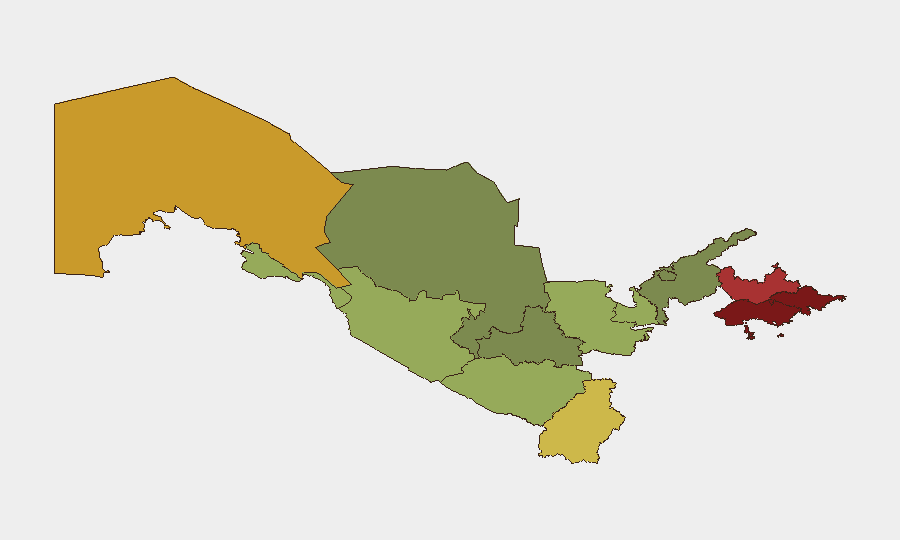
The Fergana Valley—comprising Andijan (risk 88), Fergana (82), and Namangan (78) regions—accounts for the three highest sub-national risk scores and remains the primary driver of internal threat density. Karakalpakstan (72) and Surxondaryo (65) follow, reflecting persistent border proximity, migration flows, and residual drug-trafficking networks. Risk in these zones stems from historical militant recruitment networks (since the 1990s), porous borders with Tajikistan and Kyrgyzstan, and narcotics transit from Afghanistan; central regions (Samarkand, Bukhara, Navoiy) show substantially lower scores, indicating effective state control and lower criminality.
How GeoBit Would Assist
Corporate security teams should employ OSINT fusion and multi-language search to monitor Uzbek-language law-enforcement announcements and local media for emerging patterns in drug seizures, trafficking routes, and personnel movements. AOI monitoring and early warning capabilities focused on Fergana Valley cities (Andijan, Kokand, Fergana) and Samarkand would provide persistent watch for civil unrest, border incidents, or infrastructure disruption. Network and actor analysis would enable tracking of criminal networks and trafficking organization changes, while economic and trade analysis would contextualize sanctions-evasion risks and illicit financial flows through major commercial hubs.
7-Day Outlook
No imminent escalation in threat levels is indicated. The launch of the national "Safe and Healthy Nation" campaign on 1 November will likely maintain elevated police and security operations through November, particularly in Fergana Valley zones; this should produce continued reporting of narcotics seizures and crime-prevention actions but no shift in overall stability. Border regions will remain under standard heightened monitoring due to Afghanistan proximity and existing trafficking infrastructure.
Highest-Risk Areas — Ranked
| # | State / Region | Risk |
|---|---|---|
| 1 | Andijan Region | 88 |
| 2 | Fergana Region | 82 |
| 3 | Namangan Region | 78 |
| 4 | Republic of Karakalpakstan | 72 |
| 5 | Surxondaryo Region | 65 |
| 6 | Qashqadaryo Region | 58 |
| 7 | Sirdaryo Region | 55 |
| 8 | Jizzakh Region | 48 |
| 9 | Xorazm Region | 45 |
| 10 | Bukhara Region | 42 |
| 11 | Navoiy Region | 38 |
| 12 | Samarqand Region | 35 |
Sources
Previous Weekly Briefs
A new Uzbekistan brief is written every Monday, covering the week — each with its own risk map and downloadable CSV. Use the calendar to go further back.
- October 26, 2026
- October 19, 2026
- October 12, 2026
- October 5, 2026
- September 28, 2026
- September 21, 2026
- September 14, 2026
📅 Browse past briefs by calendar →
Highlighted days have a brief. Tap a day for that day's map & analysis, or “csv” for that day's dataset ($5).
Atlas — our AI intelligence desk — emails them this snapshot personally. Nothing else, no list.