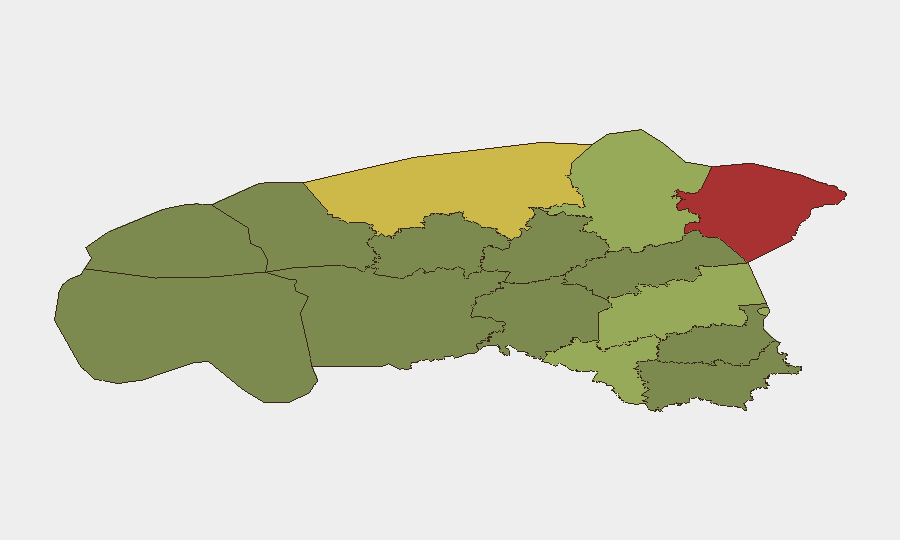
Situation Summary
Estonia remains a low-threat environment globally (rank #110, composite score 13) with no tracked security incidents of national significance as of 13 August 2026. However, sub-national risk is unevenly distributed, with Ida-Viru County (score 78) and Harju County (score 68) driving elevated concern relative to the national baseline. Recent operational friction at Tallinn detention facilities and isolated incidents (vehicle fire, traffic crash) show no systemic escalation, though migration-related pressure persists on law enforcement and border infrastructure.
Key Developments
- Tallinn detention facility, 12–13 Aug: Ongoing disputes among recently apprehended illegal-migration detainees; police characterize situation as managed but note continued migration pressure expected to sustain. No major breach or security failure reported.
- Tallinn police operations, 12–13 Aug: No new illegal-immigration cases detected on 12–13 August; operational tempo remains steady rather than escalating.
- Raadi district (Tartu County), 6 Aug: Isolated electric-vehicle charging fire; no evidence of systemic public-safety failure or broader EV-infrastructure vulnerability.
- Läänemaa, 7 Aug: Minor traffic injury crash; no indication of road-safety degradation.
Note: Live 24–48-hour event coverage for Estonia remains limited in available sources. Migration-related detention facility friction and police operational updates represent the most current substantive developments; isolated incidents (EV fire, traffic) do not reflect emerging patterns.
Highest-Risk Areas
Ida-Viru County (risk 78) and Harju County (risk 68) account for the majority of sub-national risk concentration. Ida-Viru's elevated score likely reflects proximity to the Russian border, historic industrial and environmental legacy issues, and limited economic diversification. Harju County, encompassing Tallinn and the capital region, faces higher baseline risk from population density, critical national infrastructure, migration processing, and cyber-exposure. Tartu County (score 58) follows as a secondary concern, driven partly by student-population mobility and academic-sector cyber activity. Risk distribution is steep: the top three counties account for roughly two-thirds of measurable sub-national threat, while southern and western regions (Võru, Põlva, Viljandi) remain substantially lower-risk.
How GeoBit Would Assist
A corporate security team with staff or assets in Estonia should employ persistent area-of-interest (AOI) monitoring on Tallinn detention facilities, border crossing points in Ida-Viru, and critical infrastructure in Harju to detect early-warning signals of detention escalation, migration surge, or operational disruption. Multi-language OSINT fusion (news, X/Telegram, radio SIGINT) would track police operational statements, migration ministry guidance, and regional labor-market data to anticipate staffing or resource constraints. Entity extraction and sentiment analysis on detention-sector communications and government announcements would provide 5–7 day early warning of policy shifts or facility-capacity stress affecting regional operations.
7-Day Outlook
Migration-related detention friction is expected to persist through mid-to-late August as seasonal pressure remains; no escalation to broader civil unrest is currently signaled. Police capacity and facility management will remain the primary operational constraint, particularly in Harju County. Absence of new major incidents suggests current security posture is adequate, but continued monitoring of Ida-Viru border infrastructure and Tallinn detention status is warranted for duty-of-care compliance.
Highest-Risk Areas — Ranked
| # | State / Region | Risk |
|---|---|---|
| 1 | Ida-Viru County | 78 |
| 2 | Harju County | 68 |
| 3 | Tartu County | 58 |
| 4 | Valga County | 55 |
| 5 | Lääne-Viru County | 52 |
| 6 | Pärnu County | 35 |
| 7 | Rapla County | 32 |
| 8 | Jõgeva County | 30 |
| 9 | Järva County | 28 |
| 10 | Viljandi County | 25 |
| 11 | Põlva County | 22 |
| 12 | Võru County | 18 |
Sources
Previous Daily Briefs
A new Estonia brief is written every day — each with its own risk map and downloadable CSV. Here's the last week; use the calendar to go further back.
📅 Browse every day by calendar →
Highlighted days have a brief. Tap a day for that day's map & analysis, or “csv” for that day's dataset ($5).
Atlas — our AI intelligence desk — emails them this snapshot personally. Nothing else, no list.