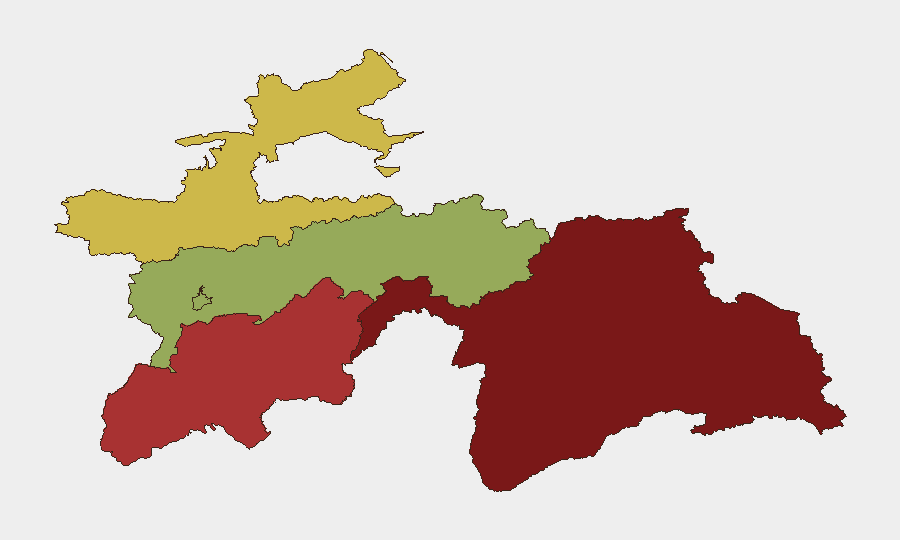
Situation Summary
Tajikistan remains a moderate-risk environment (global rank #112) with 12 tracked security events, driven primarily by instability in the remote Gorno-Badakhshan Autonomous Region and cross-border friction in southern Khatlon. Recent seismic activity—two earthquakes (M4.7–4.8) in the Pamir region on 2026-07-17–18—poses secondary hazards to mountainous areas but does not directly alter the security posture. A government disapproval signal on 2026-07-17 warrants monitoring for policy or administrative shifts, though no operational security incident has yet materialized from it.
Key Developments
- Gorno-Badakhshan Autonomous Region · 2026-07-17–18 · Two moderate earthquakes (M4.7–4.8) recorded 109–116 km northeast of Khorugh and Murghob; no casualty or infrastructure-failure reports confirmed in available 24–48-hour sources, but mountain stability and landslide risk require watch in high-altitude transport corridors.
- National Level · 2026-07-17 · Government disapproval event recorded in GEOBIT event signals; underlying cause and scope not yet clarified in live web sources; recommend monitoring for policy announcements or administrative changes in the coming 48–72 hours.
- Sughd Province · 2026-07-14 (outside 24–48h window, noted for operational awareness) · Heavy flash floods reported by Emergency and Disaster Information Service; drainage systems and road networks in northern Tajikistan may remain compromised; this is a 5-day-old incident but remains relevant to duty-of-care assessments for personnel in affected valleys.
- No confirmed terrorist, militant, or criminal incidents reported in the last 24–48 hours in available open sources; however, border clashes with Afghan nationals and narcotics trafficking remain endemic (mid-2026 summary data), indicating sustained low-level cross-border tension.
Highest-Risk Areas
Gorno-Badakhshan (risk 92) and Khatlon (risk 78) together account for the majority of national threat exposure. Gorno-Badakhshan's extreme isolation, earthquake activity, thin administrative presence, and historical militant sanctuary status make it the single highest-risk zone; Khatlon's ranking reflects sustained Afghan border instability, narcotics transit, and recurrent cross-border clashes. Sughd (risk 65), though lower, carries infrastructure and flood vulnerability. Dushanbe (risk 42) remains the lowest-risk zone, reflecting state-security presence and urban concentration of governance.
How GeoBit Would Assist
Security teams with personnel or assets in Tajikistan should deploy AOI Monitoring & Early Warning on Gorno-Badakhshan and the Afghan border corridor in Khatlon to track militant movement, cross-border incidents, and seismic aftershocks in real time. Satellite & Imagery Analysis combined with GIS & Spatial Analysis would enable rapid assessment of flood damage in Sughd, bridge and road viability, and safe routing alternatives. Intel Sweep and multi-language OSINT (Tajik, Russian, Dari media and Telegram channels) should continuously track government policy signals and regional security narratives to anticipate shifts in the "disapproval" event.
7-Day Outlook
Seismic activity is expected to decay over the next week absent a major aftershock. The government disapproval signal requires clarification; if it reflects administrative tension or policy change, secondary effects may emerge mid-to-late week. Border clashes and narcotics interdiction operations are likely to continue at baseline levels. No imminent escalation is forecast, but personnel in Gorno-Badakhshan and southern Khatlon should maintain heightened situational awareness and pre-planned evacuation routes.
Highest-Risk Areas — Ranked
| # | State / Region | Risk |
|---|---|---|
| 1 | Gorno-Badakhshan Autonomous Region | 92 |
| 2 | Khatlon Region | 78 |
| 3 | Sughd Region | 65 |
| 4 | Districts of Republican Subordination | 58 |
| 5 | Dushanbe | 42 |
Sources
Previous Daily Briefs
A new Tajikistan brief is written every day — each with its own risk map and downloadable CSV. Here's the last week; use the calendar to go further back.
📅 Browse every day by calendar →
Highlighted days have a brief. Tap a day for that day's map & analysis, or “csv” for that day's dataset ($5).
Atlas — our AI intelligence desk — emails them this snapshot personally. Nothing else, no list.