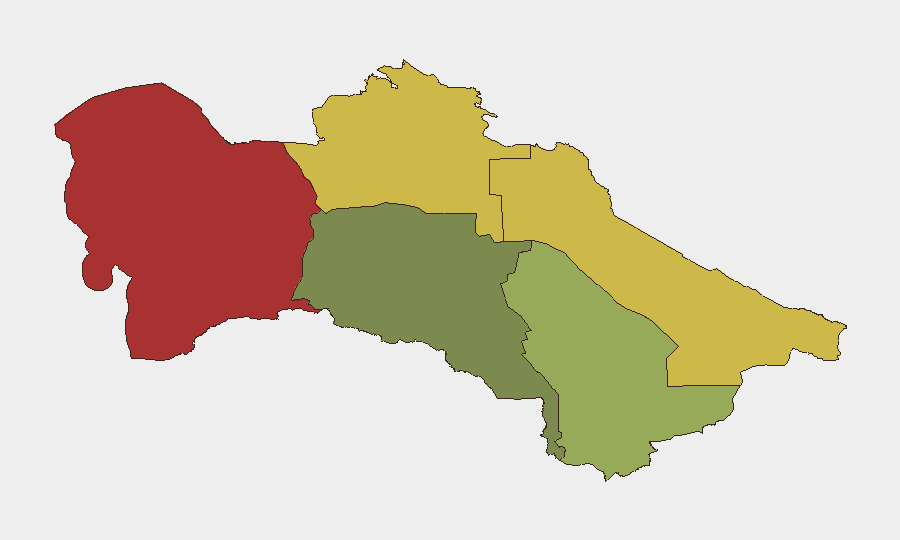
Situation Summary
Turkmenistan maintains a composite threat ranking of 4 globally (#187), with no discrete security events recorded during the reporting week of 10–16 November 2026. Official government activity during the period focused on routine security-sector oversight and international diplomatic engagement, with no indicators of acute instability, civil unrest, or infrastructure disruption. The sub-national risk profile remains concentrated in the Balkan and Lebap regions (scores 78 and 68 respectively), while Ashgabat City continues to register the lowest risk tier (18). The country's security environment remains static relative to historical baselines.
Key Developments
- Location unspecified; 14 November 2026: State Security Council convened an off-site session to review performance of armed forces, Interior Ministry, customs service, and related security bodies. Authorities destroyed more than 122.5 kg of seized narcotics at a newly opened facility. *Note: Single-source official government account; not independently corroborated.*
- Ashgabat; 15 November 2026: Foreign Ministry reported an online meeting between the Communications Ministry and the Digital Cooperation Organization. No cyber incidents, operational disruptions, or security threats were reported in the available account.
- Diplomatic activity outside Turkmenistan (Islamabad, 16 November; Astana, reporting 11–13 November): Foreign minister engaged with regional partners on economic cooperation and security dialogue. These represent routine diplomatic activity; no domestic security implications are evident from available reporting.
No verified conflict events, civil unrest, serious crime, political instability, or travel-risk escalation occurred within Turkmenistan during the reporting window. A 30-day lookback confirms zero corroborated security incidents, though this represents an assessment rather than discrete event data.
Highest-Risk Areas
The Balkan Region (risk score 78) and Lebap Region (risk score 68) drive the national threat profile and warrant priority monitoring. These northwestern zones, adjacent to the Caspian Sea and bordering Kazakhstan and Uzbekistan, historically concentrate customs violations, smuggling, trafficking, and organized-crime activity. Mary Region (score 42) and Dashoguz Region (score 62) represent secondary concentrations of risk, likely related to border-proximity factors and irregular migration routes. Ashgabat City (score 18) remains the lowest-risk jurisdiction, consistent with heightened state-security presence and infrastructure control in the capital. Corporate teams with personnel or assets in Balkan or Lebap should maintain elevated duty-of-care protocols for cross-border transit and supply-chain movement.
How GeoBit Would Assist
Security teams operating in Turkmenistan should employ AOI Monitoring & Early Warning to track the Balkan and Lebap regions for emerging trafficking, smuggling, or civil-unrest signals that may not immediately reach official channels. OSINT fusion and multi-language search capabilities enable continuous monitoring of government announcements, border-control reports, and independent media to corroborate official claims and detect unreported incidents. Routing & Network Analysis assists duty-of-care teams in planning alternative employee travel routes that avoid known high-risk corridors and facilitate rapid rerouting in the event of localized disruption.
7-Day Outlook
No indicators suggest material escalation of security risk in Turkmenistan over the next seven days. Regional diplomatic engagement and routine security-sector activity are expected to continue without disruption. Teams should maintain existing risk postures while remaining alert to unconfirmed cross-border or trafficking signals in northern regions.
Highest-Risk Areas — Ranked
| # | State / Region | Risk |
|---|---|---|
| 1 | Balkan Region | 78 |
| 2 | Lebap Region | 68 |
| 3 | Dashoguz Region | 62 |
| 4 | Mary Region | 42 |
| 5 | Ahal Region | 35 |
| 6 | Ashgabat City | 18 |
Sources
Previous Weekly Briefs
A new Turkmenistan brief is written every Monday, covering the week — each with its own risk map and downloadable CSV. Use the calendar to go further back.
- November 9, 2026
- November 2, 2026
- October 26, 2026
- October 19, 2026
- October 12, 2026
- October 5, 2026
- September 28, 2026
📅 Browse past briefs by calendar →
Highlighted days have a brief. Tap a day for that day's map & analysis, or “csv” for that day's dataset ($5).
Atlas — our AI intelligence desk — emails them this snapshot personally. Nothing else, no list.