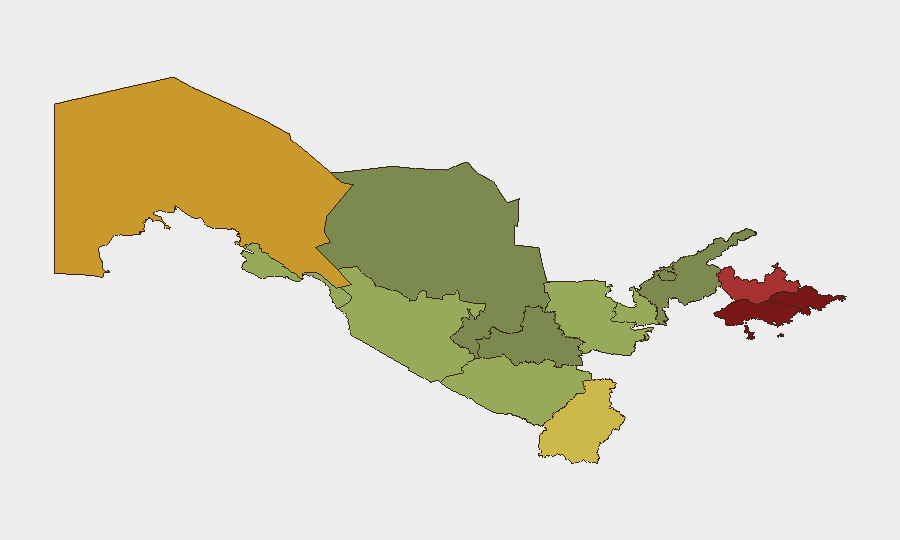
Situation Summary
Uzbekistan remains a low-threat environment globally (rank #154, composite score 9), with no tracked security events during the reporting week. However, subnational risk concentrates sharply in the Fergana Valley and adjacent regions—Andijan, Fergana, and Namangan provinces together account for the majority of domestic security concern, driven by persistent drug-trafficking activity, organized smuggling, and historical militant recruitment networks. The government's stated pivot toward AI-enabled crime analytics and enhanced drug-enforcement coordination signals official recognition of these structural vulnerabilities, even as Tashkent itself remains relatively stable and monitored.
Key Developments
- Tashkent, 3 November 2026: A university dean was dismissed after reportedly barring students from classes for non-compliance with installation of the "Safe Student" mobile application, reflecting state efforts to extend digital surveillance and control mechanisms into educational settings.
- Nationwide, 4 November 2026: President Shavkat Mirziyoyev reviewed crime-prevention policy proposals, including enhanced drug and cybercrime enforcement, organized-crime suppression, and launch of an AI-supported national crime-data platform with risk-mapping capability—signaling official recognition of drug trafficking, shadow economy, and data-governance gaps.
- Tashkent, 6 November 2026: Police arrested two previously convicted men suspected of planning kidnappings for hire; one alleged victim escaped a moving vehicle, and authorities recovered an axe from the suspects' car and filed kidnapping charges.
- Tashkent, 6 November 2026: A Russian national received a seven-day administrative arrest sentence after disrupting order during and after a flight from Kuala Lumpur, including resistance to police instructions upon landing.
Highest-Risk Areas
The Fergana Valley—comprising Andijan (risk 88), Fergana (82), and Namangan (78) regions—dominates subnational threat exposure, accounting for roughly one-third of national composite risk. These provinces have long served as a corridor for cross-border heroin trafficking from Afghanistan via Tajikistan, as well as sites of small-scale militant recruitment and extremist-sympathizer networks. Karakalpakstan (risk 72) and Surxondaryo (65) follow, reflecting similar trafficking vulnerabilities and limited state presence in remote areas. By contrast, Tashkent-proper and the southern tourist corridor (Samarqand, Bukhara) register substantially lower risk, though cybercrime and urban organized robbery remain ambient concerns.
How GeoBit Would Assist
Security teams protecting personnel or assets in Uzbekistan should deploy OSINT Fusion & Corroboration (Telegram, local media, and cross-border news feeds) to detect emerging drug-smuggling and trafficking indicators in the Fergana Valley before they escalate into organized-crime violence affecting expatriate areas. AOI Monitoring & Early Warning on Andijan, Fergana, and Namangan regions, combined with Network & Actor Analysis to track smuggling-cell composition and recruitment patterns, enables proactive duty-of-care briefing for travelers and site managers. Risk & Threat Assessment updated quarterly against the government's new crime-analytics platform output will help corporate security adapt detection and response protocols as state enforcement intensity varies.
7-Day Outlook
No major security incidents are forecast for the coming week; Tashkent and central Uzbekistan should remain operationally routine. The announced crime-policy review and AI platform rollout may intensify police and security-service visibility in high-risk provinces over the next 2–4 weeks, creating temporary friction with smuggling networks and organized-crime actors but unlikely to materially disrupt corporate or diplomatic operations. Monitoring of cross-border heroin flows and the impact of any Taliban-policy shifts on Afghan supply routes remains essential for forward planning.
Highest-Risk Areas — Ranked
| # | State / Region | Risk |
|---|---|---|
| 1 | Andijan Region | 88 |
| 2 | Fergana Region | 82 |
| 3 | Namangan Region | 78 |
| 4 | Republic of Karakalpakstan | 72 |
| 5 | Surxondaryo Region | 65 |
| 6 | Qashqadaryo Region | 58 |
| 7 | Sirdaryo Region | 55 |
| 8 | Jizzakh Region | 48 |
| 9 | Xorazm Region | 45 |
| 10 | Bukhara Region | 42 |
| 11 | Navoiy Region | 38 |
| 12 | Samarqand Region | 35 |
Previous Weekly Briefs
A new Uzbekistan brief is written every Monday, covering the week — each with its own risk map and downloadable CSV. Use the calendar to go further back.
- November 2, 2026
- October 26, 2026
- October 19, 2026
- October 12, 2026
- October 5, 2026
- September 28, 2026
- September 21, 2026
📅 Browse past briefs by calendar →
Highlighted days have a brief. Tap a day for that day's map & analysis, or “csv” for that day's dataset ($5).
Atlas — our AI intelligence desk — emails them this snapshot personally. Nothing else, no list.