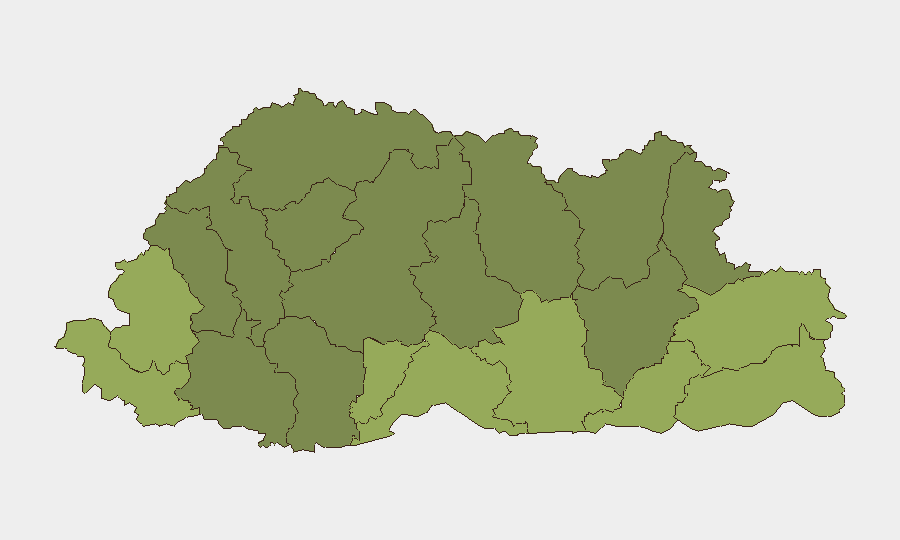
Situation Summary
Bhutan remains a low-threat environment with no confirmed security incidents, unrest, crime spikes, or infrastructure disruptions reported in the last 24–48 hours (13–14 August 2026). The most recent dedicated security assessment (8 August) explicitly documented zero tracked events and characterized the country as routine-operations baseline. Leadership attention is currently focused on external humanitarian support, with public statements expressing solidarity for flood-affected regions in neighboring Assam, India.
Key Developments
- No discrete security, unrest, crime, or infrastructure incidents confirmed in Bhutan for 13–14 August 2026 across available regional and international reporting channels.
- Bhutanese leadership engagement (14 August) centered on humanitarian messaging toward flood-affected populations in Assam, India, indicating stable domestic conditions and outward-focused posture.
- Baseline stability maintained: The 8 August security brief's "zero tracked events" finding aligns with the absence of corroborated incident reports in the current 24–48-hour window, consistent with Bhutan's historical low-incident profile.
- No regional contagion risks identified from neighboring India's flood emergency or broader regional developments that would elevate Bhutanese domestic threat levels at this time.
Highest-Risk Areas
Samtse, Sarpang, and Haa Districts (composite risk scores 58, 55, and 52 respectively) form the country's highest-risk tier, with all concentrating in the southern border region. These areas' elevated scores likely reflect border-management complexity, cross-border population movement, and historical smuggling activity rather than active conflict or unrest. The second tier—Pemagatshel and Samdrup Jongkhar in the east-central and eastern border zones (risk 50 and 48)—reflects similar geographic and transnational factors. Central and northern districts (Thimphu, Punakha, and Gasa) remain substantially lower-risk, suggesting that threat concentration follows proximity to international boundaries and transit corridors rather than domestic instability.
How GeoBit Would Assist
Security teams should employ OSINT fusion and multi-language search (including regional Hindi and Bengali media) to detect cross-border incidents, smuggling activity, or population-movement anomalies in the southern border districts before they escalate to formal incidents. AOI monitoring and early-warning capability focused on Samtse and Sarpang—combined with border and disputed-territory search—would provide persistent detection of trafficking, unauthorized crossings, or minor civil-order disruptions unlikely to surface in national reporting. Network and actor analysis of transnational crime and smuggling networks operating in the southern belt would support proactive risk mitigation for corporate assets and personnel in those zones.
7-Day Outlook
No significant threat escalation is forecast over the next seven days. Bhutan's baseline remains low-risk, with routine border and criminal-activity management the primary operational concern in southern districts. Monitoring of Indian regional flood recovery and any secondary population displacement should continue as a precautionary measure, though no current spillover into Bhutan is evidenced.
Highest-Risk Areas — Ranked
| # | State / Region | Risk |
|---|---|---|
| 1 | Samtse District | 58 |
| 2 | Sarpang District | 55 |
| 3 | Haa District | 52 |
| 4 | Pemagatshel District | 50 |
| 5 | Samdrup Jongkhar District | 48 |
| 6 | Tsirang District | 45 |
| 7 | Zhemgang District | 42 |
| 8 | Trashigang District | 40 |
| 9 | Mongar District | 38 |
| 10 | Gasa District | 35 |
| 11 | Lhuntse District | 32 |
| 12 | Wangdue Phodrang District | 30 |
Sources
Previous Daily Briefs
A new Bhutan brief is written every day — each with its own risk map and downloadable CSV. Here's the last week; use the calendar to go further back.
- August 12, 2026
- August 10, 2026
- August 8, 2026
- August 6, 2026
- August 5, 2026
- August 4, 2026
- August 3, 2026
📅 Browse every day by calendar →
Highlighted days have a brief. Tap a day for that day's map & analysis, or “csv” for that day's dataset ($5).
Atlas — our AI intelligence desk — emails them this snapshot personally. Nothing else, no list.