Situation Summary
East Timor remains a low-threat environment globally (rank #137, composite score 11) with no tracked security events in the current reporting window. The country's overall stability profile reflects a functioning state apparatus and absence of active conflict or organized insurgency. Risk concentrates in the capital, Dili, and specific western border regions, reflecting urban crime patterns and historical communal tensions rather than systemic instability. The security trajectory remains flat absent major political or economic shocks.
Key Developments
- Dili, September 16: Police National Task Force (PNTL) detained two homeless youths in Colmera following an alleged assault on a PNTL officer providing security escort to the vice minister of justice. The officer was hospitalized at Guido Valadares National Hospital; detainees were referred for prosecution. This incident reflects localized street-level crime rather than organized threat activity.
- Timor-Leste (diplomatic), September 15–16: Timor-Leste signed a declaration of accession to the Convention on Cluster Munitions at the treaty's review conference in Vientiane, Laos. Accession remains pending formal completion. This represents disarmament policy alignment and carries no immediate domestic security implications.
- Timor-Leste (infrastructure), September 18: A brief internet-routing disruption was identified but lacked sufficient detail and independent corroboration for inclusion as a confirmed infrastructure event. Root cause and scope remain unclear from available reporting.
Highest-Risk Areas
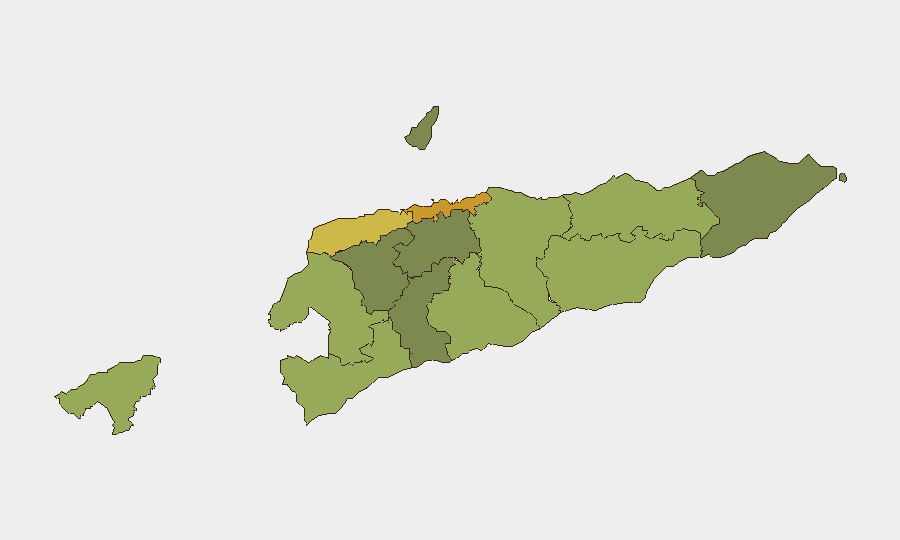
Dili (risk 72) dominates the national risk profile, reflecting capital-city concentration of crime, interpersonal violence, and transient populations—consistent with the September 16 street assault. The western border corridor—Liquiçá (62), Cova Lima (55), and Bobonaro (53)—registers elevated composite risk driven by historical communal disputes, informal settlement patterns, and limited state presence rather than active conflict. Baucau (58), the second-largest city, shows elevated urban crime signals. Risk declines sharply inland and in eastern districts (Aileu, Ermera, Manatuto), where population density and service demand are lower. Risk concentration in capital and border zones reflects patterns common to post-conflict states with uneven state capacity.
How GeoBit Would Assist
Security teams monitoring East Timor should deploy AOI Monitoring & Early Warning on Dili and the western border region (Liquiçá, Cova Lima, Bobonaro) to detect shifts in protest activity, communal incidents, or criminal patterns via persistent satellite and OSINT fusion; Intel Sweep with multi-language OSINT (Portuguese, Tetum, Indonesian) and Telegram/social-media monitoring to capture local security incident reporting ahead of official channels; and Network & Actor Analysis to map criminal and communal-dispute actors across high-risk districts. Routing & Network Analysis supports duty-of-care planning for personnel traveling between Dili and western zones. These capabilities together provide 72–96-hour early warning of localized events and alternative-route advisories.
7-Day Outlook
No significant security escalation is forecast for the coming week absent external shocks (major political crisis, natural disaster, or border incident). Routine street-level crime in Dili and low-level communal tensions in border regions will likely persist. Monitoring should remain focused on Dili and western zones, with particular attention to any organized labor actions or political gatherings coinciding with upcoming government calendar events.
Highest-Risk Areas — Ranked
| # | State / Region | Risk |
|---|---|---|
| 1 | Dili | 72 |
| 2 | Liquiçá | 62 |
| 3 | Baucau | 58 |
| 4 | Cova Lima | 55 |
| 5 | Bobonaro | 53 |
| 6 | Oecussi-Ambeno | 48 |
| 7 | Manufahi | 45 |
| 8 | Viqueque | 42 |
| 9 | Manatuto | 40 |
| 10 | Ainaro | 38 |
| 11 | Ermera | 36 |
| 12 | Aileu | 32 |
Sources
Previous Weekly Briefs
A new East Timor brief is written every Monday, covering the week — each with its own risk map and downloadable CSV. Use the calendar to go further back.
- September 15, 2026
- September 8, 2026
- September 2, 2026
- August 31, 2026
- August 29, 2026
- August 26, 2026
- August 23, 2026
📅 Browse past briefs by calendar →
Highlighted days have a brief. Tap a day for that day's map & analysis, or “csv” for that day's dataset ($5).
Atlas — our AI intelligence desk — emails them this snapshot personally. Nothing else, no list.