Situation Summary
Tunisia faces escalating civil unrest driven by environmental crises, labor friction, and political opposition mobilization against President Kais Saied. Over the past 48 hours, hospitalization of 200+ civilians due to phosphate facility pollution in Gabès has catalyzed sustained street protests, while a nationwide youth-led petition calling for the president's resignation has translated into localized demonstrations across multiple urban centers. Concurrent electricity and water outages, ongoing detention of opposition figures, and a planned electoral-process protest near central Tunis suggest a widening cycle of grievance-driven activism and potential confrontation with security forces.
Key Developments
- Gabès, southern Tunisia – 13–14 Aug 2026. Over 200 civilians hospitalized for respiratory illness linked to phosphate processing facility pollution; sustained street protests and confrontations with President Saied during his visit demanding industrial shutdown and government accountability.
- Nationwide – 14 Aug 2026. Launch of "National Petition to Save the Republic" calling for President Saied's resignation, with youth-led organizing activity reported in Tunis and other urban centers.
- Tunis and multiple cities – 14–15 Aug 2026. Ongoing demonstrations over electricity and water cuts, including night-time protests, tire-burning, and road-blocking in southern, central, and northern districts; further large-scale mobilization in Tunis planned for later in August.
- Central Tunis – 14 Aug 2026. Protests announced near Habib Bourguiba Avenue over alleged irregularities in electoral process, indicating imminent demonstrations in government-sensitive area.
- Tunis and national detention facilities – 14–15 Aug 2026. Reports of opposition figures, including activist Chawki Tabib, in poor health and on hunger strike in prison; advocacy campaigns likely to fuel further court and prison-area protests.
- Western transport corridor – 11 Aug 2026. Tripoli–Tunisia coastal highway (main westbound logistics route) closed due to active security operations, ongoing disruption to supply chains and civilian movement.
- Jendouba and Siliana border – 12 Aug 2026. Forest fire in Jbel Lqna continuing to spread into adjacent mountainous terrain; ongoing environmental strain compounding public anger.
Highest-Risk Areas
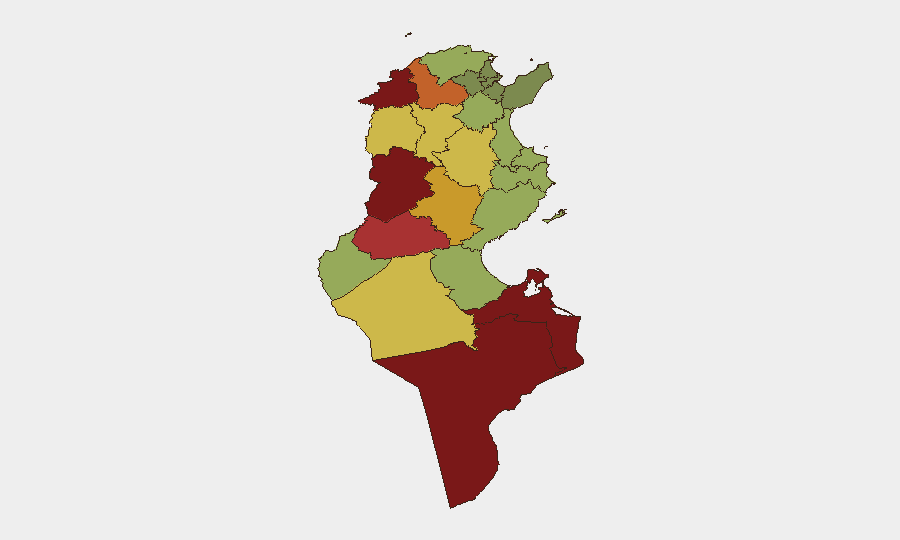
Kasserine (risk 92), Jendouba (88), Tataouine (85), and Médenine (83) remain the highest-risk governorates, driven primarily by civil unrest and historical security fragility. Jendouba's current environmental crisis (forest fire) and proximity to Siliana amplify unrest drivers. Kasserine and the southern border regions (Tataouine, Médenine) reflect persistent operational security challenges. Gabès, while not in the top tier, has emerged as an acute localized flashpoint due to industrial pollution and mobilized public anger; Kairouan (65) and Siliana (62) show elevated risk from secondary effects of environmental and labor grievances. Risk is shifting toward coastal and central urban areas as environmental and political crises ripple outward from provincial centers.
How GeoBit Would Assist
AOI Monitoring & Early Warning would enable persistent watch on Gabès industrial zone, Tunis central districts (Habib Bourguiba Avenue, court/prison perimeters), and Kasserine–Jendouba corridor for protest escalation, blockade formation, and security-force deployment. Routing & Network Analysis would identify real-time alternative logistics and evacuation routes around the closed Tripoli highway and emerging protest-affected roads. Sentiment & Temporal Analysis on Telegram, X, and local news feeds would track opposition organizing timelines and protest momentum to support duty-of-care notification and asset repositioning.
7-Day Outlook
Political and environmental grievances are consolidating into overlapping protest waves with potential for larger-scale mobilization in central Tunis by late August. Gabès unrest and electricity/water shortages are likely to sustain localized disruption and periodic clashes with security forces. Security-force posture—particularly response to Habib Bourguiba Avenue demonstrations and detention-facility access—will be critical indicators of whether the government escalates or de-escalates confrontation.
Highest-Risk Areas — Ranked
| # | State / Region | Risk |
|---|---|---|
| 1 | Kasserine | 92 |
| 2 | Jendouba | 88 |
| 3 | Tataouine | 85 |
| 4 | Médenine | 83 |
| 5 | Gafsa | 78 |
| 6 | Béja | 75 |
| 7 | Sidi Bouzid | 72 |
| 8 | Al Kaf | 70 |
| 9 | Kébili | 68 |
| 10 | Kairouan | 65 |
| 11 | Siliana | 62 |
| 12 | Tozeur | 58 |
Sources
Previous Daily Briefs
A new Tunisia brief is written every day — each with its own risk map and downloadable CSV. Here's the last week; use the calendar to go further back.
- August 13, 2026
- August 11, 2026
- August 9, 2026
- August 7, 2026
- August 5, 2026
- August 4, 2026
- August 3, 2026
📅 Browse every day by calendar →
Highlighted days have a brief. Tap a day for that day's map & analysis, or “csv” for that day's dataset ($5).
Atlas — our AI intelligence desk — emails them this snapshot personally. Nothing else, no list.