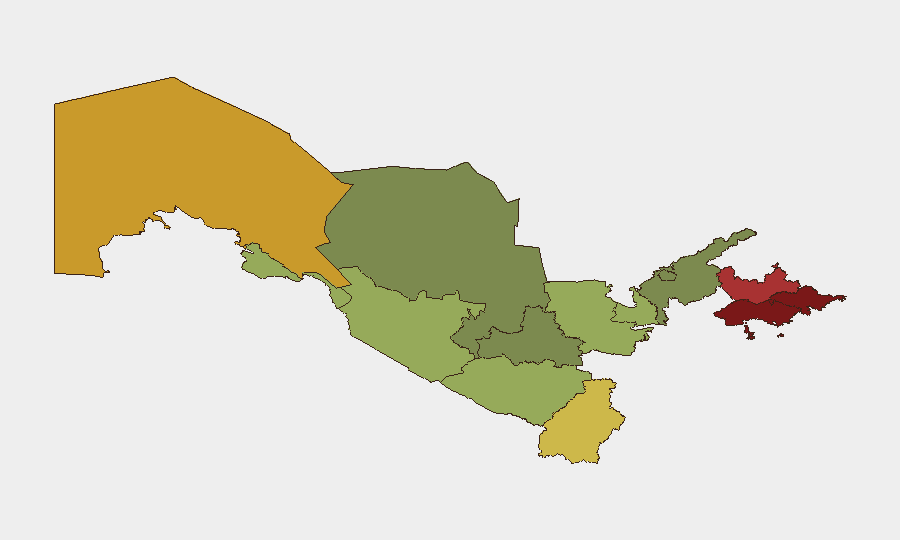
Situation Summary
Uzbekistan maintains a low overall threat profile (rank #154 globally, composite score 9) with no tracked major security events in the reporting period. However, the country exhibits marked regional variation, with the Fergana Valley—particularly Andijan, Fergana, and Namangan regions—presenting substantially elevated risk (scores 78–88) relative to the national baseline. The week of 9–16 November saw three verifiable incidents spanning traffic fatality, extremist online activity, and corruption-related prosecutions; none signal an acute destabilization, but together they underscore persistent vulnerabilities in road safety, radicalization vectors, and institutional integrity.
Key Developments
- 13 November, Kushtepa district (Fergana Region): A cyclist struck by a Chery Tiggo 2 Pro on an unmarked road section near Namuna mahalla died following hospitalization; pre-investigation inquiry initiated. Reflects ongoing road-safety and infrastructure governance gaps in higher-risk regions.
- 13 November, Karshi (Kashkadarya Region): State Security Service and internal-affairs authorities shut down a 13-member Telegram group distributing extremist, "jihad," and "martyrdom" material; investigative measures ongoing. Indicates continued reliance on encrypted platforms for radicalization messaging and active counter-extremism operations.
- 11 November, Mirabad district (Tashkent): District criminal court sentenced Demokrat.uz head Fazliddinkhon Mekhmonov and blogger Aziz Goipnazarov to 10 years imprisonment in an extortion case (underlying incident reported 10 November, alleged $50,000 demand). Underscores judicial proceedings against media figures and alleged misuse of platforms for financial coercion.
Highest-Risk Areas
The Fergana Valley—encompassing Andijan (88), Fergana (82), and Namangan (78) regions—dominates sub-national threat profiles and reflects historical concentration of extremist recruitment, cross-border trafficking, and sectarian tensions. Karakalpakstan (72) and Surxondaryo (65) present secondary but material risk, likely driven by border permeability, informal economies, and limited state capacity. By contrast, central and southern regions (Bukhara 42, Navoiy 38, Samarqand 35) register substantially lower composite scores, correlating with greater urbanization, security-force presence, and economic formalization. Corporate and NGO personnel should calibrate travel, staffing, and asset-protection protocols inversely to regional ranking.
How GeoBit Would Assist
Security teams with operations in Uzbekistan should employ AOI Monitoring & Early Warning capabilities to track flashpoints in the Fergana Valley, with alerts configured for extremist and trafficking signals. OSINT Fusion & Corroboration (Intel Sweep, Telegram OSINT, multi-language search) enables real-time vetting of emerging radicalization campaigns and coordinated law-enforcement actions. Risk & Threat Assessment combined with GIS & Spatial Analysis supports scenario planning for personnel mobility in high-risk regions and data-driven duty-of-care decision-making.
7-Day Outlook
No imminent escalation is signaled by current reporting. Extremist-content enforcement activity (13 November) may prompt brief online operational shifts among radicalization networks but is unlikely to alter ground-level threat trajectory in the near term. Road-safety incidents and judicial proceedings against media figures will likely continue at baseline frequencies; monitoring of Fergana Valley dynamics and cross-border movement patterns should remain elevated through year-end.
Highest-Risk Areas — Ranked
| # | State / Region | Risk |
|---|---|---|
| 1 | Andijan Region | 88 |
| 2 | Fergana Region | 82 |
| 3 | Namangan Region | 78 |
| 4 | Republic of Karakalpakstan | 72 |
| 5 | Surxondaryo Region | 65 |
| 6 | Qashqadaryo Region | 58 |
| 7 | Sirdaryo Region | 55 |
| 8 | Jizzakh Region | 48 |
| 9 | Xorazm Region | 45 |
| 10 | Bukhara Region | 42 |
| 11 | Navoiy Region | 38 |
| 12 | Samarqand Region | 35 |
Previous Weekly Briefs
A new Uzbekistan brief is written every Monday, covering the week — each with its own risk map and downloadable CSV. Use the calendar to go further back.
- November 9, 2026
- November 2, 2026
- October 26, 2026
- October 19, 2026
- October 12, 2026
- October 5, 2026
- September 28, 2026
📅 Browse past briefs by calendar →
Highlighted days have a brief. Tap a day for that day's map & analysis, or “csv” for that day's dataset ($5).
Atlas — our AI intelligence desk — emails them this snapshot personally. Nothing else, no list.