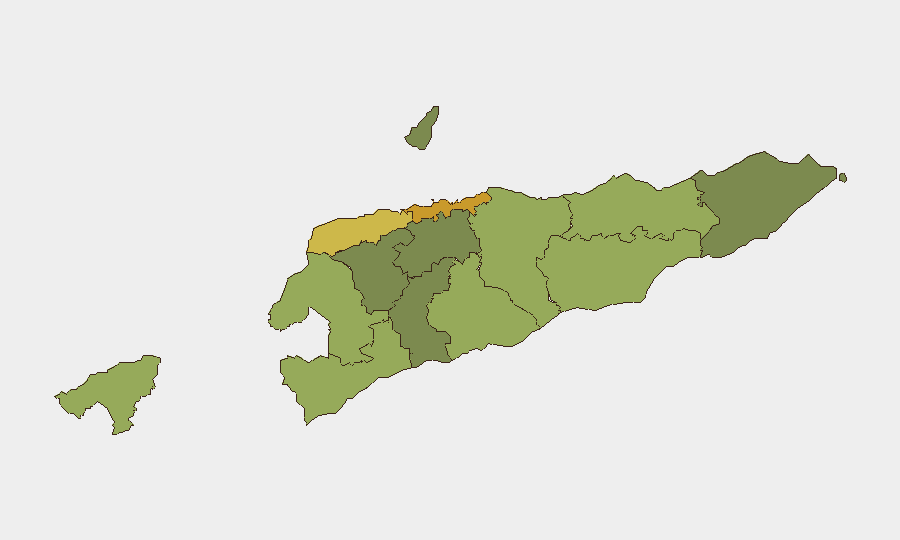
Situation Summary
East Timor remains a low-threat environment globally (rank #140, composite score 11), with no substantiated security incidents recorded in the tracking period. The country's risk profile is heavily concentrated in the capital, Dili, which accounts for the majority of domestic volatility. Current tensions centre on domestic political disagreement rather than security threats, though border-area trafficking and organized scam operations continue as chronic concerns.
Key Developments
- Dili, 10–12 October: Large-scale student-led protests against a proposed parliamentary vehicle-procurement scheme escalated into clashes with police near the National Parliament; demonstrators burned tyres and threw rocks; police deployed tear gas on at least two consecutive days; political parties subsequently pledged to seek cancellation of the procurement; President José Ramos-Horta condemned the violence and called for peaceful demonstration.
- Dili, 9 October: Prime Minister Xanana Gusmão concluded talks with Thailand on bilateral defence cooperation, information-sharing, and law-enforcement collaboration against transnational crime, including online scams; the two countries also agreed to accelerate an air-services arrangement for direct Bangkok–Dili flights.
- Belu Regency (Indonesia–Timor-Leste border), 13 October: Joint Indonesian and Timor-Leste border-security forces disrupted an alleged motorcycle-smuggling operation at an informal crossing and detained a Timor-Leste national; incident reflects ongoing informal cross-border trafficking activity.
Highest-Risk Areas
Dili (composite risk 72) dominates the subnational threat landscape, driven by its role as the political and economic centre and its concentration of organized-crime activity, including scam operations and transient civil unrest. Liquiçá (risk 62) and Baucau (risk 58) follow, likely reflecting border proximity, trafficking exposure, and lower institutional capacity. The remaining nine tracked regions show declining risk profiles, with Aileu (risk 32) the lowest; this geographic concentration suggests that security assets and monitoring should prioritize the capital and its immediate neighbours, while lower-risk peripheral regions require only baseline attention.
How GeoBit Would Assist
Corporate security and duty-of-care teams should deploy AOI Monitoring & Early Warning on Dili's National Parliament precinct and main commercial areas to capture protest activity and civil unrest in near-real time; OSINT fusion & corroboration (drawing on multi-language web research, social-media sentiment analysis, and event-feed integration) to distinguish genuine threats from political noise; and Network & Actor Analysis to track organized scam and trafficking networks that periodically intersect with foreign nationals. Routing & Network Analysis can support safe transit planning for personnel in or transiting through high-risk zones during periods of heightened protest activity.
7-Day Outlook
Parliamentary vehicle-procurement dispute is likely to remain the dominant domestic political irritant over the next week, with potential for additional protest activity and police engagement if the government does not move swiftly toward cancellation. Border-area smuggling and scam operations will persist as chronic, lower-intensity concerns; the Thailand–Timor-Leste defence and law-enforcement accord may yield incremental improvements in transnational-crime detection over the medium term. No substantive deterioration in overall security posture is anticipated absent major political shock or external destabilization.
Highest-Risk Areas — Ranked
| # | State / Region | Risk |
|---|---|---|
| 1 | Dili | 72 |
| 2 | Liquiçá | 62 |
| 3 | Baucau | 58 |
| 4 | Cova Lima | 55 |
| 5 | Bobonaro | 53 |
| 6 | Oecussi-Ambeno | 48 |
| 7 | Manufahi | 45 |
| 8 | Viqueque | 42 |
| 9 | Manatuto | 40 |
| 10 | Ainaro | 38 |
| 11 | Ermera | 36 |
| 12 | Aileu | 32 |
Sources
Previous Weekly Briefs
A new East Timor brief is written every Monday, covering the week — each with its own risk map and downloadable CSV. Use the calendar to go further back.
- October 6, 2026
- September 29, 2026
- September 22, 2026
- September 15, 2026
- September 8, 2026
- September 2, 2026
- August 31, 2026
📅 Browse past briefs by calendar →
Highlighted days have a brief. Tap a day for that day's map & analysis, or “csv” for that day's dataset ($5).
Atlas — our AI intelligence desk — emails them this snapshot personally. Nothing else, no list.