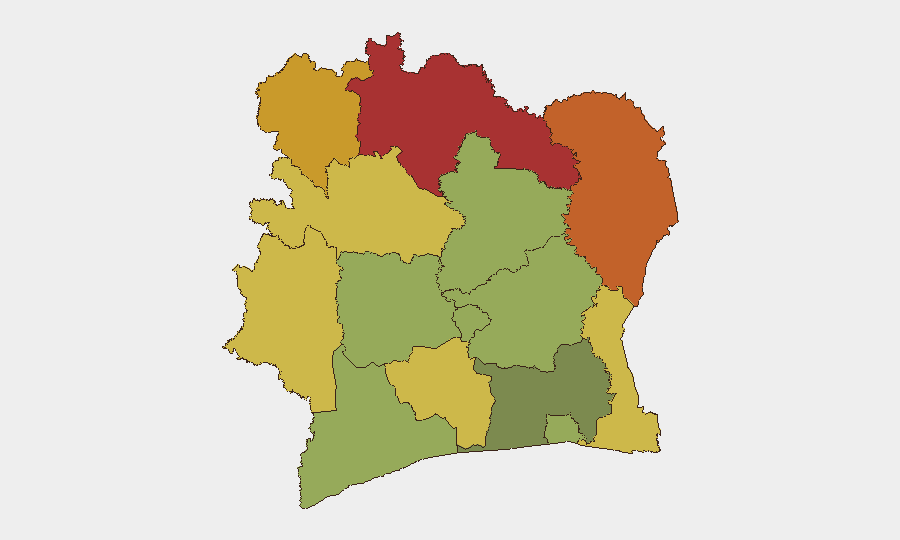
Situation Summary
Ivory Coast remains at low-to-moderate overall risk (global rank #62, composite score 32) with no discrete security incidents recorded in the current tracking window. However, the northern and northeastern districts—Savanes, Zanzan, Denguélé, and Comoé—maintain elevated risk profiles driven by ongoing cross-border instability, transnational crime networks, and residual militant activity. Recent political developments and enhanced regional security coordination suggest a stabilizing trajectory, though underlying vulnerabilities in border zones persist.
Key Developments
- Abidjan, 11 Sep 2026 — Justin Koné Katinan, a senior figure in Laurent Gbagbo's PPA-CI opposition party, was remanded in custody on terrorism and conspiracy charges linked to the 2025 electoral unrest. This reflects ongoing judicial processing of politically sensitive cases rather than a new violent incident, but signals continued security focus on opposition networks.
- Abidjan, 14 Sep 2026 — Presidents of Guinea and Ivory Coast announced a bilateral security cooperation agreement covering intelligence sharing, cross-border crime, and counter-terrorism. The move indicates heightened coordination to address transnational threats, particularly in the northern border zone.
- Cocody (Angré Djorobité), date uncertain — Infrastructure damage to fibre-optic cable reportedly disrupted telecom services for approximately 1,121 customers. While the exact date remains unconfirmed in available sources, the incident highlights vulnerability in critical communications infrastructure in the capital region.
Highest-Risk Areas
The northern and northeastern districts dominate the risk landscape: Savanes (risk 78), Zanzan (75), Denguélé (72), and Comoé (70) collectively account for the most elevated threat scores. These zones face persistent pressures from porous borders with Burkina Faso, Mali, and Guinea; trafficking networks (drugs, arms, persons); and residual militant presence. Risk declines significantly moving south and west, with Abidjan (45) and Lacs District (48) at the lower end of the ranked scale, reflecting greater state capacity, population density, and security presence in southern urban and periurban zones. Northern risk is driven primarily by transnational organized crime, militant transit, and limited border enforcement rather than active armed conflict.
How GeoBit Would Assist
Corporate security and duty-of-care teams should deploy AOI Monitoring & Early Warning on Savanes, Zanzan, and Denguélé districts to detect emerging militant activity or trafficking surges, paired with Border & Disputed-Territory Search and Network & Actor Analysis to map cross-border criminal and militant flows. OSINT fusion & corroboration and multi-language search (French-language media, local radio SIGINT, and Telegram/X networks) would provide real-time situational awareness on opposition political movements and security operations, reducing exposure to sudden escalations. Routing & Network Analysis supports alternative journey planning for staff or supply chains transiting high-risk northern zones.
7-Day Outlook
No imminent security escalation is forecast over the next seven days. The bilateral security agreement with Guinea and the continued arrest of opposition figures suggest the government is consolidating control and managing political tensions through legal mechanisms. However, the northern border zone will remain a persistent logistical and intelligence challenge; organizations with assets or personnel in Savanes, Zanzan, or Denguélé should maintain heightened situational awareness and contingency protocols.
Highest-Risk Areas — Ranked
| # | State / Region | Risk |
|---|---|---|
| 1 | Savanes District | 78 |
| 2 | Zanzan District | 75 |
| 3 | Denguélé District | 72 |
| 4 | Comoé District | 70 |
| 5 | Montagnes District | 68 |
| 6 | Woroba District | 65 |
| 7 | Gôh-Djiboua District | 60 |
| 8 | Sassandra-Marahoué District | 58 |
| 9 | Vallée du Bandama District | 55 |
| 10 | Bas-Sassandra District | 52 |
| 11 | Lacs District | 48 |
| 12 | Abidjan | 45 |
Sources
Previous Weekly Briefs
A new Ivory Coast brief is written every Monday, covering the week — each with its own risk map and downloadable CSV. Use the calendar to go further back.
- September 7, 2026
- September 2, 2026
- September 1, 2026
- August 31, 2026
- August 30, 2026
- August 28, 2026
- August 26, 2026
📅 Browse past briefs by calendar →
Highlighted days have a brief. Tap a day for that day's map & analysis, or “csv” for that day's dataset ($5).
Atlas — our AI intelligence desk — emails them this snapshot personally. Nothing else, no list.