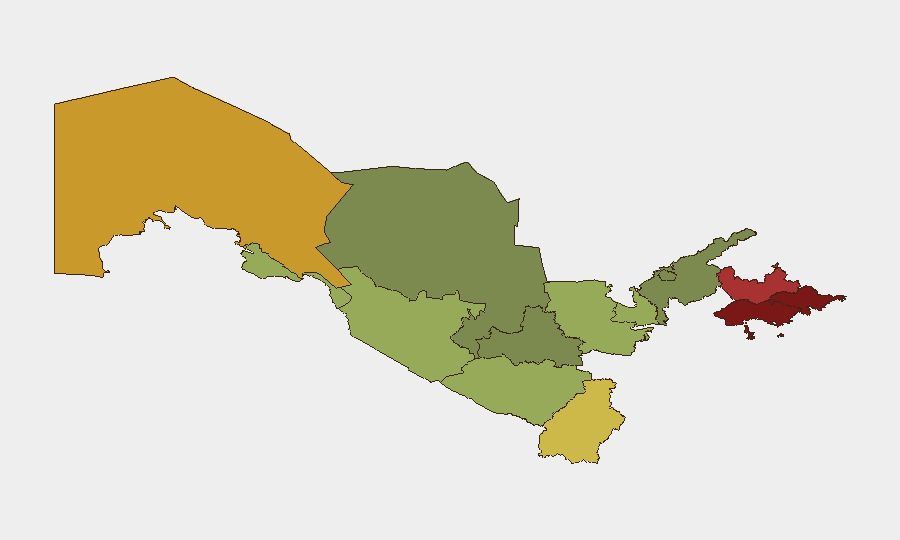
Situation Summary
Uzbekistan remains a stable but compartmentalized security environment, with the national threat score (9/255) reflecting the absence of active large-scale conflict or civil unrest during the reporting period. The Fergana Valley—encompassing Andijan, Fergana, and Namangan regions—continues to anchor elevated sub-national risk (scores 78–88), driven by historical militant activity, narcotics trafficking, and border vulnerabilities. This week saw diplomatic normalization (Russia defense cooperation), cybersecurity concerns at both national and U.S. diplomatic levels, and administrative changes to event-security cost allocation, but no acute operational incidents.
Key Developments
- Tashkent, 21 November: Uzbekistan and Russia signed a 2027 military-cooperation plan following bilateral defense-minister talks centered on regional security coordination and defense ties.
- Tashkent, 18 November: The government opened public consultation on a draft resolution requiring organizers of public events to pay for security services provided by the Interior Ministry, National Guard, Emergency Situations Ministry, and medical authorities—a potential shift in event-security funding responsibility.
- Nationwide, 19 November: Kaspersky reported blocking approximately 2.1 million attempted phishing-website visits across Uzbekistan during January–September 2026, flagging sustained cyber-reconnaissance and social-engineering activity targeting local users.
- Nationwide, 18 November: Cybersecurity assessment data presented in Tashkent indicated that 53% of individual users and 44% of corporate users encountered local cyber threats during January–October 2026, underscoring user-level exposure across both consumer and business segments.
- Tashkent, 20 November: A U.S. State Department Office of Inspector General assessment identified unresolved deficiencies at the U.S. Embassy, including fire-alarm, occupational-safety, cybersecurity-oversight, and equipment-accountability gaps.
- Uzbekistan nationwide, week of 14 November: Border and customs authorities intercepted an alleged drug-smuggling operation, recovering approximately 400 grams of opium hidden in an engine piston—consistent with ongoing narcotics interdiction efforts in Fergana Valley corridor zones.
Highest-Risk Areas
The Fergana Valley states—Andijan (88), Fergana (82), and Namangan (78)—drive the country's sub-national risk profile, reflecting decades of militant recruitment networks, porous Kyrgyz and Tajik borders, and dense narcotics-trafficking corridors linking Afghanistan to Central Asia and beyond. Karakalpakstan (72) and Surxondaryo Region (65) occupy secondary tiers, likely reflecting remote-border exposure and limited state capacity in peripheral zones. The capital and southern commercial zones (Samarqand, 35; Navoiy, 38) remain comparatively lower-risk, suggesting concentration of state control and international business activity in these nodes.
How GeoBit Would Assist
Security teams protecting personnel or assets in Uzbekistan should deploy AOI Monitoring & Early Warning on Fergana Valley crossings and narcotics-trafficking nodes to detect upstream signals of militant recruitment or smuggling-route changes. Multi-language OSINT (combining local media, Telegram channels, and regional event feeds) and Network & Actor Analysis would map emerging threat-actor cells and criminal-smuggling networks, while Cyber threat assessment and entity extraction capabilities can track phishing campaigns and malware distribution linked to both criminal and state-linked actors.
7-Day Outlook
No imminent operational threats are evident; however, cyber-threat activity remains elevated and normalized, suggesting adversaries maintain persistent reconnaissance and social-engineering access to corporate and government networks. Russian military cooperation may increase border-area activity and joint exercises. Organizations should anticipate sustained phishing pressure and regulatory flux around event-security cost allocation in coming weeks.
Highest-Risk Areas — Ranked
| # | State / Region | Risk |
|---|---|---|
| 1 | Andijan Region | 88 |
| 2 | Fergana Region | 82 |
| 3 | Namangan Region | 78 |
| 4 | Republic of Karakalpakstan | 72 |
| 5 | Surxondaryo Region | 65 |
| 6 | Qashqadaryo Region | 58 |
| 7 | Sirdaryo Region | 55 |
| 8 | Jizzakh Region | 48 |
| 9 | Xorazm Region | 45 |
| 10 | Bukhara Region | 42 |
| 11 | Navoiy Region | 38 |
| 12 | Samarqand Region | 35 |
Sources
Previous Weekly Briefs
A new Uzbekistan brief is written every Monday, covering the week — each with its own risk map and downloadable CSV. Use the calendar to go further back.
- November 16, 2026
- November 9, 2026
- November 2, 2026
- October 26, 2026
- October 19, 2026
- October 12, 2026
- October 5, 2026
📅 Browse past briefs by calendar →
Highlighted days have a brief. Tap a day for that day's map & analysis, or “csv” for that day's dataset ($5).
Atlas — our AI intelligence desk — emails them this snapshot personally. Nothing else, no list.