Situation Summary
Ivory Coast remains classified at global rank #63 with a composite threat score of 32, reflecting a broadly stable national security environment despite ongoing intensive law-enforcement operations. The past week saw no discrete security incidents, but rather a series of state-directed crackdowns on narcotics and illegal mining, coupled with emerging economic discontent in cocoa-producing regions and continued judicial proceedings in high-profile political cases. The government messaging emphasizes stability while simultaneously conducting major anti-crime operations, suggesting a controlled but actively managed threat environment rather than deteriorating conditions.
Key Developments
- Abidjan, National Security Council – 17 September 2026
The Conseil National de Sécurité convened and reaffirmed the national security situation as stable, while adopting new restrictions on artisanal mining as part of broader crime-control efforts.
- Nationwide mining suspension – decision 17 September 2026
The CNS suspended issuance of new artisanal and semi-industrial mining permits for six months, explicitly targeting illegal gold mining and associated insecurity across mining areas country-wide.
- Bouaké, Daloa, Korhogo – Operation "Épervier Spécial" (7–16 September 2026)
Security forces deployed 1,320 personnel, destroyed 56 drug consumption sites, seized ~183 tonnes of falsified medicines, and arrested 196 people on drug trafficking, medicine diversion, and incitement charges.
- Cocoa-producing regions – strike from 16 September 2026
SYNAP-CI affiliated growers launched an open-ended strike demanding removal of the Coffee–Cocoa Council head and rejection of the 1,200 FCFA/kg farm-gate price, with mobilization reported across multiple production zones.
- Divo and cocoa hubs – producer mobilization (18 September 2026)
Producer groups reiterated economic demands for subsidies, stronger border controls, and audits; though framed as non-political, the sustained dispute raises localized tension and supply-chain disruption risks.
- Abidjan, Koumassi‑Campement – prosecutor's update (16 September 2026)
The prosecutor disclosed ongoing investigation into June demolitions, implicating a member of parliament for prosecution and revealing that a local figure is in protective custody due to security concerns.
- Abidjan, Koumassi‑Campement – official implication (16–17 September 2026)
The Abidjan district governor and other officials were cited in connection with the Koumassi-Campement demolitions; prosecutor outlined financing chains, raising political controversy among displaced residents.
- Abidjan – opposition legal proceedings (16 September 2026)
An arrest warrant was issued against Me Habiba Touré, lawyer and spokesperson for Laurent Gbagbo's party, in connection with prior opposition protests against President Ouattara's fourth mandate.
Highest-Risk Areas
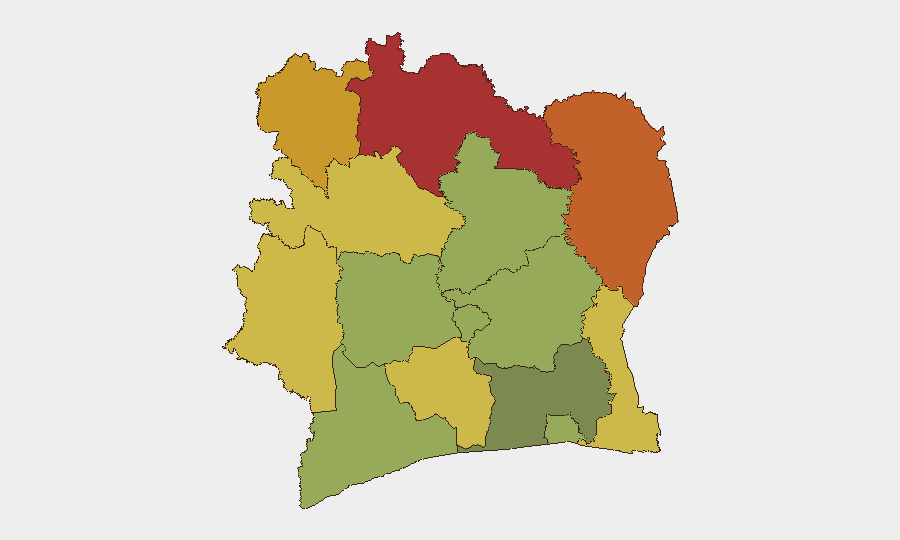
The northern and northeastern districts—Savanes (risk 78), Zanzan (75), and Denguélé (72)—drive the country's sub-national risk profile, reflecting a combination of cross-border criminality, artisanal mining activity, and limited state capacity in remote areas. Comoé and Montagnes districts (70 and 68 respectively) maintain elevated risk from similar drivers. By contrast, Abidjan (risk 45) and the southern cocoa and coastal zones show substantially lower composite scores, though localized judicial friction and economic protest activity in recent days illustrate that lower overall risk does not eliminate discrete operational concerns for corporate assets or personnel.
How GeoBit Would Assist
Security and risk teams would employ AOI Monitoring & Early Warning on cocoa-producing regions and northern mining zones to detect escalation in producer strikes or artisanal mining activity; Network & Actor Analysis to map the political and judicial networks surrounding the Koumassi-Campement case and opposition movements; and Conflict & Military tracking combined with OSINT Fusion (X/Telegram, local media) to detect any shift from law-enforcement operations toward larger-scale unrest or armed activity.
7-Day Outlook
The cocoa growers' strike and ongoing judicial cases are expected to remain the primary sources of localized instability over the next 7–10 days, with supply-chain and political complications more likely than security escalation. Northern mining operations will remain subject to heightened state scrutiny and enforcement; no indication of imminent armed threat or major civil unrest has emerged.
Highest-Risk Areas — Ranked
| # | State / Region | Risk |
|---|---|---|
| 1 | Savanes District | 78 |
| 2 | Zanzan District | 75 |
| 3 | Denguélé District | 72 |
| 4 | Comoé District | 70 |
| 5 | Montagnes District | 68 |
| 6 | Woroba District | 65 |
| 7 | Gôh-Djiboua District | 60 |
| 8 | Sassandra-Marahoué District | 58 |
| 9 | Vallée du Bandama District | 55 |
| 10 | Bas-Sassandra District | 52 |
| 11 | Lacs District | 48 |
| 12 | Abidjan | 45 |
Sources
Previous Weekly Briefs
A new Ivory Coast brief is written every Monday, covering the week — each with its own risk map and downloadable CSV. Use the calendar to go further back.
- September 14, 2026
- September 7, 2026
- September 2, 2026
- September 1, 2026
- August 31, 2026
- August 30, 2026
- August 28, 2026
📅 Browse past briefs by calendar →
Highlighted days have a brief. Tap a day for that day's map & analysis, or “csv” for that day's dataset ($5).
Atlas — our AI intelligence desk — emails them this snapshot personally. Nothing else, no list.