Situation Summary
Norway faces a convergence of acute cyber, aviation, and public-safety disruptions alongside a significant political-symbolic crisis. A sustained DDoS attack on core government digital infrastructure, attributed to pro-Russian actors in retaliation for Norway's Ukraine support pledge, has degraded e-ID and public-sector authentication services for three days. Concurrent nationwide air-traffic controller strikes have closed major hubs and cancelled ~90 flights daily, while isolated violent crime incidents in Oslo and Stavanger underscore localized security friction. The reported critical illness of King Harald V introduces an additional layer of political uncertainty amid an already elevated operational tempo.
Key Developments
- Cyber attack on government infrastructure (nationwide, ongoing through 27 Aug): Pro-Russian hacker group "Server Killers" claimed responsibility for a DDoS campaign against the Norwegian Digitalisation Agency (Digdir) and Vivicta, disrupting ID-porten, eSignering, and related authentication systems. No data breach confirmed; services were intermittently slow or unavailable for approximately 72 hours. Attack framed as retaliation for Norway's 85 billion NOK support commitment to Ukraine.
- Firearm discharge in central Oslo (Oslo city centre, 26 Aug): A 37-year-old Iraqi national fired shots from a moving vehicle in downtown Oslo during daylight hours. Armed police responded; no fatalities reported but incident represents serious urban violence risk in a high-density commercial district.
- Air-traffic controller strike (Oslo Gardermoen, Bergen, Trondheim, Stavanger, Kristiansand, Tromsø, Bodø; ongoing through 27 Aug): Strike action begun 21 Aug continues to disrupt major airport operations. Oslo Gardermoen closed for five hours on 23 Aug (06:30–11:30); approximately 90 flights cancelled daily across Norway over weekend; schedule disruption persisted through 26–27 Aug.
- King Harald V hospitalized with serious condition (Oslo, reported 27 Aug): Monarch (age 89) admitted with critical illness involving rapid red-cell destruction; royal family convened at bedside; Prime Minister cancelled foreign travel. No constitutional crisis signalled, but situation carries political-symbolic weight and media focus.
- Residential explosion and fire (Øygarden municipality, 25 Aug): Explosion followed by fire in residential building; damage and casualty details limited in current reporting but incident represents localized property/safety concern.
- Public order incident in Trondheim (Vår Frues kirke, central Trondheim, 21 Aug): Brawl at religious site; police responded; no serious injuries reported before dispersal.
- Deprivation of liberty arrests (Stavanger, 20 Aug): Three individuals arrested following alleged unlawful confinement incident; police notified near midnight.
Highest-Risk Areas
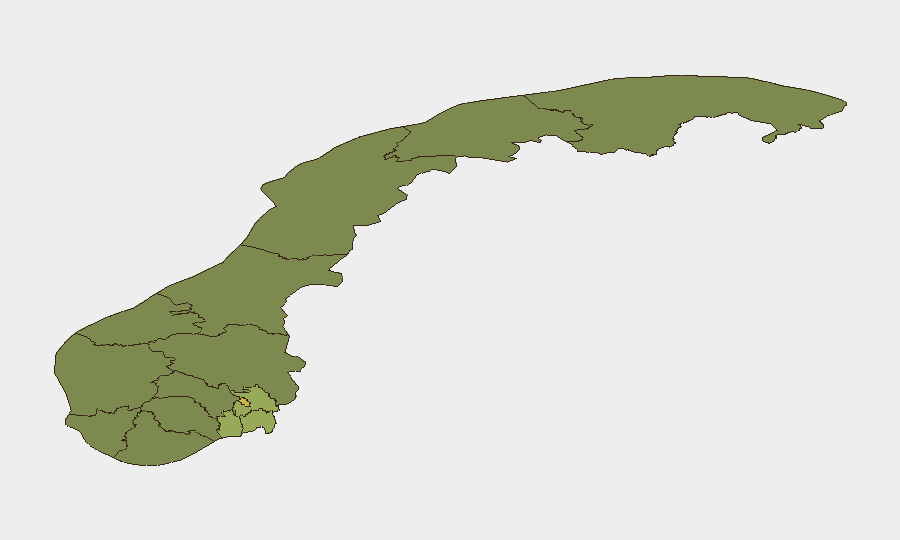
Oslo (risk 68) and Akershus (risk 52) dominate the sub-national ranking, reflecting capital-region concentration of cyber-critical infrastructure, high crime reporting density, and aviation hubs. Østfold (48), Vestfold (42), and Rogaland (38) show secondary elevation, likely tracking border-security concerns (Østfold), maritime/industrial asset concentration, and petroleum-sector espionage signals (Rogaland). The cyber attack on national digital infrastructure means threat exposure is nationwide, but localized violent-crime reports and airport disruption cluster geographically in and around Oslo and major regional hubs.
How GeoBit Would Assist
Security teams monitoring Norway should leverage Intel Sweep and Telegram/X OSINT to track pro-Russian hacker narratives and attribution claims in real time; AOI Monitoring & Early Warning on Oslo, Stavanger, and major airports to detect emerging protest, strike, or crime signals; and Risk & Threat Assessment modules to model cascading effects of cyber outages on supply-chain, finance, and duty-of-care operations. Network & Actor Analysis would help correlate the claimed "Server Killers" group with known threat profiles and assess reputational targeting of Norwegian government.
7-Day Outlook
Air-traffic disruption is likely to persist through early September pending strike resolution; government digital services are expected to return to full capacity within days but residual vulnerability to follow-on cyber activity remains elevated. King Harald's condition will remain a focal point for Norwegian media and international attention; barring sudden deterioration, constitutional continuity is not at immediate risk, but the situation may distract political focus from cyber resilience and labor-dispute resolution.
Highest-Risk Areas — Ranked
| # | State / Region | Risk |
|---|---|---|
| 1 | Oslo | 68 |
| 2 | Akershus | 52 |
| 3 | Østfold | 48 |
| 4 | Vestfold | 42 |
| 5 | Rogaland | 38 |
| 6 | Buskerud | 35 |
| 7 | Trøndelag | 32 |
| 8 | Telemark | 28 |
| 9 | Vestland | 27 |
| 10 | Agder | 26 |
| 11 | Møre og Romsdal | 22 |
| 12 | Innlandet | 20 |
Sources
Previous Daily Briefs
A new Norway brief is written every day — each with its own risk map and downloadable CSV. Here's the last week; use the calendar to go further back.
- August 27, 2026
- August 26, 2026
- August 25, 2026
- August 24, 2026
- August 23, 2026
- August 22, 2026
- August 21, 2026
📅 Browse every day by calendar →
Highlighted days have a brief. Tap a day for that day's map & analysis, or “csv” for that day's dataset ($5).
Atlas — our AI intelligence desk — emails them this snapshot personally. Nothing else, no list.