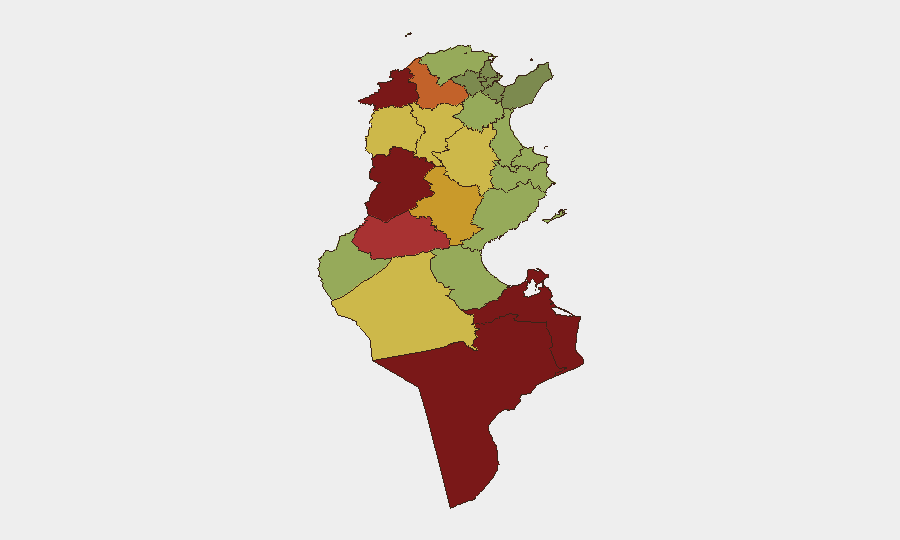
Situation Summary
Tunisia remains a moderate overall security risk (#72 globally, composite threat score 24), with civil unrest as the primary driver. The country is currently experiencing a convergence of political instability, infrastructure strain (particularly water shortages), and heightened border-control measures linked to migration and bilateral tensions with Libya. No major armed incidents or terror attacks have been recorded in the past 48 hours; the dominant threat profile centers on escalating protest movements and localized service-disruption tensions expected to peak over the next 3–5 days.
Key Developments
- Nafes civic-movement protests announced – Tunis and multiple governorates (19 August): The "Nafes" movement publicly called for coordinated marches across Tunis, Mahdia, and other regions from 20–23 August, citing political "chaos," deteriorating living conditions, and failures in basic services. High protest potential is expected over the coming four days.
- Water-shortage protests expanding – Mahdia and other governorates (ongoing, 19 August): Localized demonstrations over potable water cuts are feeding into the broader Nafes mobilization; Mahdia is a confirmed focus, with marches planned 20–23 August.
- Ras Jdir border crossing (Libya) closed following security incident (18 August): Tunisia shut the crossing on its southeastern border with Libya in response to a security incident linked to migrant-flow tensions. Heightened military/police presence and travel disruption expected in the border zone.
- Political detentions in spotlight – Tunis (18 August): Ten detainees in a high-profile "conspiracy" case, including opposition figure Ahmed Najib Chebbi, issued a statement concerning the health of imprisoned Ennahda leader Rached Ghannouchi. This incident has potential to fuel opposition mobilization and public tensions.
- Sousse desalination plant enters trial phase amid severe water shortage (19 August): A new seawater desalination facility in Sousse began operations during the country's worst water crisis in recent years, underlining the severity of infrastructure stress and its role in driving protest activity.
- Road-safety data release highlights elevated accident risk (19 August): Tunisia's National Road Safety Observatory reported 836 traffic fatalities between 1 January and 16 August 2026—a 10.14% year-on-year increase—indicating a worsening baseline risk for overland travel nationwide.
Highest-Risk Areas
Kasserine, Jendouba, Tataouine, and Médenine (composite risks 92, 88, 85, and 83 respectively) remain the highest-risk governorates, driven by a combination of historical militant activity, border proximity, and limited state capacity. Recent weather events in Jendouba (15 August thunderstorms with 80+ km/h winds and flash flooding) have compounded vulnerability in that region. Northwestern and southeastern border zones warrant particular attention given the Ras Jdir closure and persistent cross-border security tensions.
How GeoBit Would Assist
Security teams should deploy AOI Monitoring & Early Warning on Tunis and Mahdia to track protest mobilization in real time over 20–23 August; OSINT fusion (X/Twitter, Telegram, multi-language search, sentiment analysis) to detect shift in protest rhetoric or violence indicators; and Routing & Network Analysis to identify alternative travel corridors around Kasserine, Jendouba, and the Ras Jdir border zone. Intel Sweep on regime-stability and opposition movements would provide early warning of potential escalation beyond marches.
7-Day Outlook
Protest activity in Tunis and Mahdia will likely peak 20–23 August; no credible intelligence suggests armed clashes, but crowd-control tensions and localized disruption to services and transport are probable. Border closures and water shortages will remain structural risks through late August. Monitoring of detainee-health developments and opposition statements is essential, as further deterioration could accelerate mobilization beyond the planned marches.
Highest-Risk Areas — Ranked
| # | State / Region | Risk |
|---|---|---|
| 1 | Kasserine | 92 |
| 2 | Jendouba | 88 |
| 3 | Tataouine | 85 |
| 4 | Médenine | 83 |
| 5 | Gafsa | 78 |
| 6 | Béja | 75 |
| 7 | Sidi Bouzid | 72 |
| 8 | Al Kaf | 70 |
| 9 | Kébili | 68 |
| 10 | Kairouan | 65 |
| 11 | Siliana | 62 |
| 12 | Tozeur | 58 |
Sources
Previous Daily Briefs
A new Tunisia brief is written every day — each with its own risk map and downloadable CSV. Here's the last week; use the calendar to go further back.
- August 17, 2026
- August 15, 2026
- August 13, 2026
- August 11, 2026
- August 9, 2026
- August 7, 2026
- August 5, 2026
📅 Browse every day by calendar →
Highlighted days have a brief. Tap a day for that day's map & analysis, or “csv” for that day's dataset ($5).
Atlas — our AI intelligence desk — emails them this snapshot personally. Nothing else, no list.